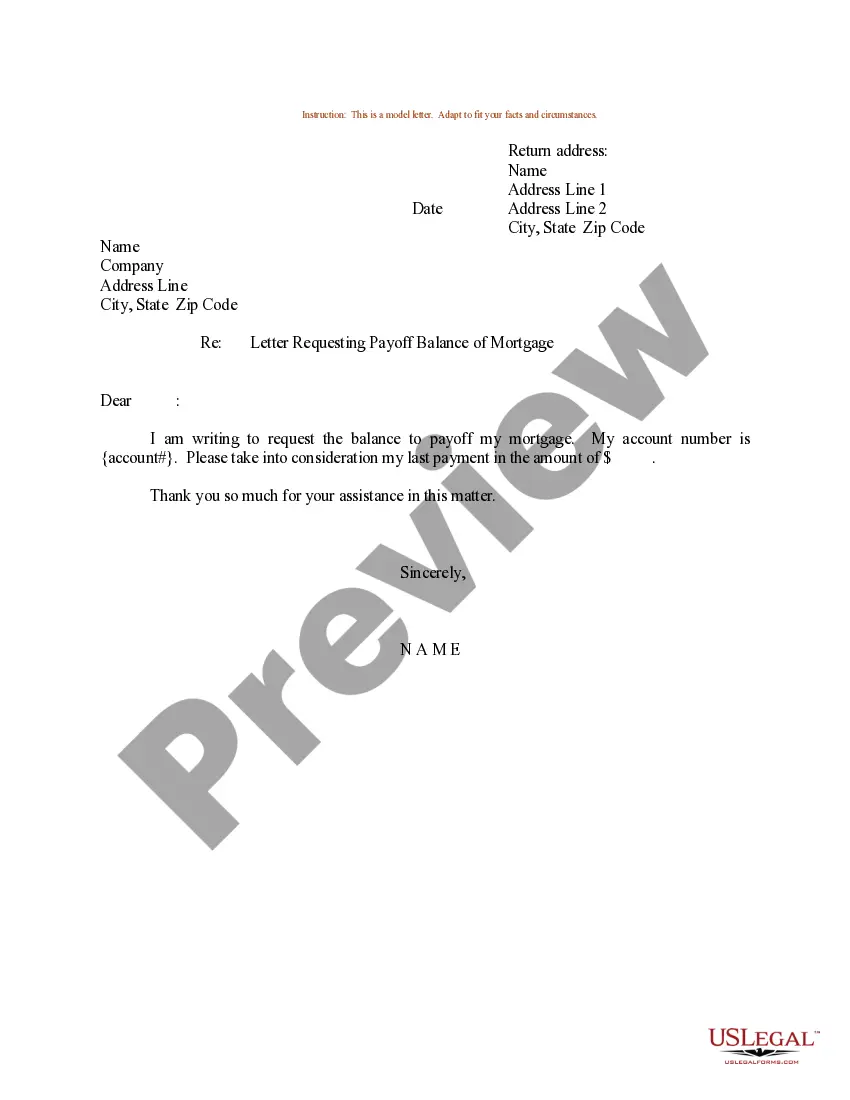
Sample Letter Payoff Mortgage Statement For Taxes In Collin
Description
Get your form ready online
Our built-in tools help you complete, sign, share, and store your documents in one place.
Make edits, fill in missing information, and update formatting in US Legal Forms—just like you would in MS Word.
Download a copy, print it, send it by email, or mail it via USPS—whatever works best for your next step.
Sign and collect signatures with our SignNow integration. Send to multiple recipients, set reminders, and more. Go Premium to unlock E-Sign.
If this form requires notarization, complete it online through a secure video call—no need to meet a notary in person or wait for an appointment.
We protect your documents and personal data by following strict security and privacy standards.

Make edits, fill in missing information, and update formatting in US Legal Forms—just like you would in MS Word.

Download a copy, print it, send it by email, or mail it via USPS—whatever works best for your next step.

Sign and collect signatures with our SignNow integration. Send to multiple recipients, set reminders, and more. Go Premium to unlock E-Sign.

If this form requires notarization, complete it online through a secure video call—no need to meet a notary in person or wait for an appointment.

We protect your documents and personal data by following strict security and privacy standards.
Looking for another form?

Form popularity
FAQ
This exemption reduces the taxable value of your property, thus potentially saving you thousands of dollars in property taxes each year. There are also additional exemptions available in certain counties, as well as based on your age and whether you have a disability.
Ing to the Comptroller, there is no provision for the cessation of property taxes at any stage. However, there is a Texas property tax exemption for people over the age of 65, which offers temporary tax relief for seniors. At the age of 65, seniors can apply for an exemption from Texas property taxes.
It basically allows you to “write down” your property value, so you don't get taxed as much. The state tax code requires public school districts to offer a $40,000 exemption on “residence homesteads” located in their district.
Does a homestead exemption lower your mortgage payment? It depends. An exemption could lower your mortgage payment if your property tax payments come from an escrow account. The lender will analyze your escrow account to determine if you are paying too much or not enough.
Texas Property Tax Code Sec 23.23 limits increases of the total assessed value (assessed value = market value minus any exemption value minus current year cap value), to 10% from year to year if the property is under homestead exemption. This 10% increase excludes any new improvements added by the property owner.
Visit Texas/PropertyTaxes to find a link to your local property tax database on which you can easily access information regarding your property taxes, including information regarding the amount of taxes that each entity that taxes your property will impose if the entity adopts its proposed tax rate.
In Collin County, property values are assessed annually by the Collin County Appraisal District (CCAD). The CCAD uses recent sales of comparable properties, among other factors, to determine your property's market value.
If the property is your residence homestead, the appraised value may not exceed the sum of: 10 percent of the appraised value of the property for the preceding tax year; plus. the appraised value of the property for the preceding year; plus. the market value of all new improvements to the property.
The Property Tax Reassessment Process If it has, your taxes might change, too. In Texas, this reassessment generally happens once a year, but certain events can trigger an additional review. Now, these triggering events could be anything from a sale to significant improvements on your property.

