Change Deed Trust Without Spouse In Georgia
Description








Get your form ready online
Our built-in tools help you complete, sign, share, and store your documents in one place.
Make edits, fill in missing information, and update formatting in US Legal Forms—just like you would in MS Word.
Download a copy, print it, send it by email, or mail it via USPS—whatever works best for your next step.
Sign and collect signatures with our SignNow integration. Send to multiple recipients, set reminders, and more. Go Premium to unlock E-Sign.
If this form requires notarization, complete it online through a secure video call—no need to meet a notary in person or wait for an appointment.
We protect your documents and personal data by following strict security and privacy standards.

Make edits, fill in missing information, and update formatting in US Legal Forms—just like you would in MS Word.

Download a copy, print it, send it by email, or mail it via USPS—whatever works best for your next step.

Sign and collect signatures with our SignNow integration. Send to multiple recipients, set reminders, and more. Go Premium to unlock E-Sign.

If this form requires notarization, complete it online through a secure video call—no need to meet a notary in person or wait for an appointment.

We protect your documents and personal data by following strict security and privacy standards.
Looking for another form?







Form popularity
FAQ
To change the trust deed itself, you must execute a deed of variation. This is a document that updates the relevant section of the original trust deed. The deed of variation forms part of the documentation of your discretionary trust and details how the trust deed has been changed over time.
TOD Deeds in Georgia Upon death of the record owner, the beneficiary must execute and record an affidavit affirming and accepting the real estate interest that includes verification of the owner's death, information regarding the owner's marital status at the time of death, and a legal description of the real estate.
Business partners, family members, and even spouses who are divorcing often use this method for transferring property. A quitclaim deed in Georgia can also transfer property from or to a revocable living trust, transfer property one party owns into co-ownership, and transfer interests from one co-owner to another.
Eviction In Georgia Landlord Serves an Eviction Notice. Landlord Files an Eviction Lawsuit with the Court. Court Serves Tenant the Summons. Tenant Files an Answer. Landlord and Tenant Attend Court Hearing and Receive Judgment. Tenant Gets Seven Days to Move Out and/or Appeal the Judgment.
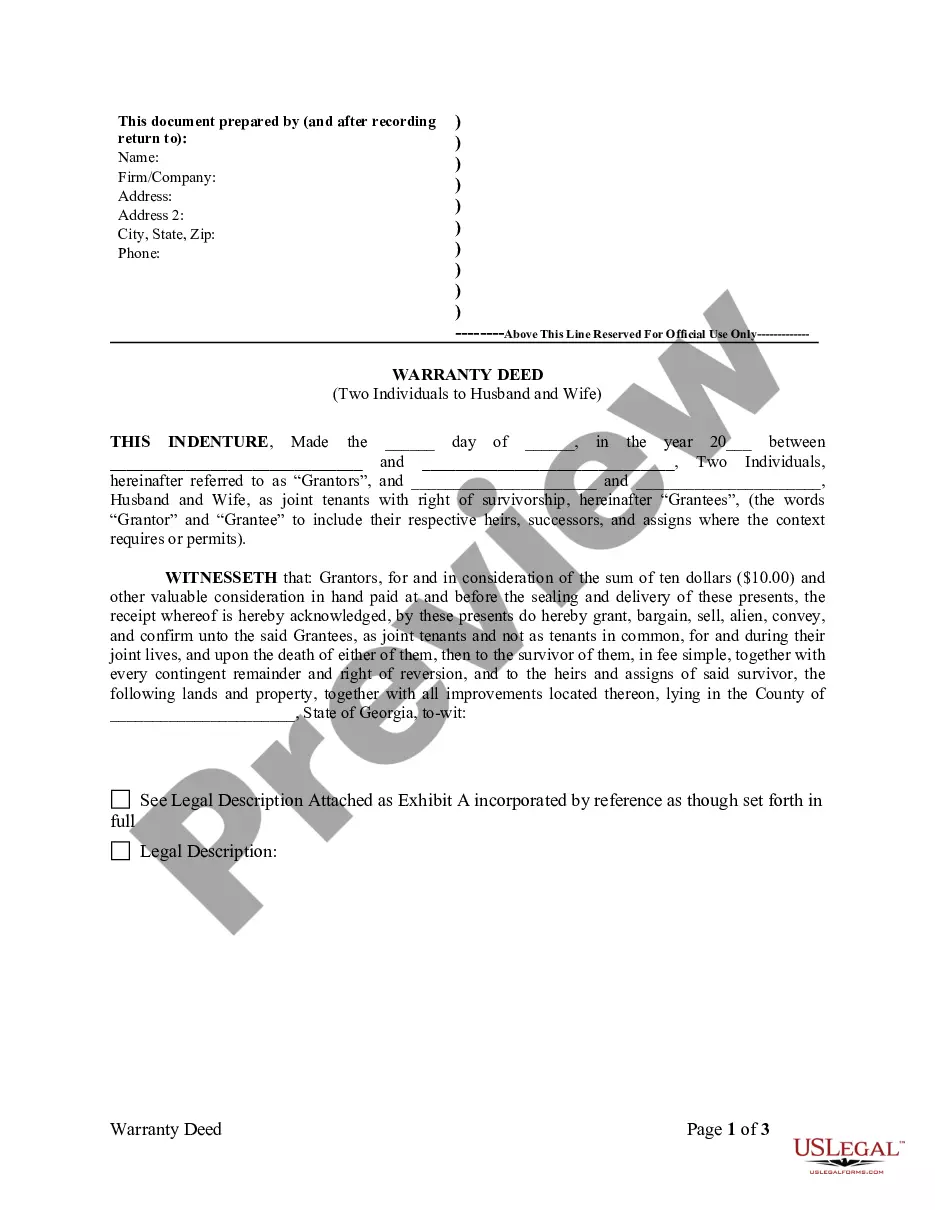
Here are the steps to completing a deed transfer in Georgia: Names the Current Owner and New Owner. Contains a Description of the Property. Signed by Current Owner. Two Witnesses: Unofficial Witness & Notary Public. Complete a PT-61, Transfer Tax Form. Record Deed in County Real Estate Records.
Here are the steps to completing a deed transfer in Georgia: Names the Current Owner and New Owner. Contains a Description of the Property. Signed by Current Owner. Two Witnesses: Unofficial Witness & Notary Public. Complete a PT-61, Transfer Tax Form. Record Deed in County Real Estate Records.
