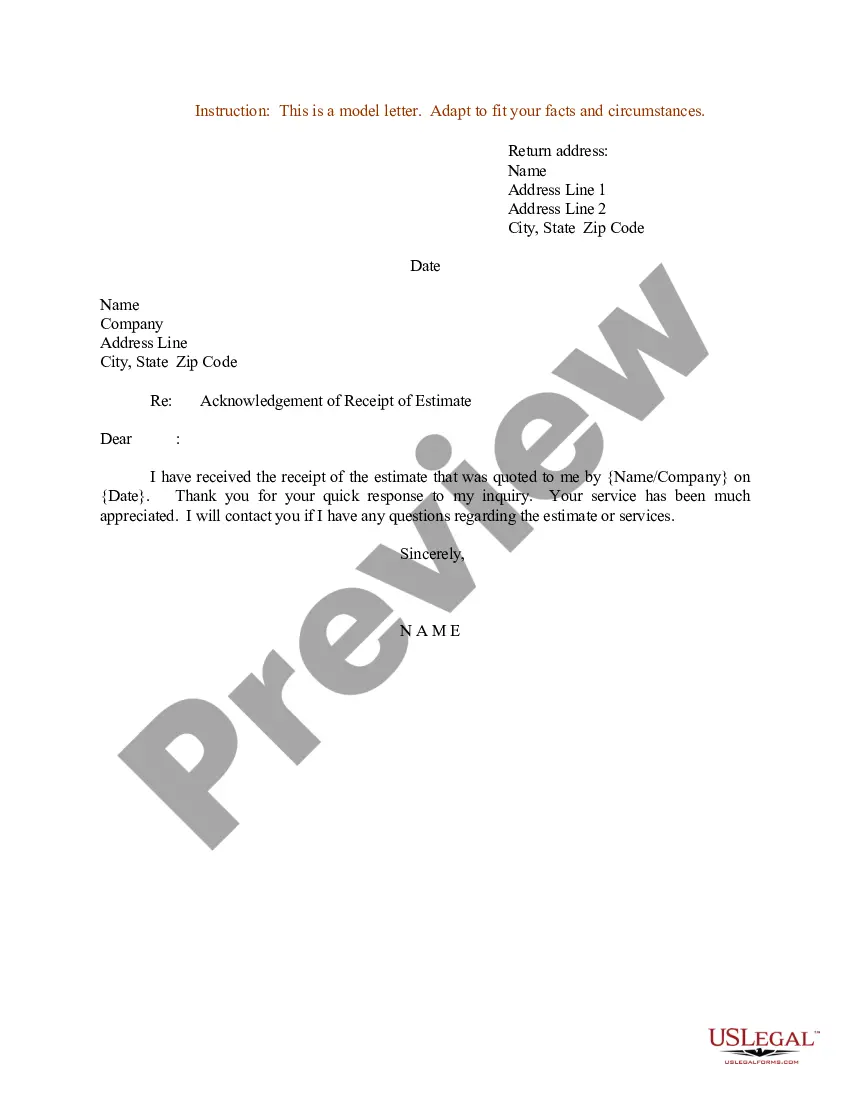
Acknowledgment Of Receipt Letter For Donation In Wake
Description


Get your form ready online
Our built-in tools help you complete, sign, share, and store your documents in one place.
Make edits, fill in missing information, and update formatting in US Legal Forms—just like you would in MS Word.
Download a copy, print it, send it by email, or mail it via USPS—whatever works best for your next step.
Sign and collect signatures with our SignNow integration. Send to multiple recipients, set reminders, and more. Go Premium to unlock E-Sign.
If this form requires notarization, complete it online through a secure video call—no need to meet a notary in person or wait for an appointment.
We protect your documents and personal data by following strict security and privacy standards.

Make edits, fill in missing information, and update formatting in US Legal Forms—just like you would in MS Word.

Download a copy, print it, send it by email, or mail it via USPS—whatever works best for your next step.

Sign and collect signatures with our SignNow integration. Send to multiple recipients, set reminders, and more. Go Premium to unlock E-Sign.

If this form requires notarization, complete it online through a secure video call—no need to meet a notary in person or wait for an appointment.

We protect your documents and personal data by following strict security and privacy standards.
Looking for another form?








Form popularity
FAQ
The receipt can take a variety of written forms – letters, formal receipts, postcards, computer-generated forms, etc. It's important to remember that without a written acknowledgment, the donor cannot claim the tax deduction.
Each letter should include the following information: The donor's name. The full legal name of your organization. A declaration of your organization's tax-exempt status. Your organization's employer identification number. The date the gift was received. A description of the gift and the amount received.
How do you acknowledge a donation? The primary ways to acknowledge your donations are with an email or letter. There are several details that the IRS requires you to include: The name of your donor.
Acknowledgement letters should be mailed no later than one week (5-7 business days) from the date of the gift. You should thank every donor, for every gift, regardless of gift amount. Gift amounts should NOT be included in your thank you letter (that's what the tax receipt is for)
A donation acknowledgment letter (sometimes called a donation receipt or thank-you letter) is an email or paper that recognizes a charitable contribution. At a bare minimum, it's a confirmation receipt to your donors acknowledging you've received their donation.
Use these steps to write an acknowledgment receipt: Use a company letterhead. Use electronic or paper letterhead. Write acknowledgment statement. Sign and date. Explain the next step. Provide contact information. Sample 1. Sample 2. Is an acknowledgment receipt valid if it is received via email?
Technically, donors don't need the substantiation until sometime before they file their personal tax returns for the year the gift was made. There are other ways to acknowledge a gift in addition to a written gift acknowledgment that is sent to the donor, whether via email or regular mail.
Key Components of a Donor Acknowledgment Letter Organization's Full Name: Clearly state the name of your organization. Donor's Name: Use the donor's name as it was given for the donation. Date of Donation: Mention the exact date the donation was made. Donation Details: Include a description of the donation.
1. Greet the recipient formally and personally to start. 2. Introduce yourself and give a succinct explanation of the reason for your email. 3. Clearly clarify your desire for a donation and describe the initiative or cause you are supporting.
Simple memorial donation card phrases “With deepest sympathy on the loss of NAME” “In loving memory of NAME, we have made a donation to ORGANIZATION/CAUSE…” “In memory of NAME, a contribution has been made to ORGANIZATION/CAUSE…” “Our hearts are with you and your family during this difficult time…”