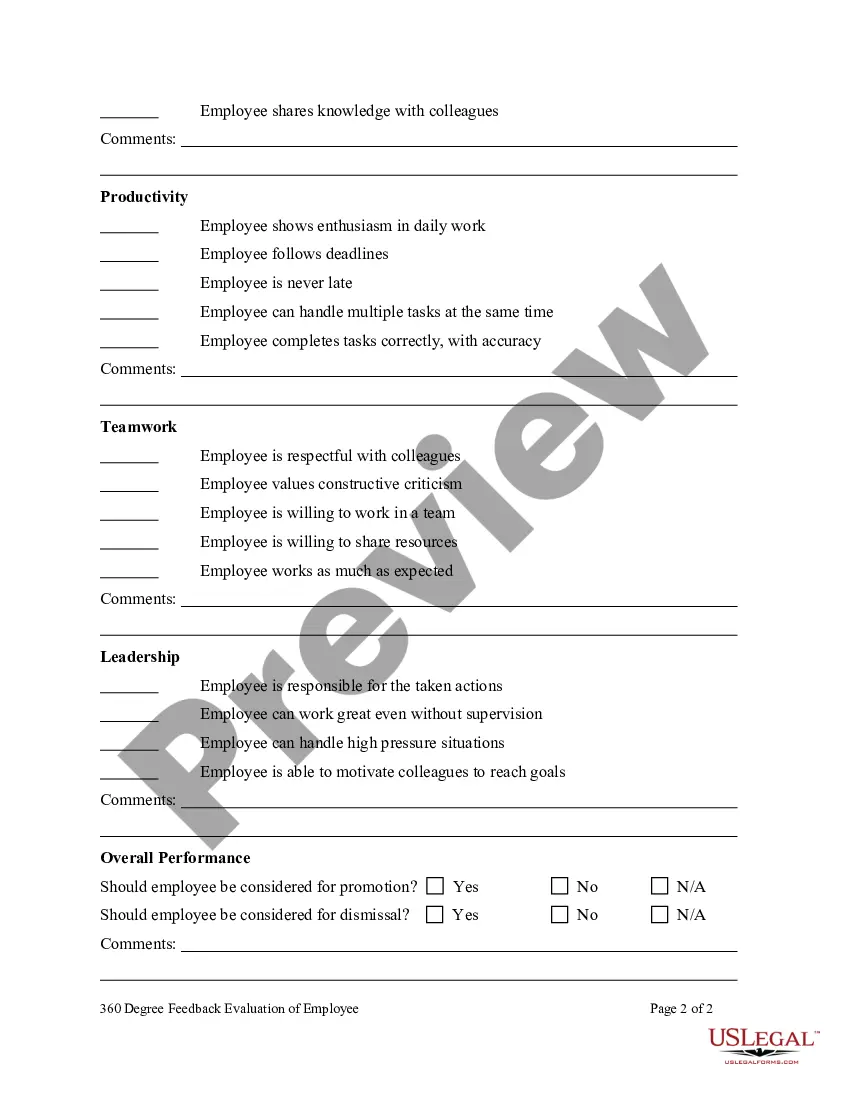
360 Feedback Examples For Peers In Franklin
Description

Get your form ready online
Our built-in tools help you complete, sign, share, and store your documents in one place.
Make edits, fill in missing information, and update formatting in US Legal Forms—just like you would in MS Word.
Download a copy, print it, send it by email, or mail it via USPS—whatever works best for your next step.
Sign and collect signatures with our SignNow integration. Send to multiple recipients, set reminders, and more. Go Premium to unlock E-Sign.
If this form requires notarization, complete it online through a secure video call—no need to meet a notary in person or wait for an appointment.
We protect your documents and personal data by following strict security and privacy standards.

Make edits, fill in missing information, and update formatting in US Legal Forms—just like you would in MS Word.

Download a copy, print it, send it by email, or mail it via USPS—whatever works best for your next step.

Sign and collect signatures with our SignNow integration. Send to multiple recipients, set reminders, and more. Go Premium to unlock E-Sign.

If this form requires notarization, complete it online through a secure video call—no need to meet a notary in person or wait for an appointment.

We protect your documents and personal data by following strict security and privacy standards.
Looking for another form?
Form popularity
FAQ
How do you write a good 360 feedback? Add specific examples highlighting the strengths and areas with room for employee development. Instead of criticizing, provide actionable feedback with insights on how to improve. If you're unsure what's good feedback, you can use performance management software to help you.
Focus on behaviour, not personality: Your feedback should address specific behaviours or actions rather than personal characteristics. This keeps the conversation professional and constructive. Be specific and provide examples: Vague feedback is not useful and can even cause undue frustration.
Examples of reinforcing employee feedback “Something I really appreciate about you is...." ... “I think you did a great job when you… ... “I would love to see you do more of X as it relates to Y” ... “I really think you have a superpower around X” ... “One of the things I admire about you is…”
What is 360 degree feedback? 360 degree feedback (also known as multi-source or multi rater feedback assessment) is a way for individuals to understand their personal strengths and weaknesses, using the constructive feedback of others who work with them the most.
360 Degree Feedback Examples for Communication “John consistently provides clear and concise instructions, making it easy for the team to understand their tasks.” “Emily is skilled at active listening, ensuring that everyone's concerns and ideas are heard.”
How 360-Degree Feedback Works Selection of participants. Survey distribution. Data collection and analysis. Feedback review session. Action planning. Follow-up. Comprehensive feedback. Increases self-awareness.
360-degree feedback questions for communication Is this employee a good active listener? Does this employee communicate well with customers? Does this employee communicate well with colleagues? Does this employee communicate well with supervisors?
The term “360” in business is used in various contexts but generally refers to a comprehensive, all-encompassing approach. Whether it's applied to performance management, marketing, or overall business strategy, 360 signifies looking at a situation from all angles.
What is 360 degree feedback? 360 degree feedback (also known as multi-source or multi rater feedback assessment) is a way for individuals to understand their personal strengths and weaknesses, using the constructive feedback of others who work with them the most.
360 degree feedback is a process in which employees get together to give feedback about their coworkers' behavior and performance. It can also involve employees submitting self-assessment reports. 360-degree evaluations usually include questions with rating-format answers.