Special Meeting Sample With Replacement In Massachusetts
Description



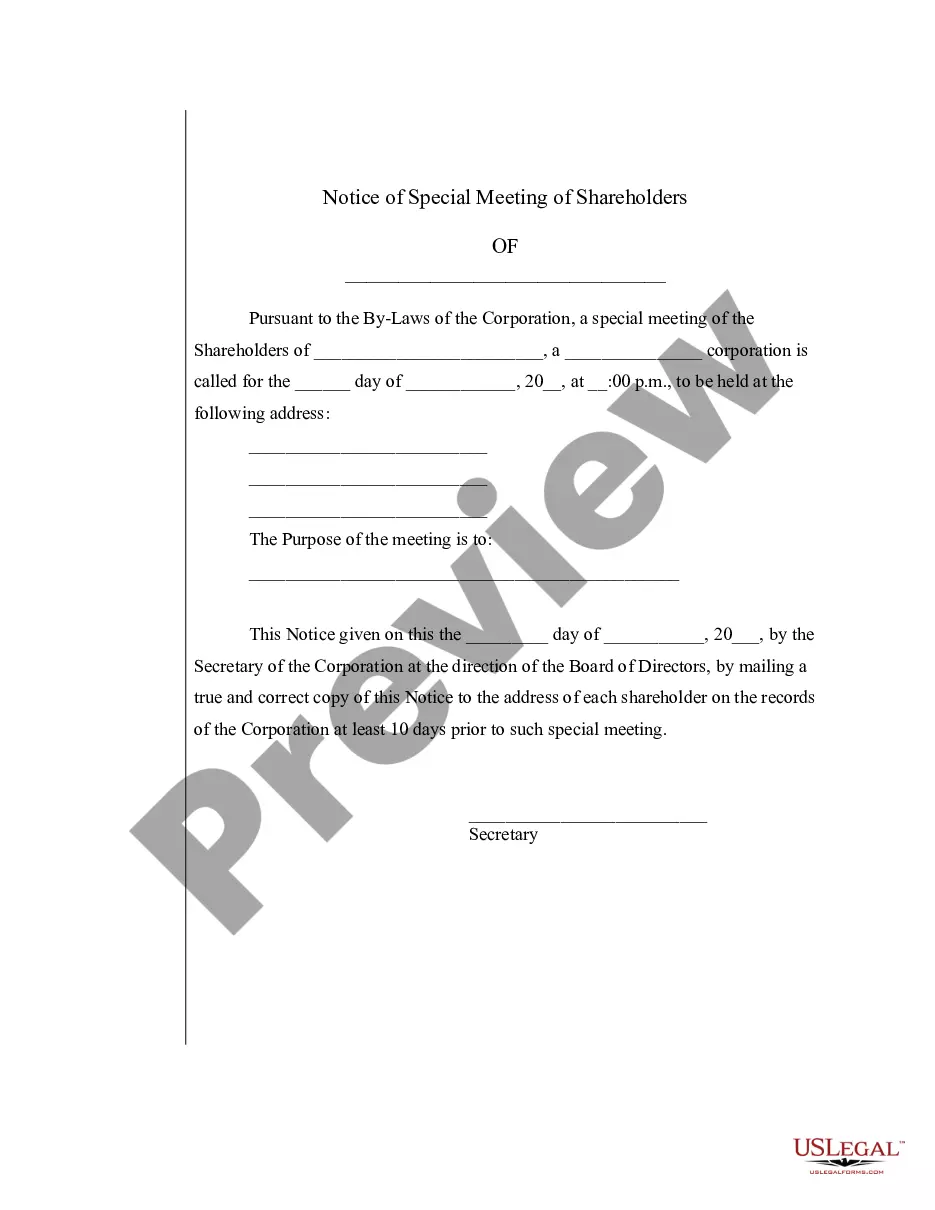
Get your form ready online
Our built-in tools help you complete, sign, share, and store your documents in one place.
Make edits, fill in missing information, and update formatting in US Legal Forms—just like you would in MS Word.
Download a copy, print it, send it by email, or mail it via USPS—whatever works best for your next step.
Sign and collect signatures with our SignNow integration. Send to multiple recipients, set reminders, and more. Go Premium to unlock E-Sign.
If this form requires notarization, complete it online through a secure video call—no need to meet a notary in person or wait for an appointment.
We protect your documents and personal data by following strict security and privacy standards.

Make edits, fill in missing information, and update formatting in US Legal Forms—just like you would in MS Word.

Download a copy, print it, send it by email, or mail it via USPS—whatever works best for your next step.

Sign and collect signatures with our SignNow integration. Send to multiple recipients, set reminders, and more. Go Premium to unlock E-Sign.

If this form requires notarization, complete it online through a secure video call—no need to meet a notary in person or wait for an appointment.

We protect your documents and personal data by following strict security and privacy standards.
Looking for another form?









Form popularity
FAQ
The Open Meeting Law defines a quorum as a simple majority of the members of a public body, unless otherwise provided in a general or special law, executive order, or other authorizing provision. G.L. c. 30A, § 18.
“Written Consent in Lieu of Meeting” is a legal mechanism that allows the board of directors, shareholders, or members of an organization to make a decision or approve a resolution without actually convening a physical or virtual meeting.
Occasionally, special meetings need to be called because of an urgent or special matter. ing to Robert's Rules of Order, special meetings always require previous notice. Here are a few valid reasons for calling a special meeting: An urgent matter needs to be dealt with before the next regular meeting.
Special meeting in lieu of an annual meeting means a special meeting called by Trustees for the purpose of removing Trustees in ance with Section 1.5 of Article I of these By-Laws.
In lieu of is a preposition that means instead of or in place of. It is often used to describe a substitution or replacement for something else. For example, if someone is unable to attend an event, they might send a gift in lieu of their attendance.
Summary. Massachusetts prohibits the recording, interception, use or disclosure of any conversation, whether in person or over the telephone, without the permission of all the parties. The state also prohibits the recording and disclosure of images intercepted in violation of its hidden camera laws.
The complaint must be filed using the Open Meeting Law complaint form available on the Attorney General's website. Public bodies, or in the case of local public bodies the municipal clerk, should provide members of the public with a copy of the complaint form upon request.
A quick definition of special meeting: A special meeting is a gathering of people that is called for a specific purpose or reason. It is different from a regular meeting because it is not scheduled in advance and is only held when necessary.
Under the Open Meeting Law, the public is permitted to attend meetings of public bodies but is excluded from an executive session that is called for a valid purpose listed in the law. While the public is permitted to attend an open meeting, an individual may not address the public body without permission of the chair.
Common types of nonprofits that are subject to open meeting laws are: State, local and federal boards, commissions and authorities. State educational institutions. Private entities receiving public funds.

