Special Meeting Sample With Client In Fulton
Description



Get your form ready online
Our built-in tools help you complete, sign, share, and store your documents in one place.
Make edits, fill in missing information, and update formatting in US Legal Forms—just like you would in MS Word.
Download a copy, print it, send it by email, or mail it via USPS—whatever works best for your next step.
Sign and collect signatures with our SignNow integration. Send to multiple recipients, set reminders, and more. Go Premium to unlock E-Sign.
If this form requires notarization, complete it online through a secure video call—no need to meet a notary in person or wait for an appointment.
We protect your documents and personal data by following strict security and privacy standards.

Make edits, fill in missing information, and update formatting in US Legal Forms—just like you would in MS Word.

Download a copy, print it, send it by email, or mail it via USPS—whatever works best for your next step.

Sign and collect signatures with our SignNow integration. Send to multiple recipients, set reminders, and more. Go Premium to unlock E-Sign.

If this form requires notarization, complete it online through a secure video call—no need to meet a notary in person or wait for an appointment.

We protect your documents and personal data by following strict security and privacy standards.
Looking for another form?








Form popularity
FAQ
Be Polite and Respectful: Greet everyone you meet with a friendly demeanor. Use formal titles unless invited to do otherwise. Listen Actively: Show interest in what the client says. Nod, maintain eye contact, and ask clarifying questions. Be Mindful of Body Language: Maintain open and positive body language.
For example, a company may call a special meeting to discuss a major decision, such as a merger or acquisition. A school board may call a special meeting to address a specific issue, such as a budget shortfall.
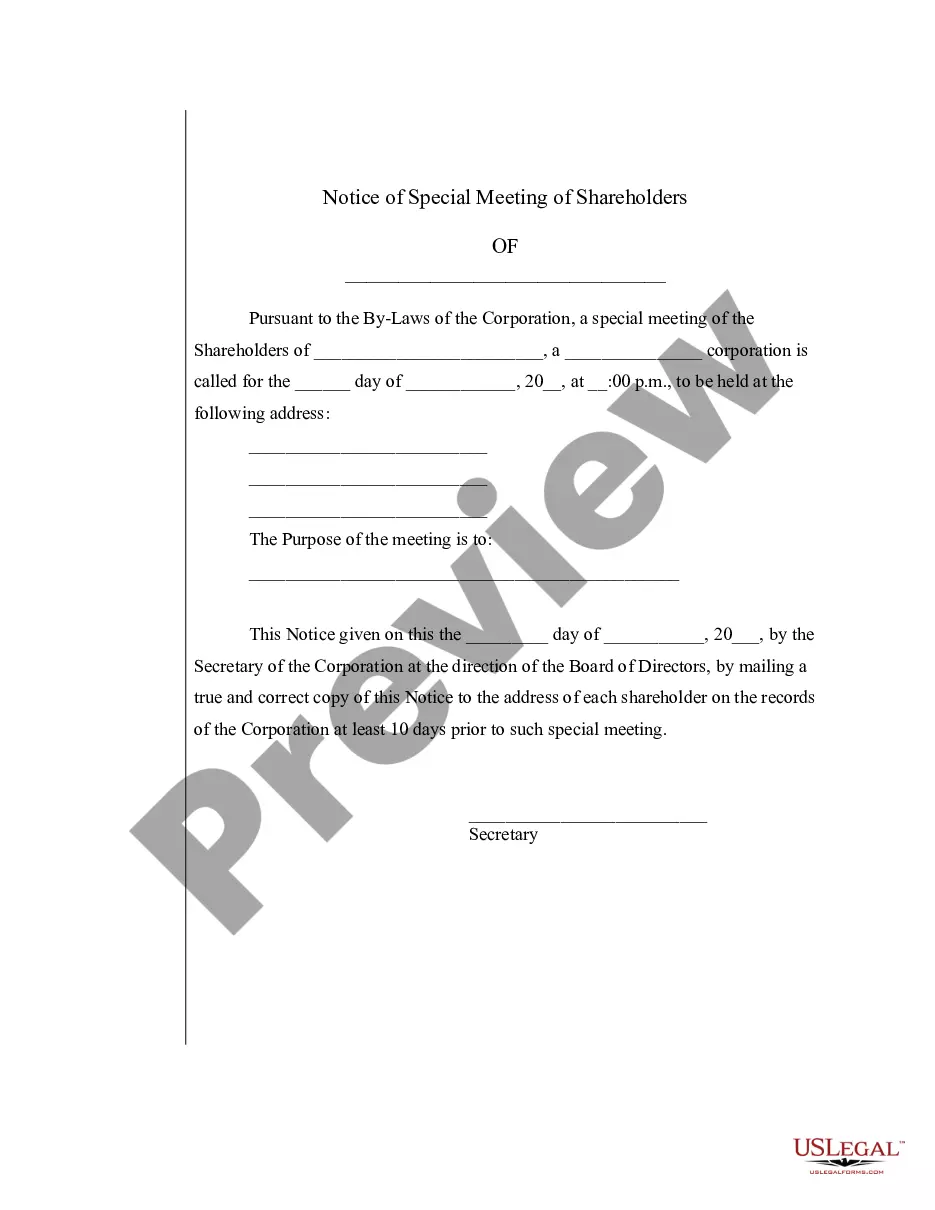
The notice must provide directors with the date, time, and location of the meeting. Although technically, the purpose of the meeting does not have to be provided, it is generally a good idea to include an agenda or similar information so directors know what to expect and why it is important to attend.
The 4 Ps framework helps improve meeting efficiency by ensuring that the meeting has a clear objective (Purpose), a targeted outcome (Product), the right participants (People), and a well-structured agenda (Process).
Be Polite and Respectful: Greet everyone you meet with a friendly demeanor. Use formal titles unless invited to do otherwise. Listen Actively: Show interest in what the client says. Nod, maintain eye contact, and ask clarifying questions. Be Mindful of Body Language: Maintain open and positive body language.
Starting the Meeting: ``Good (morning/afternoon), everyone. Thank you for joining us today. I'd like to welcome you to this meeting. Our agenda includes (briefly outline the agenda items). Let's begin with our first topic.''
At the start of your meeting, re-introduce yourself to your client to form a friendly connection then quickly shift to business topics. A polite introduction with some small talk is normal, but you shouldn't let socializing take up too much of your time.
Content of Notice A proper meeting notice should include: Date, Time, and Venue: Clear details on when and where the meeting will take place. Purpose of the Meeting: A brief description of the meeting's objectives. Agenda: An outline of topics to be discussed; this helps attendees prepare for the meeting.
How to plan and run an effective client meeting Research your client. Prepare everyone in the meeting. Communicate your agenda ahead of time. Eliminate any distractions. Quickly transition from introductions to business discussions. Appeal to the client's sensibilities. Focus on what your data means. Use subtle repetition.
We can transform our meetings into engaging and productive sessions by applying the principles of the 40-20-40 rule. This rule suggests dedicating 40% of the time to preparation, another 40% to productive follow-up, and only 20% to the actual meeting itself.

