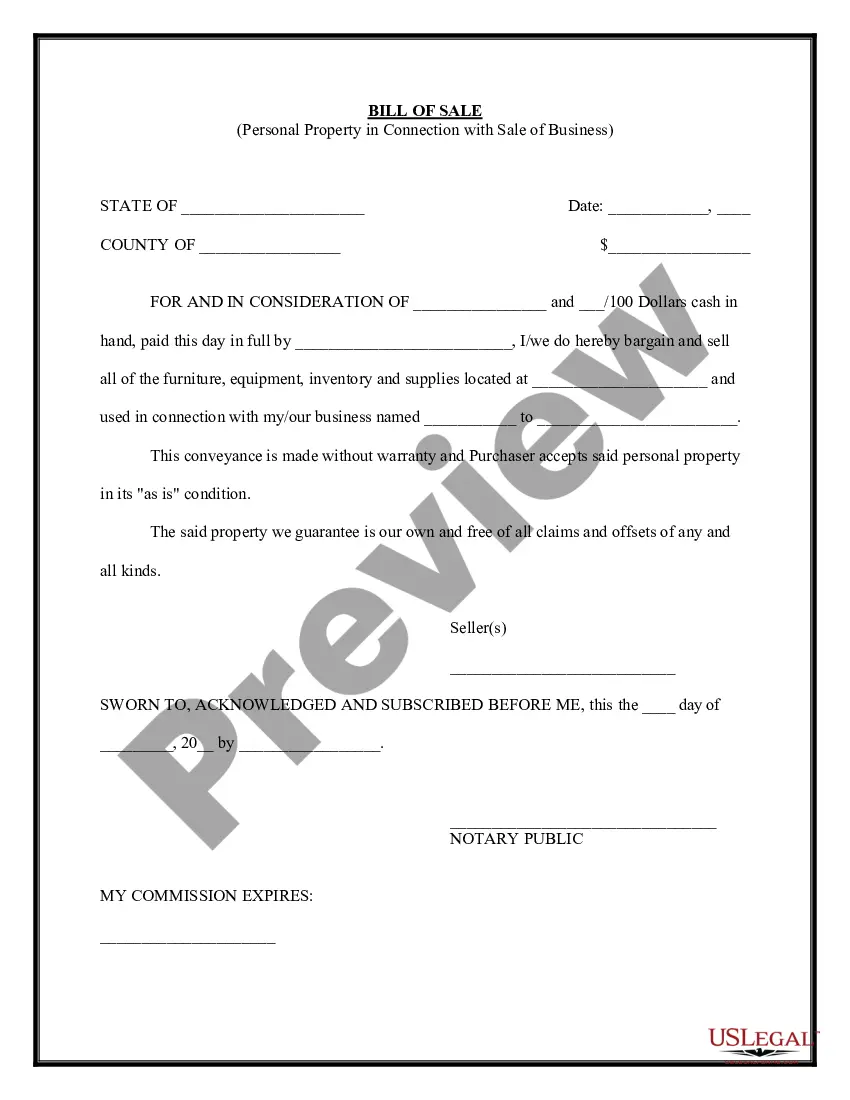
Personal Property Business Form With Tax In Georgia
Description
Get your form ready online
Our built-in tools help you complete, sign, share, and store your documents in one place.
Make edits, fill in missing information, and update formatting in US Legal Forms—just like you would in MS Word.
Download a copy, print it, send it by email, or mail it via USPS—whatever works best for your next step.
Sign and collect signatures with our SignNow integration. Send to multiple recipients, set reminders, and more. Go Premium to unlock E-Sign.
If this form requires notarization, complete it online through a secure video call—no need to meet a notary in person or wait for an appointment.
We protect your documents and personal data by following strict security and privacy standards.

Make edits, fill in missing information, and update formatting in US Legal Forms—just like you would in MS Word.

Download a copy, print it, send it by email, or mail it via USPS—whatever works best for your next step.

Sign and collect signatures with our SignNow integration. Send to multiple recipients, set reminders, and more. Go Premium to unlock E-Sign.

If this form requires notarization, complete it online through a secure video call—no need to meet a notary in person or wait for an appointment.

We protect your documents and personal data by following strict security and privacy standards.
Looking for another form?
Form popularity
FAQ
Georgia law requires owners of personal property in Georgia to file a return in the county where the owner resides. In most counties personal property tax reports should be filed between January 1 and April 1. In some counties the law specifies that returns should be filed between January 1 and March 1.
Include the income from the business on your Form 1040, U.S. Individual Income Tax Return and the appropriate schedule(s): Schedule C (Form 1040), Profit or Loss from Business (Sole Proprietorship); Schedule E (Form 1040), Supplemental Income and Loss; and/or Schedule SE (Form 1040), Self-Employment Tax.
Business Personal Property Tax is a tax assessed on tangible personal property businesses own. This type of property includes equipment, furniture, computers, machinery, and inventory, among other items not permanently attached to a building or land.
WHICH STATES DO NOT TAX BUSINESS PERSONAL PROPERTY? North Dakota. South Dakota. Ohio. Pennsylvania. New Jersey. New York. New Hampshire. Hawaii.
Georgia exempts a property owner from paying property tax on: Items of personal property used in the home if not held for sale, rental, or other commercial use. All tools and implements of trade of manual laborers in an amount not to exceed $2,500 in actual value.
If you own a business - furniture, fixtures, equipment, inventory, and supplies are considered personal property. Ownership of personal property is established as of January 1 each year. A property tax return must be filed with the Tax Assessor's Office annually, prior to April 1. Tax returns are mailed out in January.
Business Personal Property Tax is a tax assessed on tangible personal property businesses own. This type of property includes equipment, furniture, computers, machinery, and inventory, among other items not permanently attached to a building or land.
If your business or organization owns a lot of equipment, you might decide to move your business to New York, where only real property (like land and the structures attached to it) are subject to taxation.
Commercial & Industrial Property Tax Minnesota exempts personal property, including machinery and inventory, from the property tax, which lowers the effective tax rate for real and personal property.
All property in Georgia is taxed at an assessment rate of 40% of its full market value. Exemptions, such as a homestead exemption, reduce the taxable value of your property. Let's say this homeowner has a standard homestead exemption of $2,000. The taxable value is then multiplied by the millage rate.