Corporation First Meeting For Love In Wake
Description
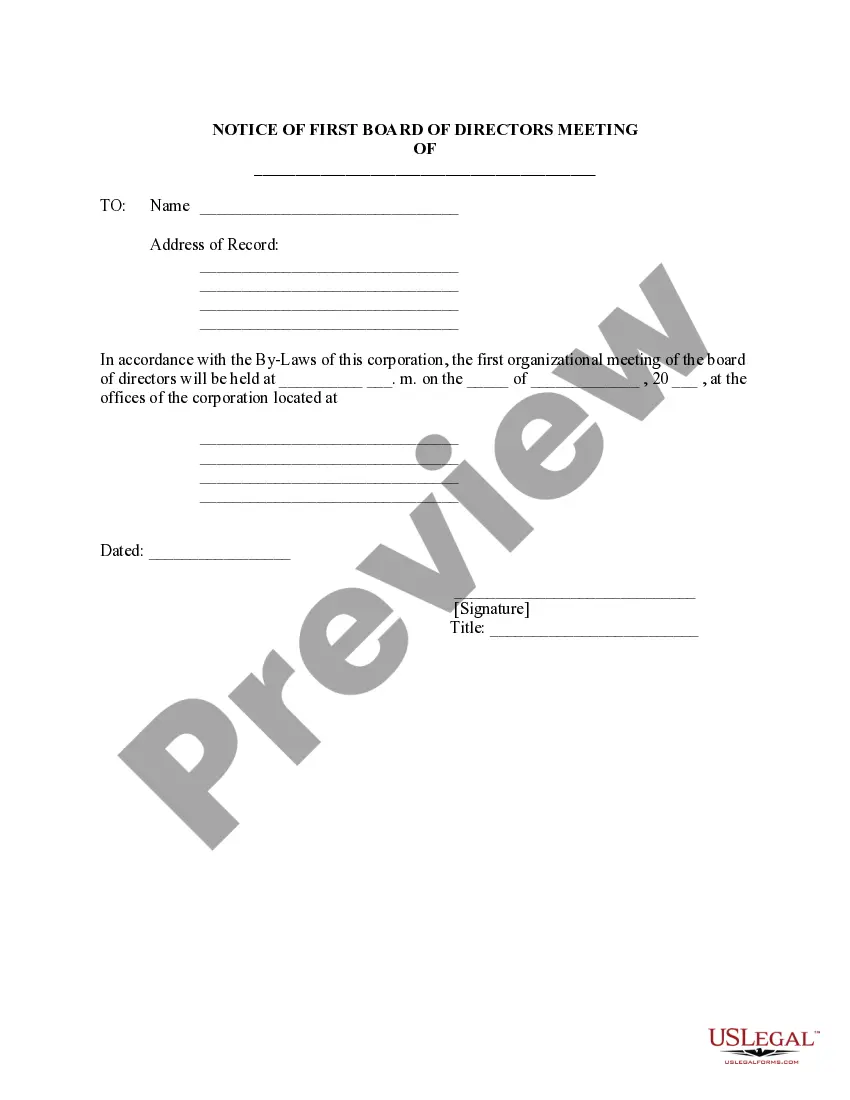


Get your form ready online
Our built-in tools help you complete, sign, share, and store your documents in one place.
Make edits, fill in missing information, and update formatting in US Legal Forms—just like you would in MS Word.
Download a copy, print it, send it by email, or mail it via USPS—whatever works best for your next step.
Sign and collect signatures with our SignNow integration. Send to multiple recipients, set reminders, and more. Go Premium to unlock E-Sign.
If this form requires notarization, complete it online through a secure video call—no need to meet a notary in person or wait for an appointment.
We protect your documents and personal data by following strict security and privacy standards.

Make edits, fill in missing information, and update formatting in US Legal Forms—just like you would in MS Word.

Download a copy, print it, send it by email, or mail it via USPS—whatever works best for your next step.

Sign and collect signatures with our SignNow integration. Send to multiple recipients, set reminders, and more. Go Premium to unlock E-Sign.

If this form requires notarization, complete it online through a secure video call—no need to meet a notary in person or wait for an appointment.

We protect your documents and personal data by following strict security and privacy standards.
Looking for another form?


Form popularity
FAQ
We can transform our meetings into engaging and productive sessions by applying the principles of the 40-20-40 rule. This rule suggests dedicating 40% of the time to preparation, another 40% to productive follow-up, and only 20% to the actual meeting itself.
Percentage Of Meetings That Are Productive Just 11% of meetings are productive and 89% aren't, despite organizations spending around 15% of their working hours in meetings.
We surveyed 182 senior managers in a range of industries: 65% said meetings keep them from completing their own work. 71% said meetings are unproductive and inefficient. 64% said meetings come at the expense of deep thinking. 62% said meetings miss opportunities to bring the team closer together.
Average time spent in meetings per week Our data shows that across all regions and job titles, the average employee spends 11.3 hours in meetings each week. That's an aggregate number, based on the average percentage of the workweek spent in meetings, which is 28.3%.
On average, organizations spend roughly 15% of their time in meetings. An estimated $37 billion is lost due to unproductive meetings per year. Only 30% of meetings are considered productive and 37% of workplace meetings actively use an agenda.
As for the ideal cadence, it is generally advised that the ideal is to cap weekly meetings at 20% of your time with each meeting should be not more than 30 minutes long.
71% of workers waste time every week due to unnecessary or cancelled meetings. Employees spend 31 hours each month in unproductive meetings. On average, meetings are delayed 10 minutes and 40 seconds, which is equivalent to 3 days and 2 hours lost each year for each employee!
How to use the Falls First trope in creative ways. Avoiding Clichés: Add complexity to the trope by giving the character with earlier feelings their own arc and growth that isn't solely dependent on their love interest's reciprocation.
Yes, it is possible to feel a strong attraction or connection at first meeting, which some people describe as ``love at first sight.'' This phenomenon can occur due to a combination of physical attraction, emotional chemistry, and shared interests or values.
A ``meet-cute'' is a cinematic term referring to a humorous or charming first encounter between two characters, often romantic leads, that sets the stage for their relationship. This moment is typically characterized by a quirky or unexpected situation that leads to an immediate connection or conflict.
