First Stockholders Sample For A Startup
Description
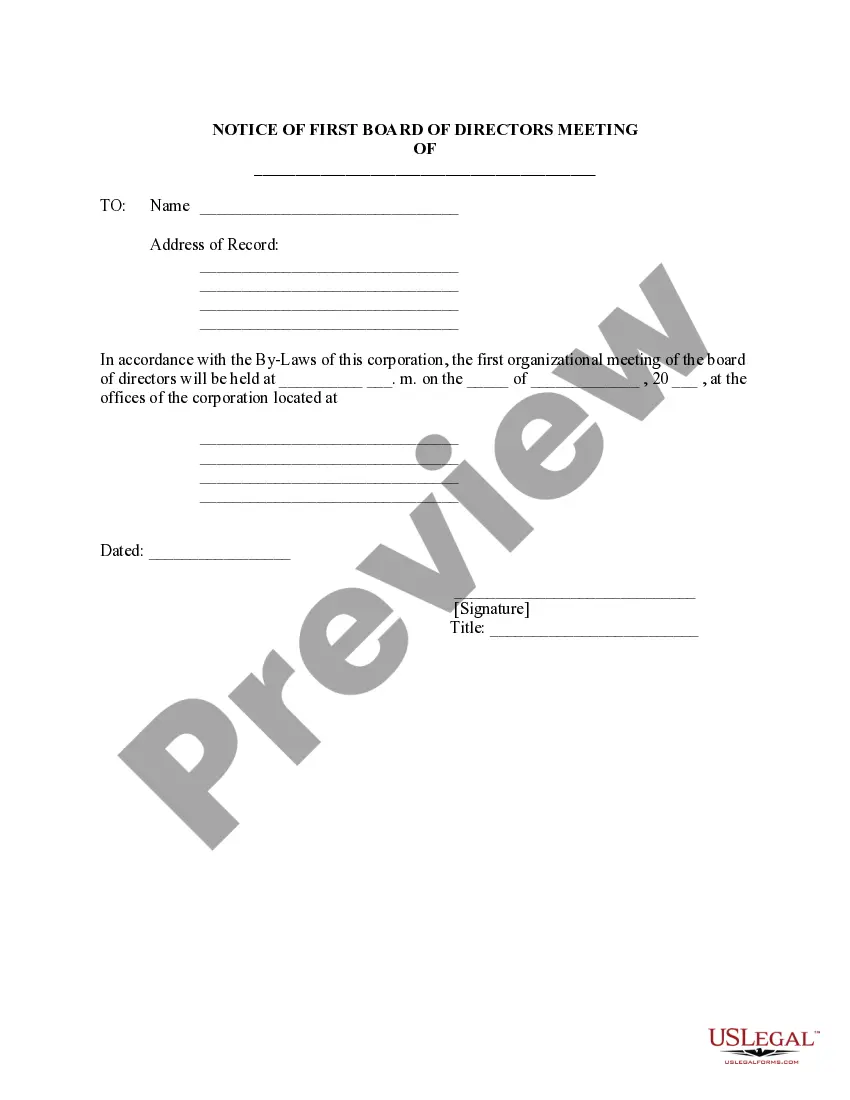




How to fill out Notice Of First Stockholders Meeting - Corporate Resolutions?
- Start by logging in to your account on the US Legal Forms website. If it's your first time, you will need to create a new account to get started.
- Browse the extensive online library and use the search feature to find the stockholders sample that meets your specific requirements.
- Review the document preview to ensure it suits your needs and adheres to your local jurisdiction's requirements.
- Select the appropriate subscription plan that fits your needs and click on the 'Buy Now' button to proceed.
- Complete your purchase by entering your payment information through credit card or PayPal.
- Download the completed stockholders sample to your device and access it anytime through the 'My Forms' section of your account.
By following these steps, you'll be well-equipped to obtain the necessary legal documentation quickly and effectively. US Legal Forms not only simplifies the process but also provides essential support to ensure your documents are accurate and legally binding.
Start your journey towards successful business ownership by accessing the vast library at US Legal Forms today!
Form popularity
FAQ
The first meeting of shareholders serves as a crucial step in establishing your startup. During this meeting, the initial stockholders come together to discuss important decisions, such as electing a board of directors and approving company bylaws. By holding this meeting, you create a foundation for effective governance and communication. Utilizing a first stockholders sample for a startup can guide you in organizing this meeting efficiently and professionally.
Good equity for startups often varies but typically aligns with the stage of the business and investor interests. In early rounds, giving away 10% to 30% may strike a balance between retaining control and attracting investment. As the business matures, the percentage might decrease, ensuring founders maintain a significant ownership stake. An informative first stockholders sample for a startup can provide insights into what constitutes a reasonable equity structure.
1% equity signifies ownership of 1% of the company's total shares. This level of equity may seem minimal but can represent a meaningful financial stake as the company grows. It's vital to understand the potential future value and implications of this ownership. Looking into a first stockholders sample for a startup can clarify how shares function and their long-term impact.
1% equity in a startup can be valuable, depending on the company's growth potential and valuation. For some, it can represent a significant share in a successful company. However, as an early-stage opportunity, it’s crucial to evaluate the long-term vision and market environment. A relevant first stockholders sample for a startup can provide insights to help assess the value of such equity positions.
Allocating shares in a startup requires a well-thought-out strategy. Typically, founders, early employees, and investors will receive shares based on their contributions and negotiations. For instance, a common starting point may involve 50% for founders, 20% for key early employees, and 30% reserved for future investors. Using a detailed first stockholders sample for a startup can guide the allocation process effectively.
The amount of equity a startup should give away depends on several factors, including the stage of the business, funding needs, and investor expectations. Commonly, early-stage startups offer between 10% to 30% of equity during investment rounds. It's essential to carefully assess how much equity aligns with your goals and future funding plans. A comprehensive first stockholders sample for a startup can help you understand the implications of equity distribution.
To determine shares in a startup, evaluate the total valuation of the company and the investment contributions from each investor. This assessment will reveal how many shares each stakeholder should have based on their financial input. Implementing a first stockholders sample for a startup can also clarify the process, ensuring a transparent and equitable distribution of shares.
Splitting ownership of a company requires negotiation among stakeholders. Start by defining each party's investment and role, which will guide the distribution of shares. Using a first stockholders sample for a startup can streamline this process by providing a clear framework for ownership shares and responsibilities.
To split ownership of a startup, first assess the contributions of each member, including capital, skills, and time. Create a fair agreement that reflects these contributions while considering future roles and responsibilities. A first stockholders sample for a startup can serve as a valuable guide in establishing ownership shares amicably among partners.
Owning 20% of a company means you hold one-fifth of its shares. This level of ownership can impact decision-making, voting rights, and profit-sharing. For startups, it’s crucial to understand how this stake translates into influence and financial returns. Utilizing a first stockholders sample for a startup can help clarify ownership implications.
