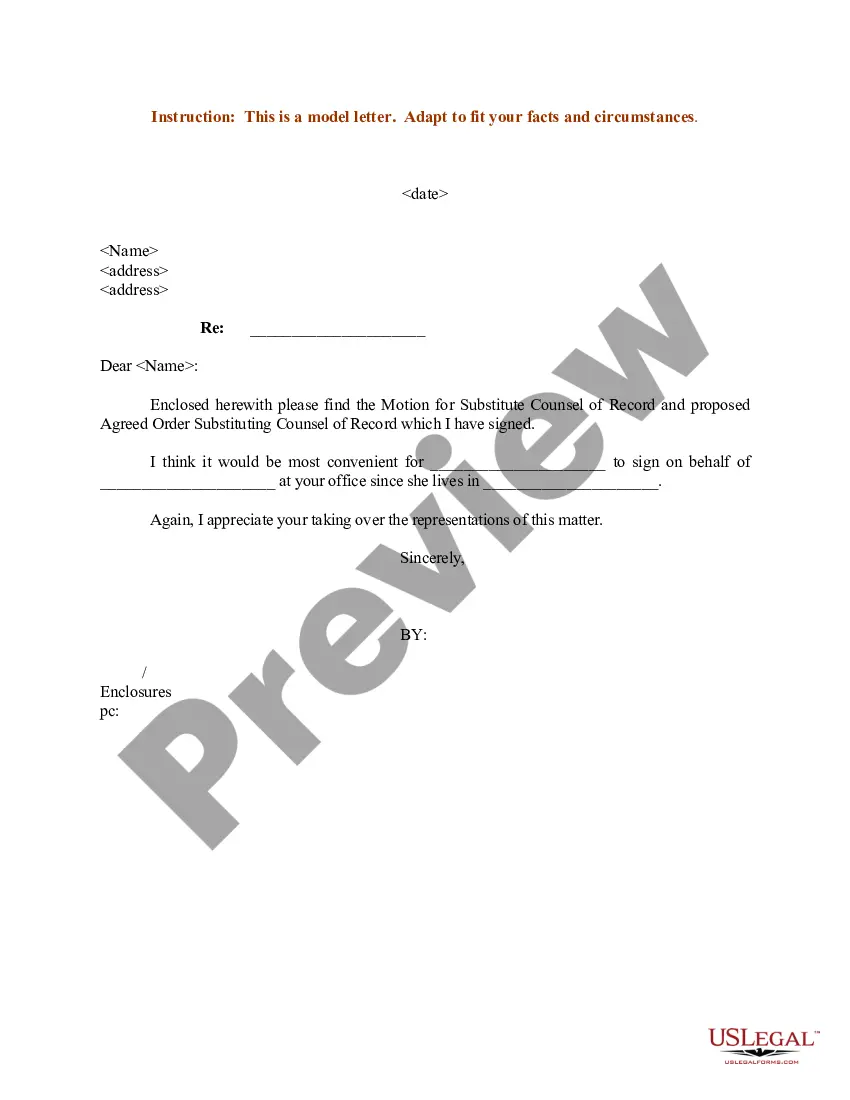
Sample Letter For Court In Maryland
Description




Get your form ready online
Our built-in tools help you complete, sign, share, and store your documents in one place.
Make edits, fill in missing information, and update formatting in US Legal Forms—just like you would in MS Word.
Download a copy, print it, send it by email, or mail it via USPS—whatever works best for your next step.
Sign and collect signatures with our SignNow integration. Send to multiple recipients, set reminders, and more. Go Premium to unlock E-Sign.
If this form requires notarization, complete it online through a secure video call—no need to meet a notary in person or wait for an appointment.
We protect your documents and personal data by following strict security and privacy standards.

Make edits, fill in missing information, and update formatting in US Legal Forms—just like you would in MS Word.

Download a copy, print it, send it by email, or mail it via USPS—whatever works best for your next step.

Sign and collect signatures with our SignNow integration. Send to multiple recipients, set reminders, and more. Go Premium to unlock E-Sign.

If this form requires notarization, complete it online through a secure video call—no need to meet a notary in person or wait for an appointment.

We protect your documents and personal data by following strict security and privacy standards.
Looking for another form?






Form popularity
FAQ
As long as your ``letter'' is filed as a motion, a request to the court for an order, and served on opposing parties as required, it is legal. It is incredibly to do so if you are represented by an attorney.
Letters from non-lawyers to judges are absolutely to be avoided. They are inappropriate and violate many rules regarding proper communication with judges. Some letters may be in violation of criminal law that prohibits improper efforts to influence the judge. Being a judge is not entering a popularity contest.
The Statement of Probable Cause (form DC/CR 4) is a document used by the arresting officer to write a concise statement that articulates the probable cause related to the arrest of the defendant, including articulating the elements of each crime charged on forms DC/CR002 and DC/CR002A.
Judge's Information: Include the judge's name, title, and court address. Introduction: - State your name and your relationship to the defendant (if applicable). - Briefly explain the purpose of your letter. Body: - Express Understanding: Acknowledge the seriousness of the situation and the crime.
Start with a Clear Introduction Begin your letter by addressing it to the court appropriately. Use the specific name of the judge if possible (e.g., “Dear Judge Jones”). If you cannot find the judge's name, “Honorable Judge” is an acceptable alternative. In your introduction, clearly state the purpose of your letter.
File a Notice of Intention to Defend If you choose to defend yourself, you must file the Notice of Intention to Defend, appearing on the bottom half of the summons. The Notice should be cut at the perforated line and returned to the court address listed at the top of the summons.
Use a Court Forms Finder, which will guide you through a series of questions to help identify the form you need. Still have questions? Call the Maryland Court Help Center at 410-260-1392. Using Search will allow you to filter the list of titles by form number or keyword.
The Statement of Probable Cause (form DC/CR 4) is a document used by the arresting officer to write a concise statement that articulates the probable cause related to the arrest of the defendant, including articulating the elements of each crime charged on forms DC/CR002 and DC/CR002A.
Small claims court is a part of the District Court of Maryland. It handles claims for $5,000 or less. The rules of evidence and procedure are simplified so it's easier to represent yourself without a lawyer. A judge will decide the case.
In Maryland, for most civil actions you have a period of three years after the act which caused you the harm to file a lawsuit. However, by law some types of cases have a different limitation period. For example, the limitation period for assault, libel, or slander is one year.

