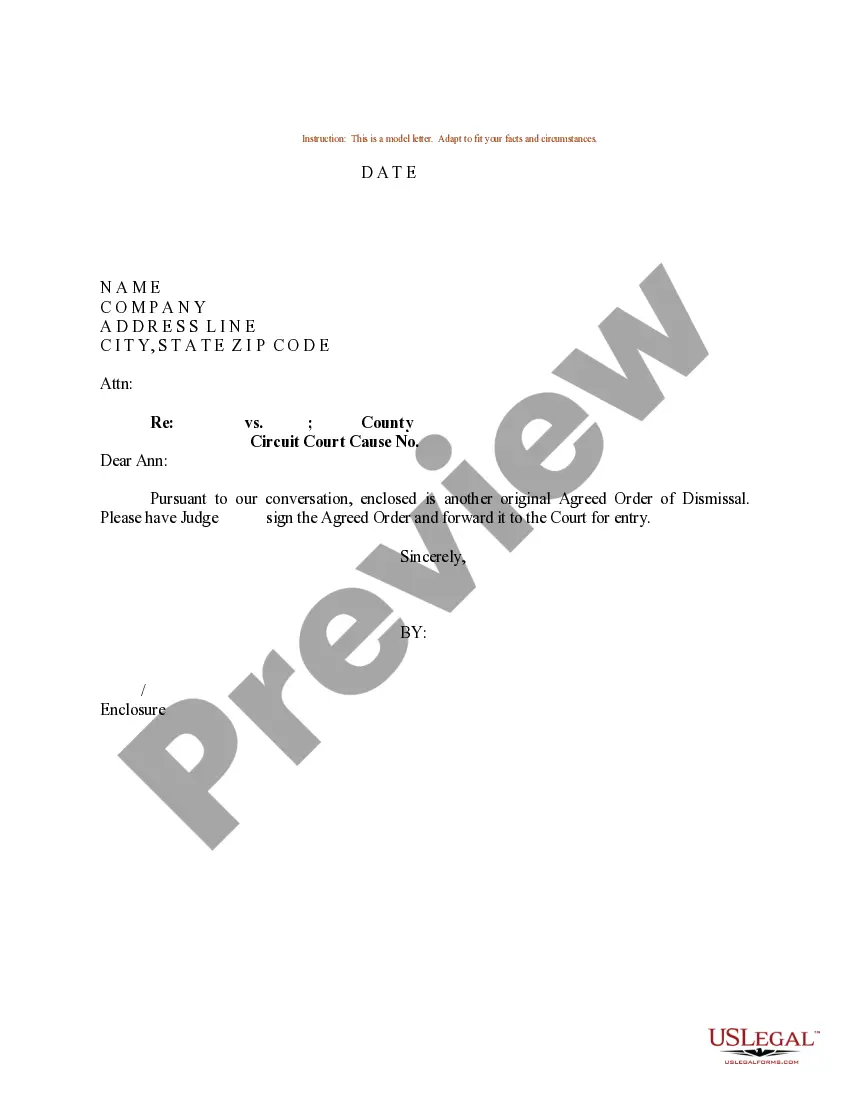
Court Letter Sample With Greetings In Clark
Description


Get your form ready online
Our built-in tools help you complete, sign, share, and store your documents in one place.
Make edits, fill in missing information, and update formatting in US Legal Forms—just like you would in MS Word.
Download a copy, print it, send it by email, or mail it via USPS—whatever works best for your next step.
Sign and collect signatures with our SignNow integration. Send to multiple recipients, set reminders, and more. Go Premium to unlock E-Sign.
If this form requires notarization, complete it online through a secure video call—no need to meet a notary in person or wait for an appointment.
We protect your documents and personal data by following strict security and privacy standards.

Make edits, fill in missing information, and update formatting in US Legal Forms—just like you would in MS Word.

Download a copy, print it, send it by email, or mail it via USPS—whatever works best for your next step.

Sign and collect signatures with our SignNow integration. Send to multiple recipients, set reminders, and more. Go Premium to unlock E-Sign.

If this form requires notarization, complete it online through a secure video call—no need to meet a notary in person or wait for an appointment.

We protect your documents and personal data by following strict security and privacy standards.
Looking for another form?

Form popularity
FAQ
Outside of the Supreme Court, always use “The Honorable (full name)” in your correspondence. STATE COURTS Note: States may vary on titles of judges. Check with court or various state court resources to determine proper address and salutation forms, particularly for Chief Judges/Chief Justices.
Write an introduction If you're writing a legal statement, elements such as the date and subject of the statement should appear at the top. You should also identify relevant parties and explain how they're connected to the subject.
The best bet is, ``Your Honor'' and if they ask you a question (any lawyer, any officer of the court), always address your answer to the judge, so, answer ``Yes, sir'' or ``Yes, ma'am'' or ``Yes, Your Honor.'' Sounds archaic, but really, this formal address is showing respect for the authority of the judge.
Introduce yourself in the opening paragraph. Outline your relationship with the person who is the subject of the legal proceedings. Acknowledge the charges that have been brought against the person. State your opinion of the person's general character.
Do not write “Honorable Judge” because that's redundant. Either “Judge” or “The Honorable” is acceptable. It's also acceptable to use “To Whom It May Concern.”
Dear Judge's Name, I am writing to bring your attention to a claim I have against name of defendant regarding briefly describe the nature of the claim. I am writing this letter in support of my claim and to request that the court consider my case. On date of incident, I briefly describe what happened.
How to Write a Good Court Statement Be clear and concise in your writing. Keep your sentences and paragraphs short, making them easier to read and understand. Make sure all of your facts are accurate and complete. Proofread your statement before submitting it to the court.
7 Keys to drafting a strong statement of the case Accuracy. Accuracy is the cornerstone of a good statement of facts. Clarity. A good statement of facts and procedural history should be clear and easy to read. Chronological order. Relevant facts. Organization. Objectivity. Relevant citations.
If you are asked to write a character letter for someone, it can be helpful to keep the following tips in mind when creating your letter: Address Your Letter to the Judge. Establish a Clear Relationship with the Defendant. Be Truthful. Be Positive. Include a Discussion of the Crime. Do Not Suggest Penalties for the Crime.
Provide relevant details and supporting information to back up your statements. Use specific examples, dates, and times to add credibility to your statement letter. Make sure all the information you provide is accurate and truthful.

