Sample Letter Rejecting Settlement Offer For Car Accident In Santa Clara
Description


Get your form ready online
Our built-in tools help you complete, sign, share, and store your documents in one place.
Make edits, fill in missing information, and update formatting in US Legal Forms—just like you would in MS Word.
Download a copy, print it, send it by email, or mail it via USPS—whatever works best for your next step.
Sign and collect signatures with our SignNow integration. Send to multiple recipients, set reminders, and more. Go Premium to unlock E-Sign.
If this form requires notarization, complete it online through a secure video call—no need to meet a notary in person or wait for an appointment.
We protect your documents and personal data by following strict security and privacy standards.

Make edits, fill in missing information, and update formatting in US Legal Forms—just like you would in MS Word.

Download a copy, print it, send it by email, or mail it via USPS—whatever works best for your next step.

Sign and collect signatures with our SignNow integration. Send to multiple recipients, set reminders, and more. Go Premium to unlock E-Sign.

If this form requires notarization, complete it online through a secure video call—no need to meet a notary in person or wait for an appointment.

We protect your documents and personal data by following strict security and privacy standards.
Looking for another form?


Form popularity
FAQ
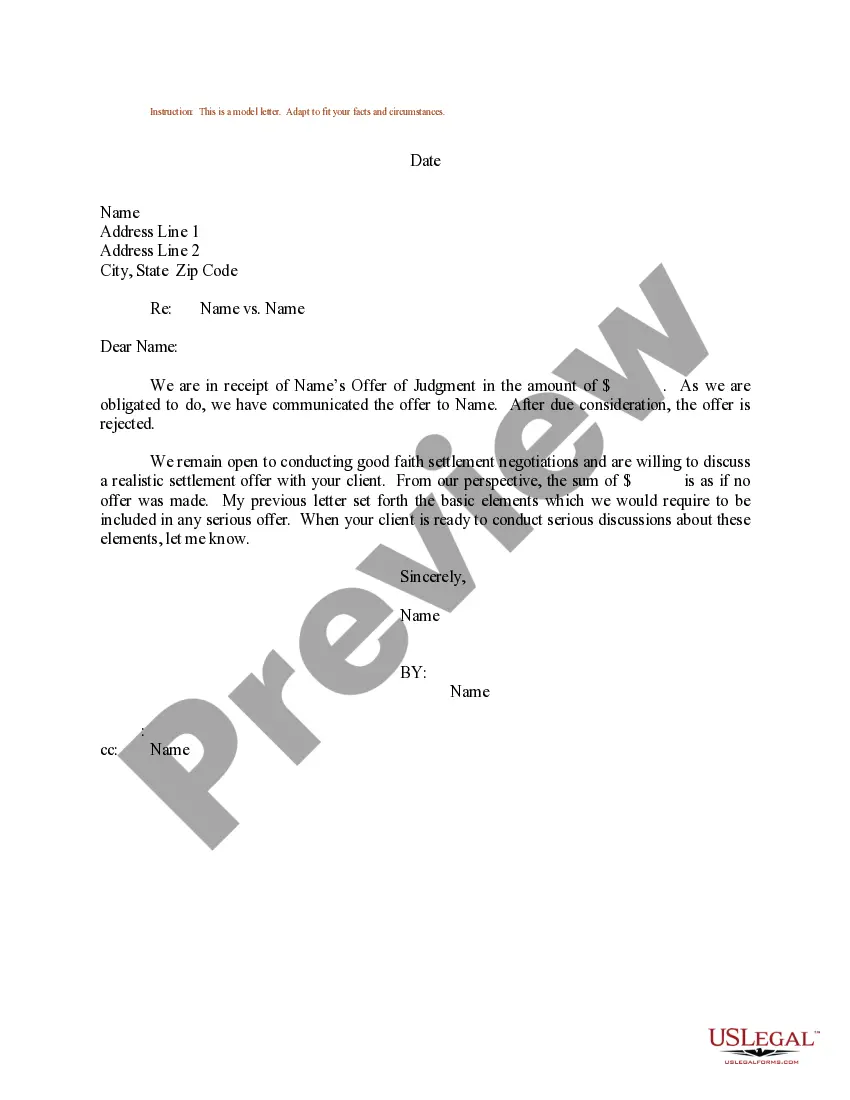
If you find the offer unacceptable, your attorney can draft a formal letter and propose a counteroffer. This letter should clearly state that the initial offer is unacceptable and refute any inaccuracies in the insurance adjuster's statements.
I am writing in response to the settlement offer you presented on Settlement Offer Date, related to claim number Claim Number for the incident that occurred on Incident Date. After careful consideration, I must reject this offer as it does not meet my needs based on the severity and ongoing nature of my injuries.
If, after you have thought about reasonableness and the policy limit, you still think the offer you have is too low, you can reject it. Always reject a settlement offer in writing. Type a letter to your contact at the insurance company listing the reasons you think that their offer is too low.
This letter should state: That you will not accept the initial settlement offer; The reasons why you feel you deserve a higher settlement amount; Each of their low-offer reasons, and your responses; The higher settlement amount that you will accept.
You can reject the first settlement offer to set the ground for settlement negotiations. A personal injury attorney can compile various sources of evidence to convince the insurer to a higher valuation of your losses. Your attorney can propose a counteroffer, a value likely to cover your losses.
If you reject an offer, it can technically be taken off the table. However more likely than not the insurance company will continue to negotiate with you.
However, refusing a settlement offer does extend the life of your claim and delays when you receive compensation. If you have pressing medical bills or other expenses, this is a factor to consider. You'll also need to invest more time and energy into your case, including providing more documentation of your damages.
File a Lawsuit You can initiate a personal injury lawsuit if you and the insurance company can't agree on a settlement value. Filing a trial will bring the matter before a judge or jury who may decide to award the damages per your request.
When you decline an offer from an insurance company, it is an opportunity to commence settlement negotiations. Rejecting a settlement offer signals to an insurer that you will advocate for a fair settlement value that matches your losses.
Rejecting the first compensation offer is often a wise decision, especially if it feels rushed or doesn't account for the full scope of your injuries and potential long-term expenses. Many initial offers address only immediate costs, allowing insurers to settle quickly while minimizing their payout.
