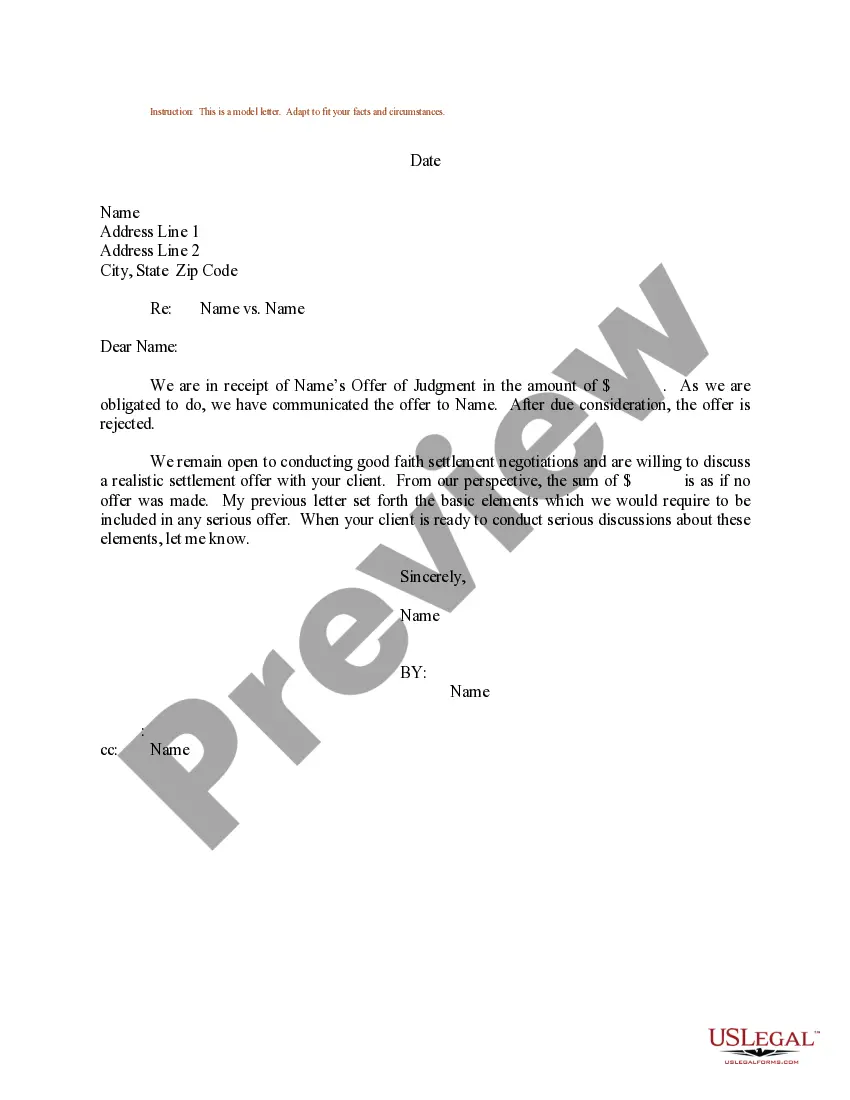
Sample Settlement Letter Without Prejudice In Maryland
Description


Get your form ready online
Our built-in tools help you complete, sign, share, and store your documents in one place.
Make edits, fill in missing information, and update formatting in US Legal Forms—just like you would in MS Word.
Download a copy, print it, send it by email, or mail it via USPS—whatever works best for your next step.
Sign and collect signatures with our SignNow integration. Send to multiple recipients, set reminders, and more. Go Premium to unlock E-Sign.
If this form requires notarization, complete it online through a secure video call—no need to meet a notary in person or wait for an appointment.
We protect your documents and personal data by following strict security and privacy standards.

Make edits, fill in missing information, and update formatting in US Legal Forms—just like you would in MS Word.

Download a copy, print it, send it by email, or mail it via USPS—whatever works best for your next step.

Sign and collect signatures with our SignNow integration. Send to multiple recipients, set reminders, and more. Go Premium to unlock E-Sign.

If this form requires notarization, complete it online through a secure video call—no need to meet a notary in person or wait for an appointment.

We protect your documents and personal data by following strict security and privacy standards.
Looking for another form?







Form popularity
FAQ
Unless otherwise specified in the notice of dismissal, stipulation, or order of court, a dismissal is without prejudice, except that a notice of dismissal operates as an adjudication upon the merits when filed by a party who has previously dismissed in any court of any state or in any court of the United States an ...
MD. RULE 3-506(a)(2). Stipulations of dismissal are most commonly filed when an action has been settled prior to trial. Third, and finally, if a party wishes to dismiss an action for any other reason, it must be by order of the Court "upon such terms and conditions as the court deems proper." MD.
A case dismissed with prejudice is over and done with, once and for all, and can't be brought back to court. A case dismissed without prejudice means the opposite. It's not dismissed forever. The person whose case it is can try again.
As we have explained, Md. Rule 2-507(b) authorizes a circuit court to dismiss a case when the court has not obtained jurisdiction over the defendant within 120 days of the date on which the clerk's office issued a summons for the defendant, which in this case was the day on which Mr. Powers filed his complaint.
MD. RULE 3-506(a)(2). Stipulations of dismissal are most commonly filed when an action has been settled prior to trial. Third, and finally, if a party wishes to dismiss an action for any other reason, it must be by order of the Court "upon such terms and conditions as the court deems proper." MD.
The following defenses may be made by motion to dismiss filed before the answer, if an answer is required: (1) lack of jurisdiction over the subject matter, (2) failure to state a claim upon which relief can be granted, (3) failure to join a party under Rule 2-211, (4) discharge in bankruptcy, and (5) governmental ...
Notice of Intention to Defend - This is a form located on the bottom of your summons. Complete the Notice of Intention to Defend if you dispute owing all or some of what the plaintiff claims. The completed form must be returned to the Maryland District Court location listed at the top of your summons.
As we have explained, Md. Rule 2-507(b) authorizes a circuit court to dismiss a case when the court has not obtained jurisdiction over the defendant within 120 days of the date on which the clerk's office issued a summons for the defendant, which in this case was the day on which Mr. Powers filed his complaint.
The 'without prejudice' label can be attached to any form of communication – letters, emails, phone calls, and meetings – whether online or otherwise. All that is required is that one or both parties state that the communication is 'without prejudice' before the communication occurs.
“Without Prejudice” means that you are sending a communication in an honest attempt to compromise a matter, in which you might make a concession (either expressly or implicitly) to the other side that cannot be later put into evidence in Court.

