Contract Law In Hindi In Cook
Description

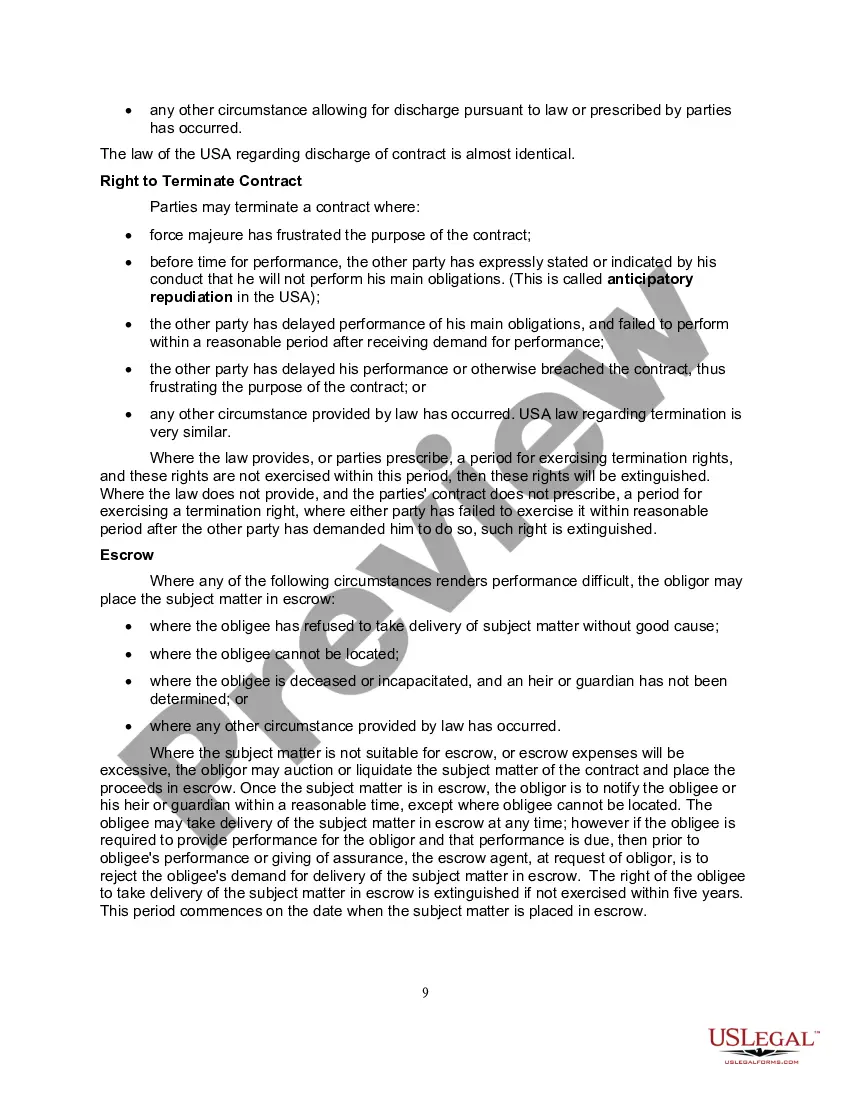



Get your form ready online
Our built-in tools help you complete, sign, share, and store your documents in one place.
Make edits, fill in missing information, and update formatting in US Legal Forms—just like you would in MS Word.
Download a copy, print it, send it by email, or mail it via USPS—whatever works best for your next step.
Sign and collect signatures with our SignNow integration. Send to multiple recipients, set reminders, and more. Go Premium to unlock E-Sign.
If this form requires notarization, complete it online through a secure video call—no need to meet a notary in person or wait for an appointment.
We protect your documents and personal data by following strict security and privacy standards.

Make edits, fill in missing information, and update formatting in US Legal Forms—just like you would in MS Word.

Download a copy, print it, send it by email, or mail it via USPS—whatever works best for your next step.

Sign and collect signatures with our SignNow integration. Send to multiple recipients, set reminders, and more. Go Premium to unlock E-Sign.

If this form requires notarization, complete it online through a secure video call—no need to meet a notary in person or wait for an appointment.

We protect your documents and personal data by following strict security and privacy standards.
Looking for another form?








Form popularity
FAQ
Lesson Summary. A contract is a legal agreement between two or more parties in which they agree to each other's rights and responsibilities. Offer, acceptance, awareness, consideration, and capacity are the five elements of an enforceable contract.
For a contract to be valid and recognized by the common law, it must include certain elements-- offer, acceptance, consideration, intention to create legal relations, authority and capacity, and certainty. Without these elements, a contract is not legally binding and may not be enforced by the courts.
There are four essential elements of forming a contract: offer, acceptance, consideration, and intention to create legal relations. Beyond this, the terms of the contract must also be unambiguous, and the parties must have the mental capacity to agree.
The Indian Contract Act, 1872 defines the term “Contract” under its section 2 (h) as “An agreement enforceable by law”. In other words, we can say that a contract is anything that is an agreement and enforceable by the law of the land.
A legally enforceable contract must include an offer, acceptance, consideration, capacity, legality, and mutual assent.
Both parties must clearly understand and agree to the terms outlined in the contract. Additionally, consideration, or something of value exchanged between the parties, must be present to support the contract's validity. Moreover, legality and the capacity of the parties involved are essential components to consider.
Both parties must clearly understand and agree to the terms outlined in the contract. Additionally, consideration, or something of value exchanged between the parties, must be present to support the contract's validity. Moreover, legality and the capacity of the parties involved are essential components to consider.
To that end, several key elements constitute contract formation; contract law is shaped by considerations of public policy, and parties involved, such as the offeror, must be aware of these legal principles. Those elements are offer, consideration, acceptance, and mutuality.
Write the contract in six steps Start with a contract template. Open with the basic information. Describe in detail what you have agreed to. Include a description of how the contract will be ended. Write into the contract which laws apply and how disputes will be resolved. Include space for signatures.
REQUIREMENTS FOR A CONTRACT In order for a contract to be valid, there must be an offer, an acceptance of the offer, an exchange between the parties of something of value, and an agreement to the terms.