Agreement Arbitrate Document Without Comments In Houston
Description

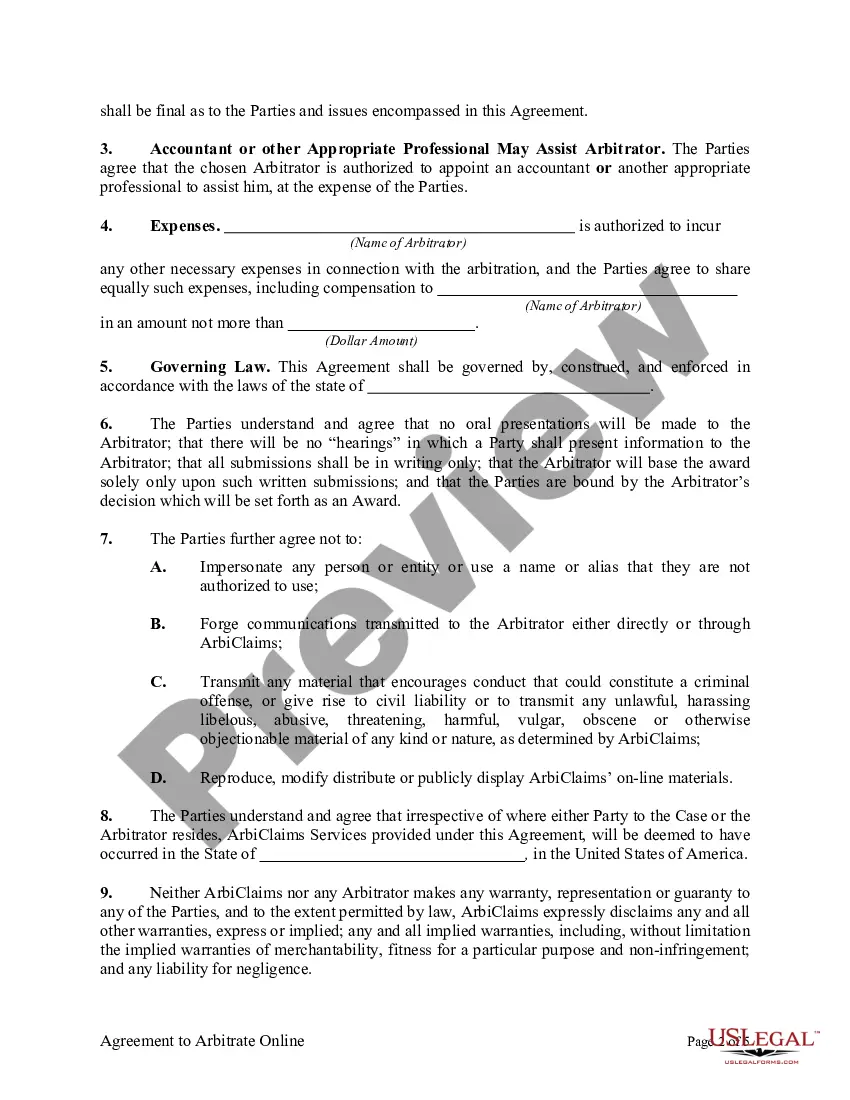
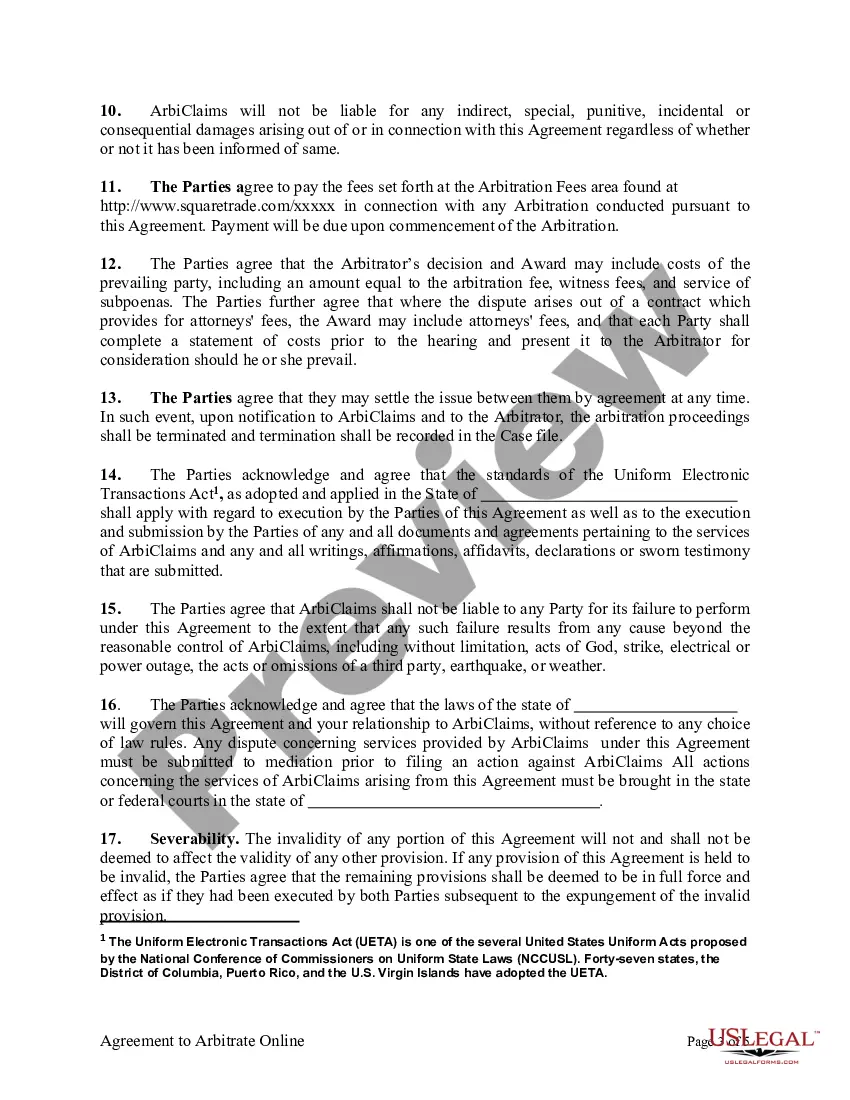




Get your form ready online
Our built-in tools help you complete, sign, share, and store your documents in one place.
Make edits, fill in missing information, and update formatting in US Legal Forms—just like you would in MS Word.
Download a copy, print it, send it by email, or mail it via USPS—whatever works best for your next step.
Sign and collect signatures with our SignNow integration. Send to multiple recipients, set reminders, and more. Go Premium to unlock E-Sign.
If this form requires notarization, complete it online through a secure video call—no need to meet a notary in person or wait for an appointment.
We protect your documents and personal data by following strict security and privacy standards.

Make edits, fill in missing information, and update formatting in US Legal Forms—just like you would in MS Word.

Download a copy, print it, send it by email, or mail it via USPS—whatever works best for your next step.

Sign and collect signatures with our SignNow integration. Send to multiple recipients, set reminders, and more. Go Premium to unlock E-Sign.

If this form requires notarization, complete it online through a secure video call—no need to meet a notary in person or wait for an appointment.

We protect your documents and personal data by following strict security and privacy standards.
Looking for another form?









Form popularity
FAQ
However, the Texas Supreme Court has ruled that an employer can simply notify at-will employees of the details of an arbitration program it is adopting, and the employees can be bound to that arbitration program by continuing their employment, even if they never sign anything.
Yes. The Federal Arbitration Act, or FAA, was passed in 1925 in response to a variety of court decisions that held arbitration agreements unenforceable. This law provides that arbitration agreements are generally valid and enforceable.
In some instances, you may be able to sue if you signed a valid arbitration agreement. While courts generally favor arbitration agreements, they will allow you to file a lawsuit if either you didn't understand your rights or your claims fall outside the arbitration provision's scope.
1 The ICC Rules, Article 6(8) provides, “If any of the parties refuses or fails to take part in the arbitration or any stage thereof, the arbitration shall proceed notwithstanding such refusal or failure.” Similar provisions are also provided for in the LCIA Rules, Article 15.8; SIAC Rules, Rule 20.9; UNCITRAL Rules, ...
In some instances, you may be able to sue if you signed a valid arbitration agreement. While courts generally favor arbitration agreements, they will allow you to file a lawsuit if either you didn't understand your rights or your claims fall outside the arbitration provision's scope.
As a general rule, only strong evidence of duress or fraud are sufficient to invalidate an arbitration clause.
Under Section 171.001 of the TAA, written agreements to arbitrate are generally valid and enforceable in Texas.
If you are in a contract containing an arbitration clause naming the AAA Rules, you may still be able to bring your dispute in small claims court instead of arbitration, as long as the claim falls within the jurisdiction requirements of the small claims court.
If the arbitration agreement is claimed to be invalid based on reasons such as error, fraud, or threat, the validity of the arbitration agreement will be governed by the law chosen by the parties, and in the absence of a choice of law, the law of the place of arbitration applied.
