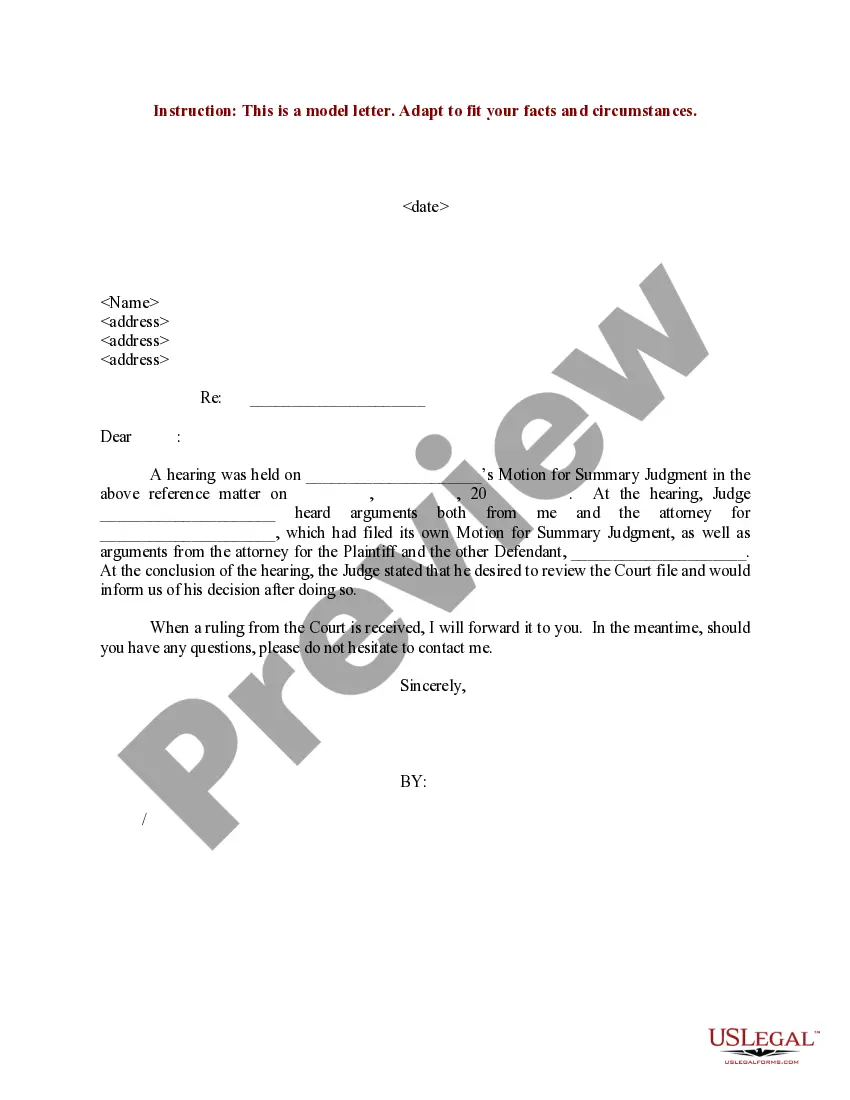
Letter Concerning Hearing Without Consent In Santa Clara
Description
Get your form ready online
Our built-in tools help you complete, sign, share, and store your documents in one place.
Make edits, fill in missing information, and update formatting in US Legal Forms—just like you would in MS Word.
Download a copy, print it, send it by email, or mail it via USPS—whatever works best for your next step.
Sign and collect signatures with our SignNow integration. Send to multiple recipients, set reminders, and more. Go Premium to unlock E-Sign.
If this form requires notarization, complete it online through a secure video call—no need to meet a notary in person or wait for an appointment.
We protect your documents and personal data by following strict security and privacy standards.

Make edits, fill in missing information, and update formatting in US Legal Forms—just like you would in MS Word.

Download a copy, print it, send it by email, or mail it via USPS—whatever works best for your next step.

Sign and collect signatures with our SignNow integration. Send to multiple recipients, set reminders, and more. Go Premium to unlock E-Sign.

If this form requires notarization, complete it online through a secure video call—no need to meet a notary in person or wait for an appointment.

We protect your documents and personal data by following strict security and privacy standards.
Looking for another form?







Form popularity
FAQ
The steps to respond to a Request for Order (form FL-300) are similar no matter what type of order the other side (your current or former spouse, partner, or child's parent) requested. You'll use the Responsive Declaration to Request for Order (form FL-320) to respond.
FL300 refers to 300 mb (or hPa in metric), which is a pressure level that corresponds to an altitude somewhere in the range of 27,000 - 32,000 feet. This level is of particular interest in aviation because it is near or somewhat below the jet stream, and also where many jets fly.
Declaration Regarding Notice and Service of Request for Temporary Emergency (Ex Parte) Orders (FL-303) Tells the court if and how you let the other party know that you are asking the court to make emergency orders in your case.
Form FL-300, Request for Order, is the basic form you need to file with the court. Depending on your request, you may need these additional forms: When specific Judicial Council forms must be used to ask the court for orders. For example, to ask: • If you and the other party have an agreement.
CHECK WHETHER YOU “AGREE” OR “DISAGREE” WITH WHAT THE OTHER PARTY HAS REQUESTED. IF YOU DISAGREE, TELL THE COURT WHAT YOU WANT. EXPLAIN TO THE COURT WHY THE REQUESTS OF THE OTHER PARTY SHOULD NOT BE GRANTED CLEARLY AND CONCISELY. EXPLAIN TO THE COURT WHY YOU WANT WHAT YOU ASKED FOR.
Ask the court to make decisions (orders) about specific issues in your family law case. This is also used by the court to set the date, time, and location of the hearing.
On the next court date, there will be a hearing to determine if you have indeed violated a previous written order of the court. If you are unable to show the Court that you have not violated the Order, then you will most likely be held in Contempt of Court.
To file or defend a case in small claims court, you must be (a) at least 18 years old or legally emancipated, and (b) mentally competent. A person must be represented by a Guardian ad Litem if he or she is under 18 and not legally emancipated, or has been declared mentally incompetent by a court.
Small claims basics Generally, you can only sue for up to $12,500 in small claims court (or up to $6,250 if you're a business). You can ask a lawyer for advice before you go to court, but you can't have one with you in court. Starting November 1, 2021, you can sue or be sued for COVID-19 rental debt in small claims.
As an individual you can use Small Claims Court if your claim is for $12,500 or less. If you are an individual who owns a business (i.e. sole proprietor) and do business under a fictitious business name, you are considered to be an "individual" in Small Claims Court.