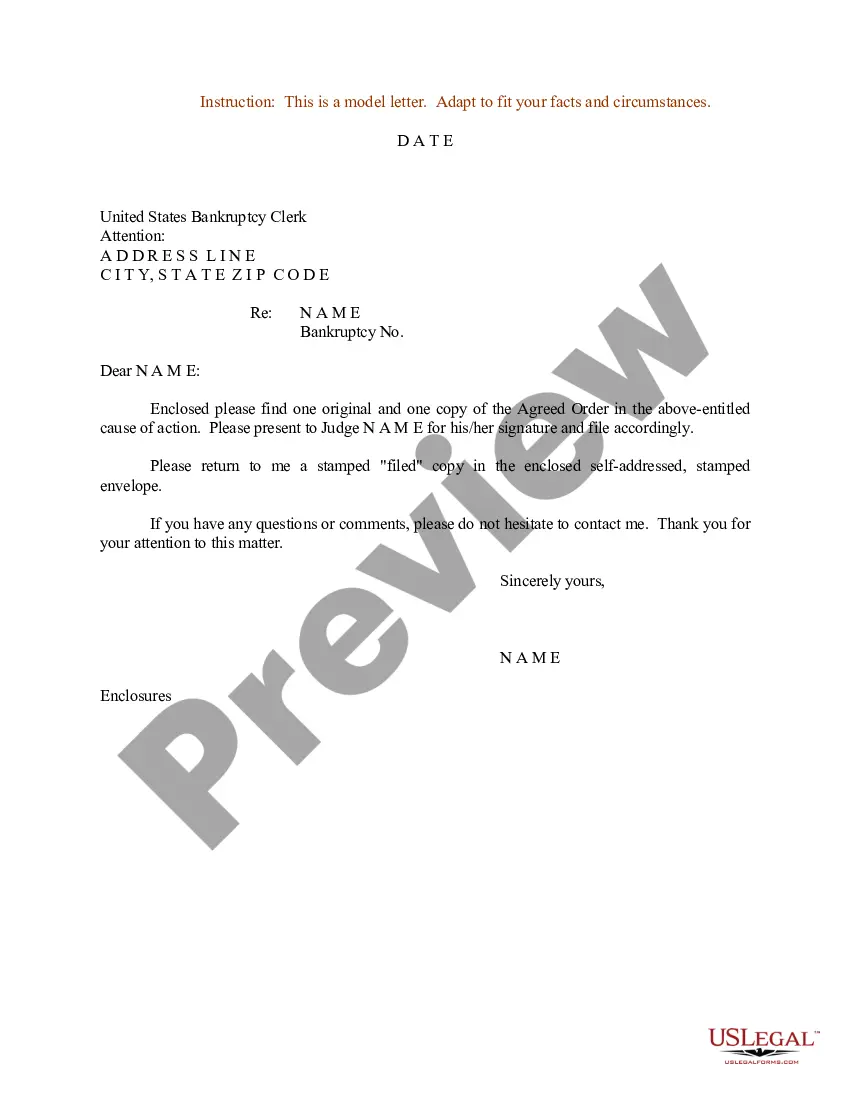
Sample Order For Judge To Sign In Miami-Dade
Description


Get your form ready online
Our built-in tools help you complete, sign, share, and store your documents in one place.
Make edits, fill in missing information, and update formatting in US Legal Forms—just like you would in MS Word.
Download a copy, print it, send it by email, or mail it via USPS—whatever works best for your next step.
Sign and collect signatures with our SignNow integration. Send to multiple recipients, set reminders, and more. Go Premium to unlock E-Sign.
If this form requires notarization, complete it online through a secure video call—no need to meet a notary in person or wait for an appointment.
We protect your documents and personal data by following strict security and privacy standards.

Make edits, fill in missing information, and update formatting in US Legal Forms—just like you would in MS Word.

Download a copy, print it, send it by email, or mail it via USPS—whatever works best for your next step.

Sign and collect signatures with our SignNow integration. Send to multiple recipients, set reminders, and more. Go Premium to unlock E-Sign.

If this form requires notarization, complete it online through a secure video call—no need to meet a notary in person or wait for an appointment.

We protect your documents and personal data by following strict security and privacy standards.
Looking for another form?






Form popularity
FAQ
Yes, but all letters, email or other written communications sent to a judge should be filed with the clerk and provided to the attorneys or litigants, and will become public record.
Record a Document You have three options for recording your documents in the Official Records: You can bring your original documents in person, along with the appropriate fees, and a self-addressed stamped envelope to the Miami-Dade County Courthouse. You can eRecord your document through one of our approved vendors.
You can obtain a judgment lien on all of the judgment debtor's personal property located anywhere in the state by filing a Judgment Lien Certificate with the Department of State. To get the proper form you must go on the internet to the Department's website: .sunbiz.
Florida Statute of Limitations on a Judgment Lasts 20 Years. Until recently, there has been some debate on this litigation question caused by the interpretation of some Courts that a Florida judgment is subject to a five year statute of limitations. However, the Florida Supreme Court, in Salinas v.
Documents are recorded at the Clerk of the Courts, MIAMI-DADE COUNTY RECORDER, COURTHOUSE EAST, 22 N.W. First Street, 1st Floor, Miami, FL 33128. You can record the Notice of Commencement by mail. The original Notice should be sent to the County Recorder, P.O. Box 011711, Flagler Station, Miami, Florida 33101.
Contact Clerk of the Court and Comptroller For general information, call 305-275-1155 for the Interactive Voice Response System.
311 Direct Mobile App Email 311@miamidade with as much information as possible and 311 will respond with a service request number or provide an answer to your question. Visit one of the three 311 Service Centers in North, South, or West Miami-Dade County, and a 311 specialist will provide in-person assistance.
As a result, you will begin to see the case status Post-Judgement Inactive (PJREPINACT) or Post-Judgement Active (PJREPACT) appear when viewing cases through the Clerk of Court Online Docket or the Florida Courts E-filing Portal.
Make sure that everything you say, you say clearly, calmly, and politely. Before you begin speaking, take a deep breath and clear your head. Speak directly to the judge, using his or her proper form of address, and do not gesticulate wildly or use inappropriate language.
Final answer: In a letter, an unknown Judge should be addressed as 'Your Honor'. If you know their name, 'Judge Last Name' is also acceptable. In context, a court, the rights of the accused, and fair procedures are all pillars of the rule of law.

