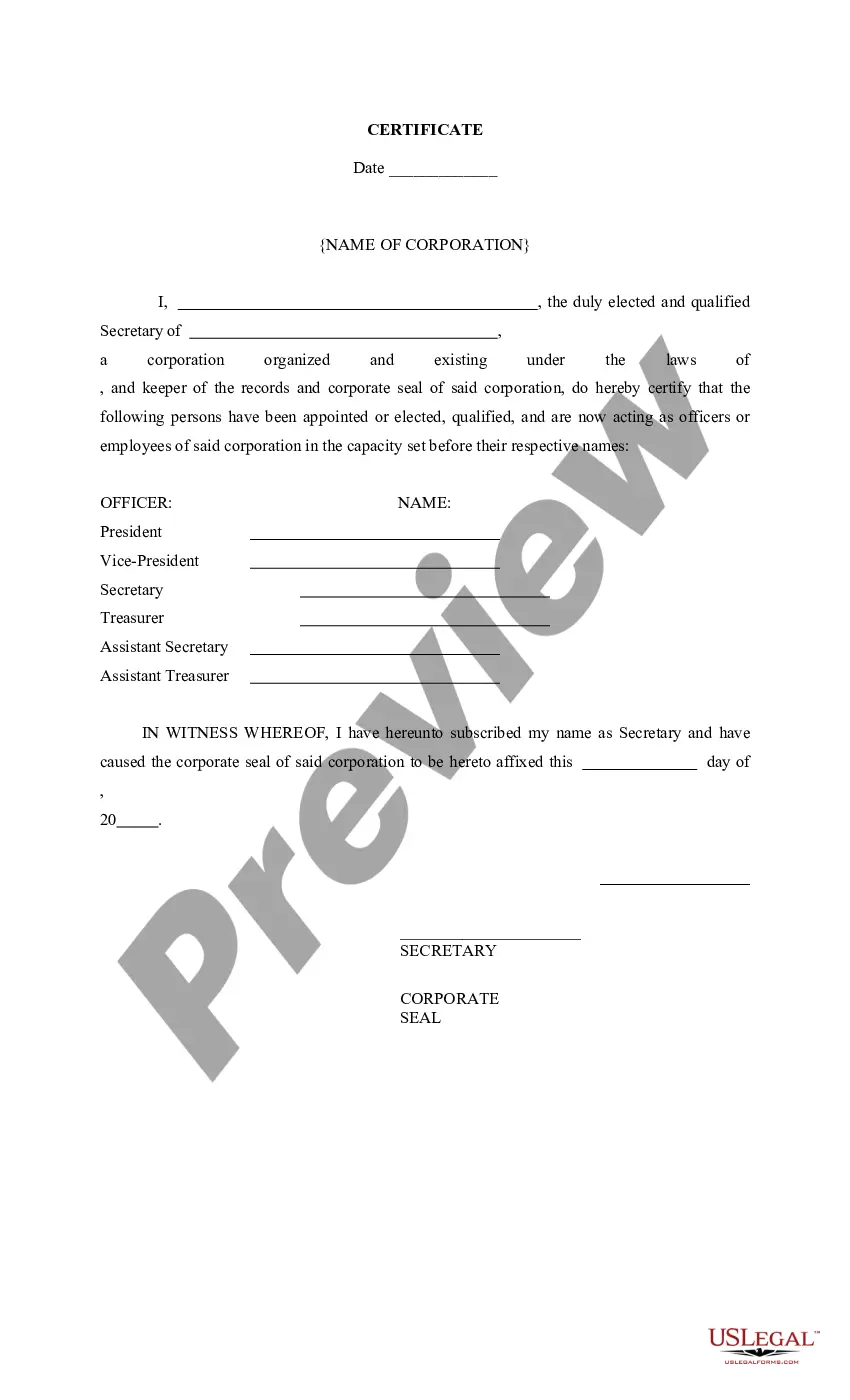
Corporation Corporate Officer For Blooming Flora In San Diego
Description
Get your form ready online
Our built-in tools help you complete, sign, share, and store your documents in one place.
Make edits, fill in missing information, and update formatting in US Legal Forms—just like you would in MS Word.
Download a copy, print it, send it by email, or mail it via USPS—whatever works best for your next step.
Sign and collect signatures with our SignNow integration. Send to multiple recipients, set reminders, and more. Go Premium to unlock E-Sign.
If this form requires notarization, complete it online through a secure video call—no need to meet a notary in person or wait for an appointment.
We protect your documents and personal data by following strict security and privacy standards.

Make edits, fill in missing information, and update formatting in US Legal Forms—just like you would in MS Word.

Download a copy, print it, send it by email, or mail it via USPS—whatever works best for your next step.

Sign and collect signatures with our SignNow integration. Send to multiple recipients, set reminders, and more. Go Premium to unlock E-Sign.

If this form requires notarization, complete it online through a secure video call—no need to meet a notary in person or wait for an appointment.

We protect your documents and personal data by following strict security and privacy standards.
Looking for another form?


Form popularity
FAQ
The Statement of Information contains information regarding the registered agent for the company, the principal officers and incumbent directors, along with other details of the organization.
An individual or a business entity must file a fictitious business name (FBN) statement with the Registrar-Recorder/County Clerk's office in the county where the business will be located when the name of the business does not include the owner's last name.
Corporations must file with the California Secretary of State every year, and Limited Liability Companies (LLC) and certain other organizations every two years.
A fictitious business name statement expires five years from the date it is filed in the County Clerk. A refile of a fictitious business name statement must be filed prior to the date of expiration if you intend to continue doing business under that name and if there are no changes from the original.
California Annual Report. All California corporations, nonprofits, and LLCs must file a California Statement of Information – also called a California Annual Report. This report must be filed with the California Secretary of State each year OR every other year – depending on what type of business you own.
Failure to file the required Statement of Information with the Secretary of State as outlined in statute may result in penalties being assessed by the Franchise Tax Board and suspension or forfeiture.
A Statement of Information must be filed either every year for California stock, cooperative, credit union, and all qualified out-of-state corporations or every two years (only in odd years or only in even years based on year of initial registration) for California nonprofit corporations and all California and ...
To submit Form SI-100, you may file it online at the California Secretary of State's website or mail it to the Statement of Information Unit at P.O. Box 944230, Sacramento, CA 94244-2300. For in-person submissions, visit the Sacramento office located at 1500 11th Street, Sacramento, CA 95814.
Directors add officers formally at an annual directors meeting but can do so at any time within the scope of the bylaws. After recording minutes of a decision, the directors notify California secretary of state to update its records of the articles of incorporation with a statement of information.
A Statement of Information must be filed either every year for California stock, cooperative, credit union, and all qualified out-of-state corporations or every two years (only in odd years or only in even years based on year of initial registration) for California nonprofit corporations and all California and ...