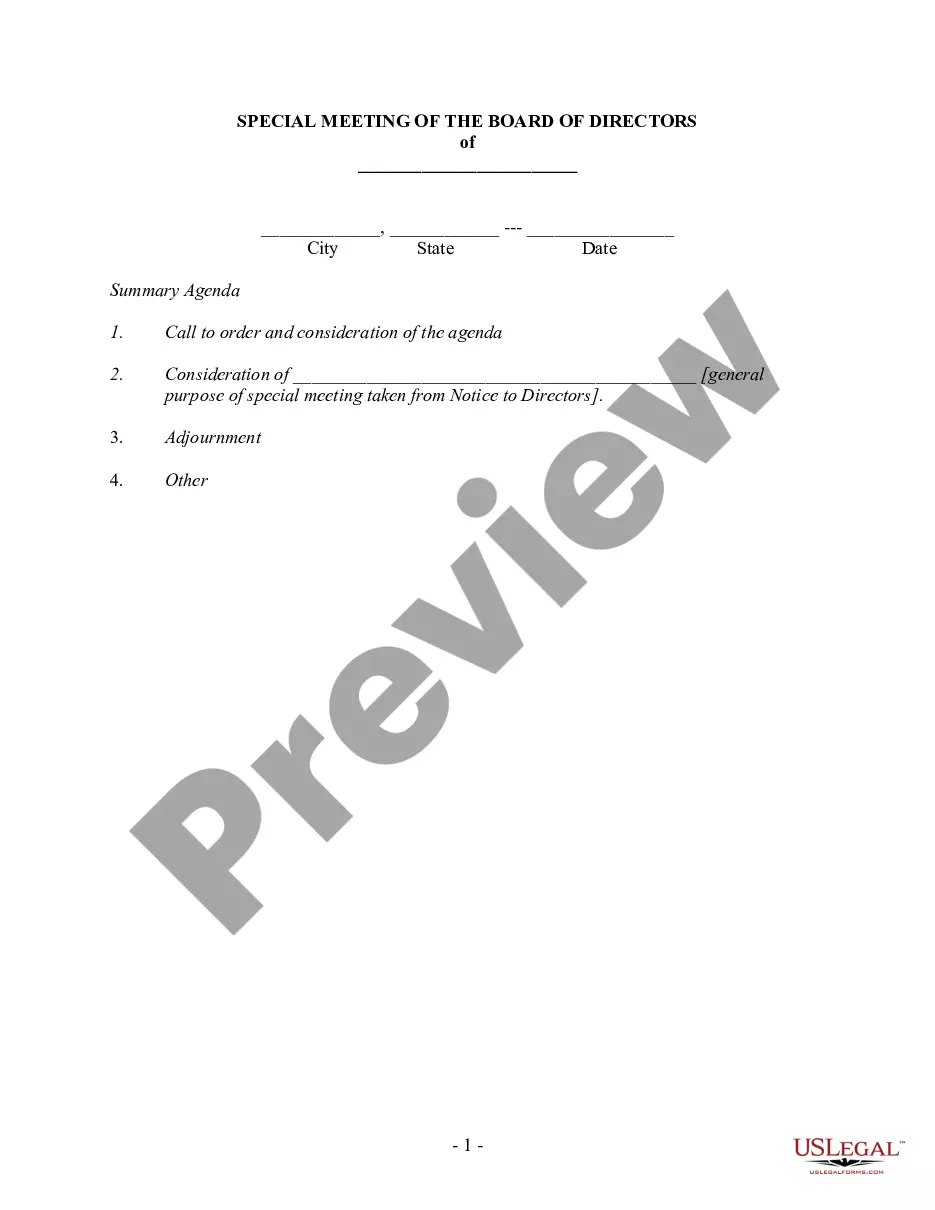
Annual Board Directors Template For Nonprofits In Utah
Description



Get your form ready online
Our built-in tools help you complete, sign, share, and store your documents in one place.
Make edits, fill in missing information, and update formatting in US Legal Forms—just like you would in MS Word.
Download a copy, print it, send it by email, or mail it via USPS—whatever works best for your next step.
Sign and collect signatures with our SignNow integration. Send to multiple recipients, set reminders, and more. Go Premium to unlock E-Sign.
If this form requires notarization, complete it online through a secure video call—no need to meet a notary in person or wait for an appointment.
We protect your documents and personal data by following strict security and privacy standards.

Make edits, fill in missing information, and update formatting in US Legal Forms—just like you would in MS Word.

Download a copy, print it, send it by email, or mail it via USPS—whatever works best for your next step.

Sign and collect signatures with our SignNow integration. Send to multiple recipients, set reminders, and more. Go Premium to unlock E-Sign.

If this form requires notarization, complete it online through a secure video call—no need to meet a notary in person or wait for an appointment.

We protect your documents and personal data by following strict security and privacy standards.
Looking for another form?







Form popularity
FAQ
Who Should Not Serve On A Board Of Directors? Those Who Lack Objectivity. People Who Are All Talk And No Action. Those Who Are Conflict-Averse. People Who Don't Play Well With Others. Those Who Are Greedy. People Who Are Resistant To Change. People Who Are Not Team Players. People Who Don't Believe in the Mission.
Nonprofit board member positions There are usually four Officers: President or Board Chair, Vice President or Vice Chair, Secretary, and Treasurer, and the terms unique to each will be defined in the nonprofit's bylaws. The president is the head of the board.
Yes, the founder of a nonprofit organization may serve on the board of directors and they usually do. However, refrain from adopting undemocratic terms or special considerations for the founder in the bylaws.
For publicly traded companies, boards typically comprise executive, nonexecutive, and independent directors elected by shareholders. This is known as a one-tier board structure. The board of directors often includes the CEO and sometimes the CFO of the company.
Yes, in order to satisfy state and IRS regulations for tax-exempt status, all 501c3 nonprofit organizations will need a board of directors.
Step 2: Recruit Incorporators and Board of Directors The board of directors make up the governing body of the nonprofit corporation and are committed to the purpose and success of the organization. The IRS requires a minimum of three unrelated individuals and Utah law requires them to be 18 years of age or older.
While affluent connections are always helpful, you should also consider board members with connections who have a passion for the mission, have a connection to those you serve, and who can help you better serve the community.
It is best practice to find individuals within the community who have the passion and experience that aligns with the nonprofit's mission. In addition, you probably want to choose board members who have experience in overseeing business affairs at some level.
Nonprofit charities are under the jurisdiction of state and national laws, so they must comply with both legal systems. With that in mind, the federal government requires a minimum of three board members to acquire coveted 501c3 tax-exempt status.
Hierarchical Org Chart In a nonprofit setting, this chart usually starts with the board of directors at the top, followed by the executive director, and then cascades down through various levels of management and staff. Pros: It follows a clear chain of command and provides transparent reporting lines.

