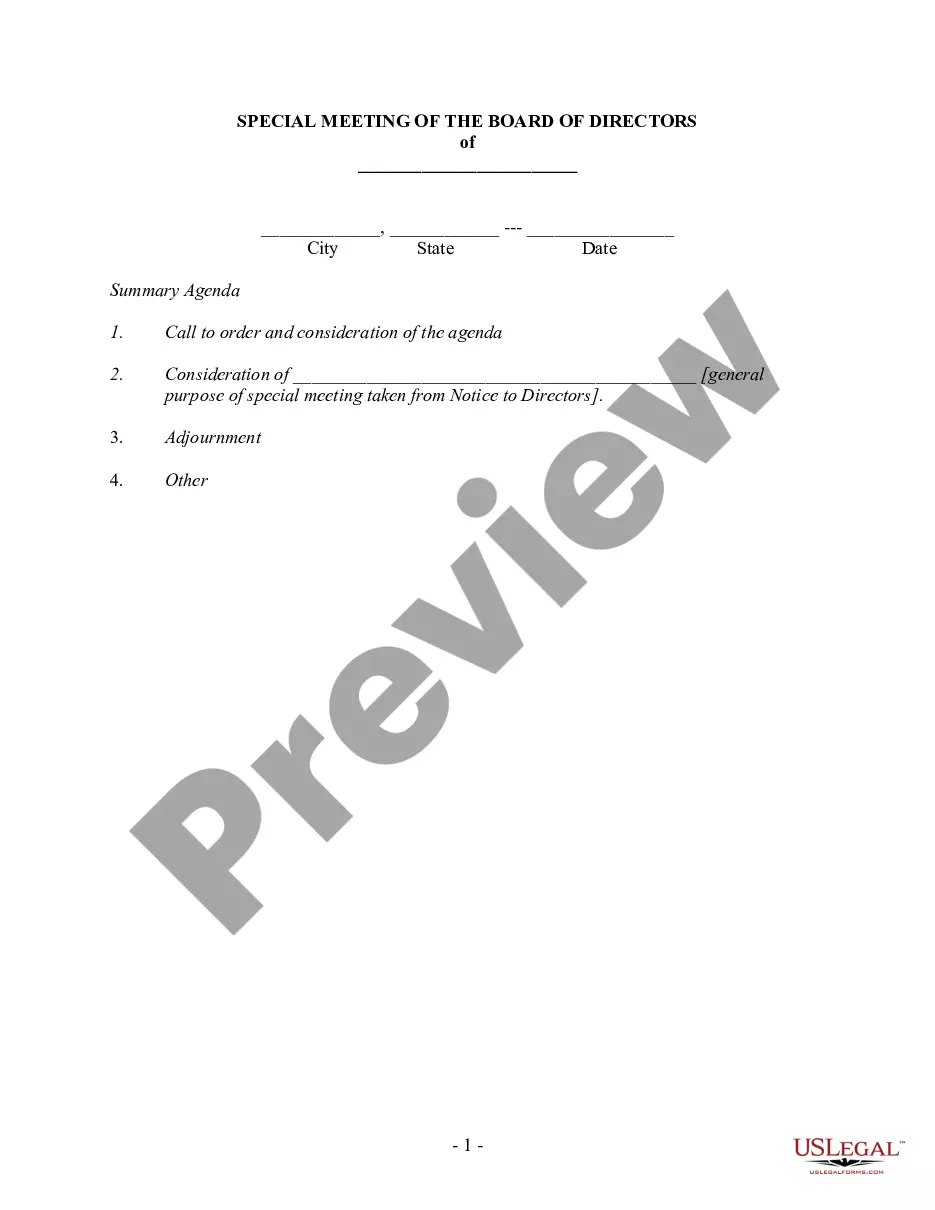
Annual Board Directors Template With Multiple Directors In San Jose
Description



Get your form ready online
Our built-in tools help you complete, sign, share, and store your documents in one place.
Make edits, fill in missing information, and update formatting in US Legal Forms—just like you would in MS Word.
Download a copy, print it, send it by email, or mail it via USPS—whatever works best for your next step.
Sign and collect signatures with our SignNow integration. Send to multiple recipients, set reminders, and more. Go Premium to unlock E-Sign.
If this form requires notarization, complete it online through a secure video call—no need to meet a notary in person or wait for an appointment.
We protect your documents and personal data by following strict security and privacy standards.

Make edits, fill in missing information, and update formatting in US Legal Forms—just like you would in MS Word.

Download a copy, print it, send it by email, or mail it via USPS—whatever works best for your next step.

Sign and collect signatures with our SignNow integration. Send to multiple recipients, set reminders, and more. Go Premium to unlock E-Sign.

If this form requires notarization, complete it online through a secure video call—no need to meet a notary in person or wait for an appointment.

We protect your documents and personal data by following strict security and privacy standards.
Looking for another form?








Form popularity
FAQ
Larger companies generally have monthly meetings. Smaller companies may find quarterly meetings more effective. The effect of board meetings will be weakened if there are too many. Limited companies must hold a board meeting if any director or shareholders representing more than 5% of voting rights request one.
In 2022, S&P 500 companies held an average of 7.5 formal board meetings, not only down from 9.1 in 2020, when the pandemic began, but also down from 7.8 before the pandemic. Russell 3000 companies also held 7.5 meetings on average, down from 9.5 meetings in 2020 and from 8.0 meetings annually before the pandemic.
1. DIRECTORS: Not less than three, unless there are only one or two shareholders of record, in which case the number of directors may be less than three but not less than the number of shareholders. 2. OFFICERS: The three required positions are President, Secretary and Treasurer.
The annual board of directors meeting is held to go over the details of the past year and decide on actions and strategies for the corporation for the next year. Keeping meeting minutes helps to ensure all these actions are documented in the corporate record.
The job of a board of directors is to provide oversight for the company, which means they need to be regularly updated on the company's status and recent developments. For this reason, most boards meet at least once a quarter.
The annual meeting should be held on the date and time designated in the bylaws. All shareholders who are entitled to vote are entitled to written notice of the annual meeting as well as any special meeting. Notice must include the date, time and place of the meeting and how shareholders may attend.
Board meetings should be scheduled on a periodic basis in ance with the organization's bylaws. While most states require only one meeting per year, best practices suggest a minimum of four meetings per year.
Every company shall hold minimum 4(four) board meetings each year. Here "year" means calendar year (from January to December) and not financial year of the company. Gap between Two consecutive board meetings should not be more than 120 days as prescribed under section 173(1).
What Goes Into a Report for the Board of Directors? Date. Name of committee. Name of committee chair. Names of committee members. The objective of the committee. Summary of recent accomplishments and current activities. List of activities in progress and upcoming events. Financial impact.
A nonprofit's structure typically includes a board of directors, executive director or CEO, staff, and volunteers. The board sets policies and oversees the organization, while the executive director manages daily operations.
