Director In Meeting In Chicago
Description



Get your form ready online
Our built-in tools help you complete, sign, share, and store your documents in one place.
Make edits, fill in missing information, and update formatting in US Legal Forms—just like you would in MS Word.
Download a copy, print it, send it by email, or mail it via USPS—whatever works best for your next step.
Sign and collect signatures with our SignNow integration. Send to multiple recipients, set reminders, and more. Go Premium to unlock E-Sign.
If this form requires notarization, complete it online through a secure video call—no need to meet a notary in person or wait for an appointment.
We protect your documents and personal data by following strict security and privacy standards.

Make edits, fill in missing information, and update formatting in US Legal Forms—just like you would in MS Word.

Download a copy, print it, send it by email, or mail it via USPS—whatever works best for your next step.

Sign and collect signatures with our SignNow integration. Send to multiple recipients, set reminders, and more. Go Premium to unlock E-Sign.

If this form requires notarization, complete it online through a secure video call—no need to meet a notary in person or wait for an appointment.

We protect your documents and personal data by following strict security and privacy standards.
Looking for another form?







Form popularity
FAQ
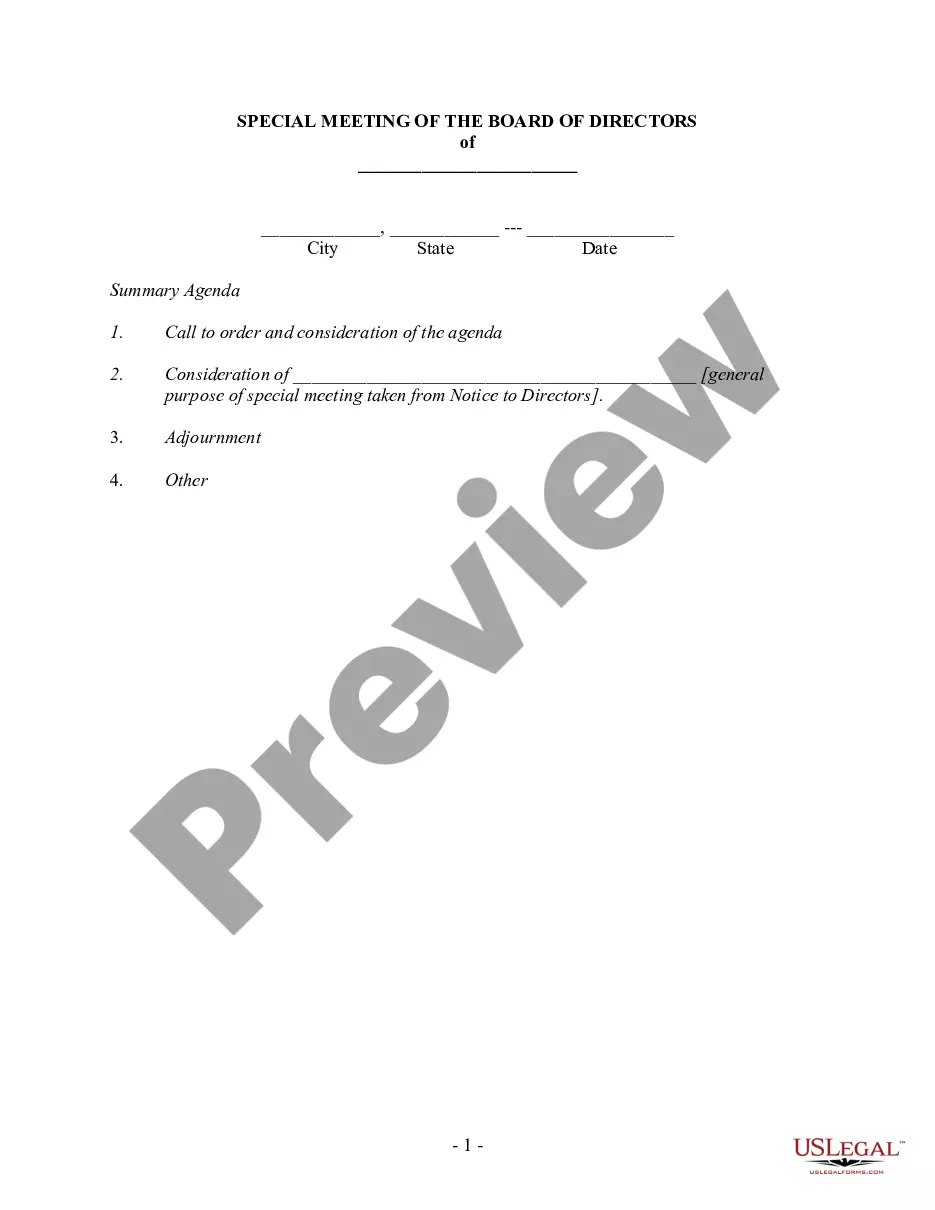
Most board meeting agendas follow a classic meeting structure: Calling meeting to order – ensure you have quorum. Approve the agenda and prior board meeting minutes. Executive and committee reports – allow 25% of time here for key topic discussion. Old/new/other business. Close the meeting and adjourn.
Board meetings typically focus on the internal workings and decisions of a company, which is why they will involve the entire board of directors. Key agenda items relating to the business will often be discussed which is why this type of meeting will often require board meeting minutes to be kept.
Topics on the agenda at this meeting include adopting the by-laws, authorizing the issuance of shares, appointing officers, appointing an auditor, and more. The by-laws are the internal rules of the corporation.
When addressing the board, always use the title Mr. Chairman” or Madam Chairwoman.” If you are unsure of the proper title, Board of Directors” is always acceptable. When speaking to the board, always refer to them as sir” or ma'am.”
(1) Any director may call a directors' meeting. (2) The company secretary must call a directors' meeting if a director so requests. (3) A directors' meeting is called by giving notice of the meeting to the directors.
12 tips for having a good meeting with your boss Establish what you'll go over with your boss. Make a list of items you want to discuss during the meeting. View the meeting as a positive opportunity. Come up with ideas and solutions for problems. Confirm your meeting time the day before. Bring a notepad with you.
Board meetings typically focus on the internal workings and decisions of a company, which is why they will involve the entire board of directors. Key agenda items relating to the business will often be discussed which is why this type of meeting will often require board meeting minutes to be kept.
Board meetings are formal gatherings held by the board of directors that aim to discuss major problems, areas of concern, vote on decisions, review performance, consider policy issues, and, in some cases, perform the legal duties of the board.
Salary for a Front Office Executive in India ranges between ₹1.0 Lakhs to ₹4.5 Lakhs per year.
Your role as a director is to participate in board meetings to enable the board to reach these decisions and make sure that the company's obligations are fulfilled. The directors are effectively the agents of the company, appointed by the shareholders to manage the company's day-to-day affairs.

