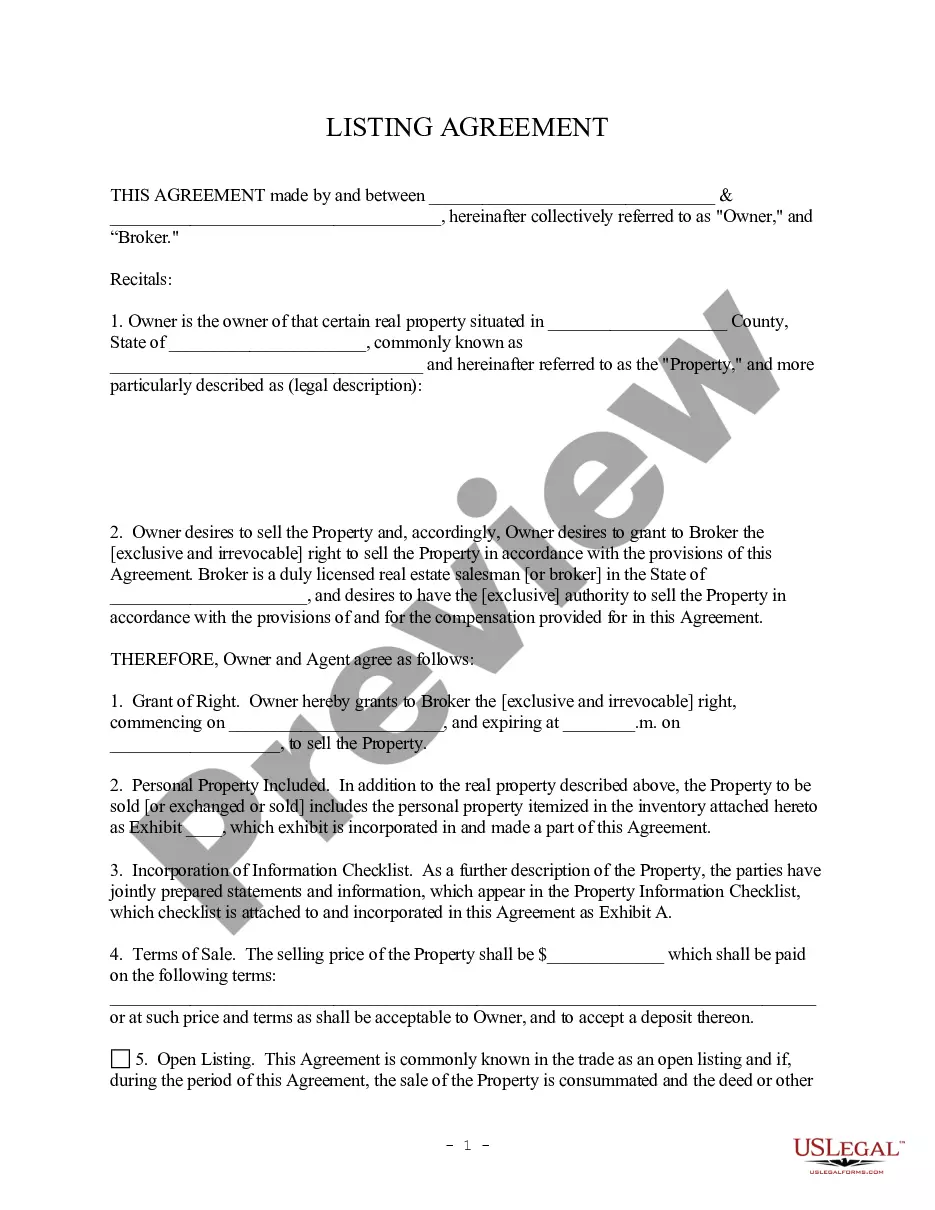
Listing Agreement Contract With Corporate Governance In San Jose
Description
Get your form ready online
Our built-in tools help you complete, sign, share, and store your documents in one place.
Make edits, fill in missing information, and update formatting in US Legal Forms—just like you would in MS Word.
Download a copy, print it, send it by email, or mail it via USPS—whatever works best for your next step.
Sign and collect signatures with our SignNow integration. Send to multiple recipients, set reminders, and more. Go Premium to unlock E-Sign.
If this form requires notarization, complete it online through a secure video call—no need to meet a notary in person or wait for an appointment.
We protect your documents and personal data by following strict security and privacy standards.

Make edits, fill in missing information, and update formatting in US Legal Forms—just like you would in MS Word.

Download a copy, print it, send it by email, or mail it via USPS—whatever works best for your next step.

Sign and collect signatures with our SignNow integration. Send to multiple recipients, set reminders, and more. Go Premium to unlock E-Sign.

If this form requires notarization, complete it online through a secure video call—no need to meet a notary in person or wait for an appointment.

We protect your documents and personal data by following strict security and privacy standards.
Looking for another form?
Form popularity
FAQ
A listing agreement is a legally binding contract between you — the homeowner — and the real estate broker (and agent) you hire to sell your property. It's a contract that outlines the realtor-seller relationship during a real estate transaction.
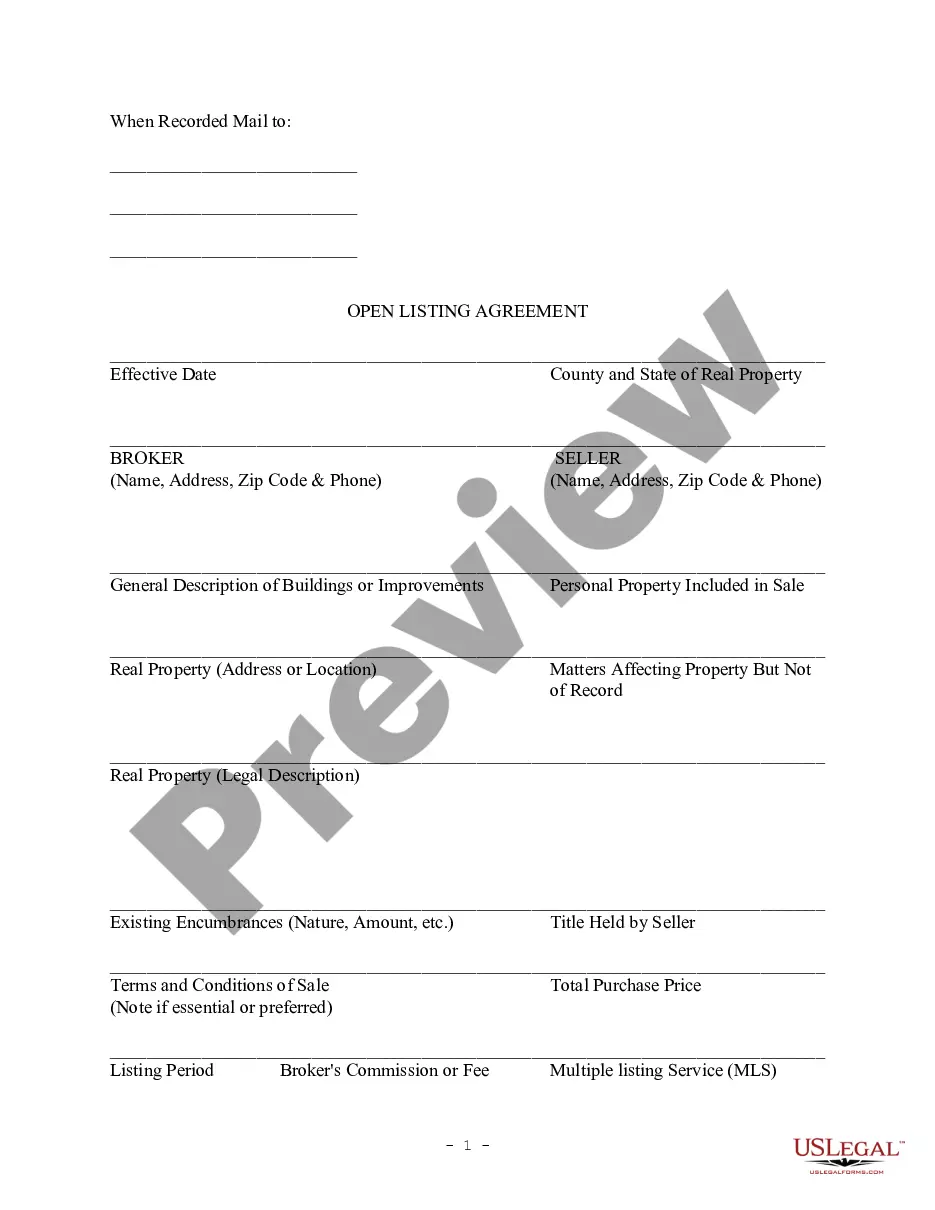
The three types of real estate listing agreements are open listing, exclusive agency listing, and exclusive right-to-sell listing.
Regulatory Compliance: A listing agreement lays out the various terms, conditions, and covenants which a company agrees to comply with, as per the regulations of the securities and exchange board. This is crucial for maintaining transparency, investor protection, and overall market integrity.
A "listing agreement" is a contract between a real estate agent or broker (the industry professional who will be listing the property for sale) and a home seller.
Although a document must be signed by each party to be considered legally binding, the mere presence of signatures does not guarantee that an agreement is enforceable in court. To be considered a legally binding contract or document, three critical elements must also be present: Subject, Consideration, and Capacity.
A "listing agreement" is a contract between a real estate agent or broker (the industry professional who will be listing the property for sale) and a home seller.
An addendum can be used to change, add to, or update the information found in the original contract. They're usually dated and signed and refer back to specific parts of the contract.
All parties must agree to in writing to any changes. The listing agent is the only one that can make changes to the listing contract. All changes can be made by attaching a hand-written note to the existing contact. All parties must agree to in writing to any changes.
While terminating a listing agreement is an option, it should be considered a last resort after exploring all possible avenues for communication and clarification. For Ontario-specific insights, the Real Estate Council of Ontario (RECO) and the Ontario Real Estate Association (OREA) offer valuable resources.
To avoid such predatory practices, California enacted Civil Code 1670.12 and Government Code 27280.6, which took effect January 1, 2024, prohibiting an exclusive listing agreement to last longer than 24 months or to renew such a listing for longer than 12 months.

