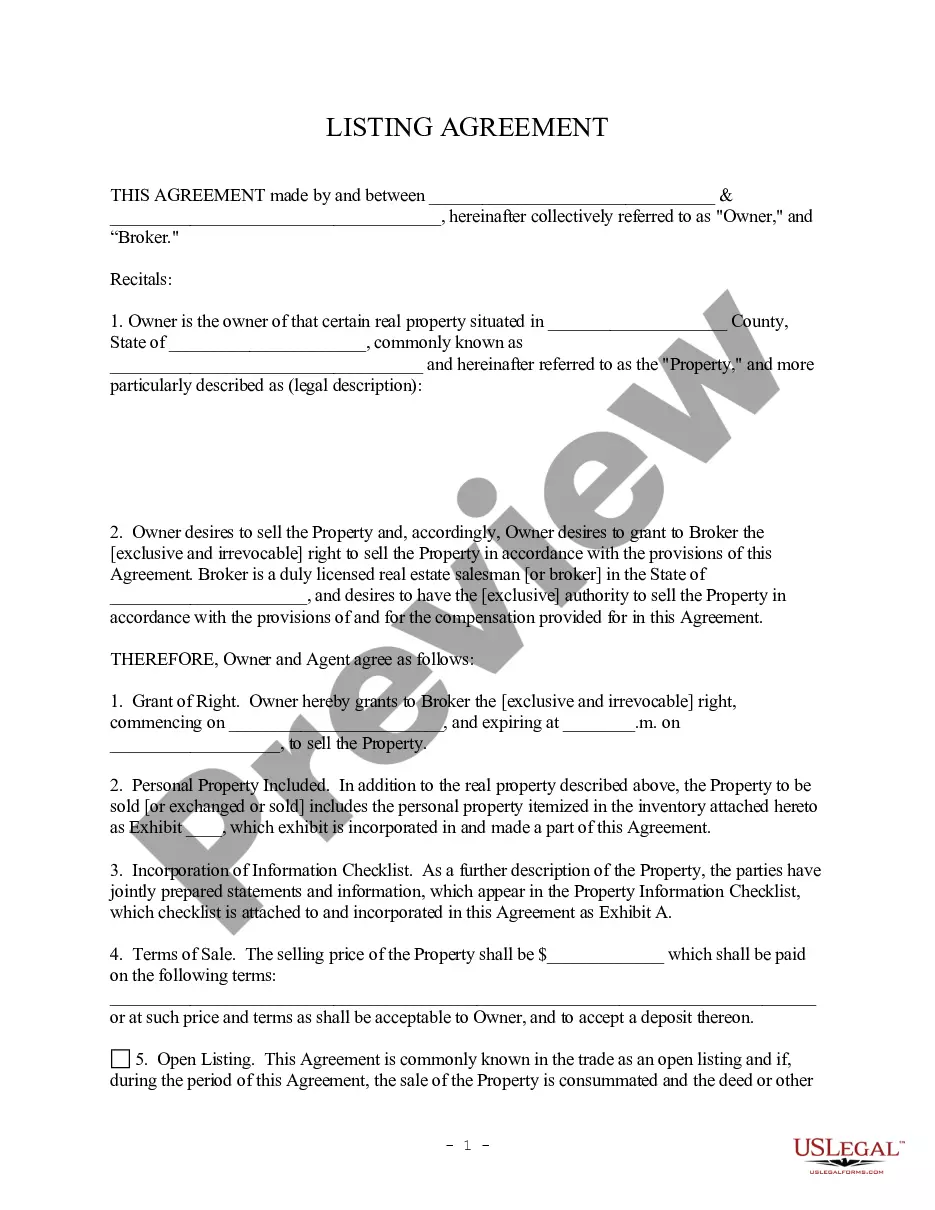
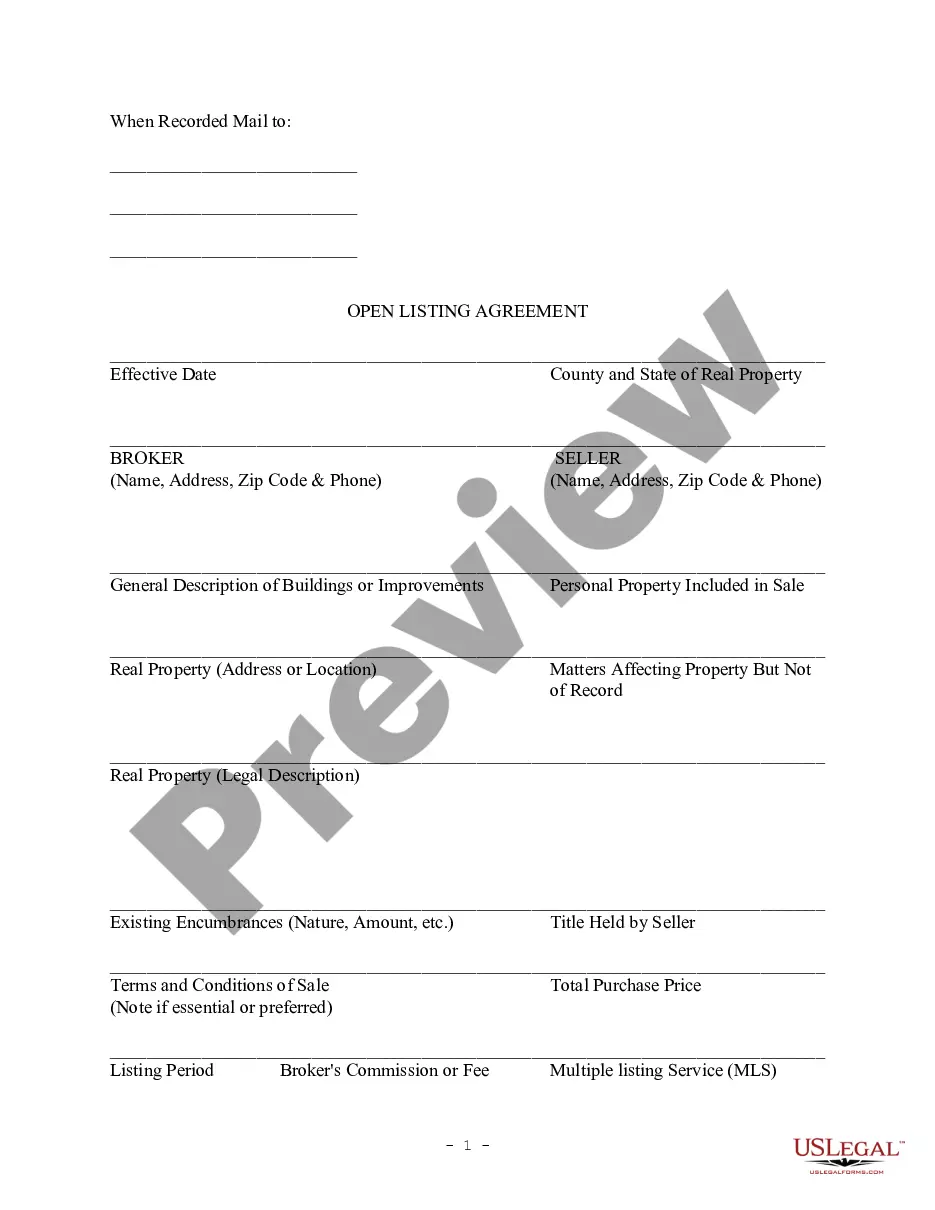
Listing Agreement Document For Land In Maryland
Description

Get your form ready online
Our built-in tools help you complete, sign, share, and store your documents in one place.
Make edits, fill in missing information, and update formatting in US Legal Forms—just like you would in MS Word.
Download a copy, print it, send it by email, or mail it via USPS—whatever works best for your next step.
Sign and collect signatures with our SignNow integration. Send to multiple recipients, set reminders, and more. Go Premium to unlock E-Sign.
If this form requires notarization, complete it online through a secure video call—no need to meet a notary in person or wait for an appointment.
We protect your documents and personal data by following strict security and privacy standards.

Make edits, fill in missing information, and update formatting in US Legal Forms—just like you would in MS Word.

Download a copy, print it, send it by email, or mail it via USPS—whatever works best for your next step.

Sign and collect signatures with our SignNow integration. Send to multiple recipients, set reminders, and more. Go Premium to unlock E-Sign.

If this form requires notarization, complete it online through a secure video call—no need to meet a notary in person or wait for an appointment.

We protect your documents and personal data by following strict security and privacy standards.
Looking for another form?







Form popularity
FAQ
The three types of real estate listing agreements are open listing, exclusive agency listing, and exclusive right-to-sell listing.
Some property owners may lean toward an open listing because it can sell a property faster. However, it's typically not favored by listing agents because it increases competition and can lead to shared commission costs. Some brokerages may not allow this type of listing agreement.
Open listing: Definition An open listing enables multiple real estate agents to try to sell your home. This setup gives the seller the ability to work with multiple agents at once. This differs from an exclusive listing, in which the seller works exclusively with one listing agent to find a buyer.
In an open listing, the person who takes the biggest risk is the seller. This is because in an open listing, the seller is not working exclusively with one agent, and therefore, has to rely on multiple agents to sell their property.
Here are the steps to write a letter of agreement: Title the document. Add the title at the top of the document. List your personal information. Include the date. Add the recipient's personal information. Address the recipient. Write an introduction paragraph. Write your body. Conclude the letter.
Writing your own contracts is perfectly possible, and legal. But it's also an incredibly bad idea. There's two reasons for this: Property law is complicated. Because it's such a fundamental part of legislation, it's often lots and lots of different laws layered on top of each other.
How to draft a contract between two parties: A step-by-step checklist Know your parties. Agree on the terms. Set clear boundaries. Spell out the consequences. Specify how you will resolve disputes. Cover confidentiality. Check the legality of the contract. Open it up to negotiation.
If you're open to new ideas and a fresh approach and you want to learn how to get more listings, keep reading! Start with your sphere. Grow your sphere consistently and purposefully. Prospect old expired listings. Door knock the neighborhoods you want to work in. Host open houses for other agents. Host open houses for FSBOs.
Though notarization is not required, it may still be a good idea to have a notary present in order to verify the identities of all signers.
A listing agreement is a contract between a property owner and a real estate broker that authorizes the broker to represent the seller and find a buyer for the property. The three types of real estate listing agreements are open listing, exclusive agency listing, and exclusive right-to-sell listing.
