Sample Performance Bonus Policy In San Bernardino
Description
Get your form ready online
Our built-in tools help you complete, sign, share, and store your documents in one place.
Make edits, fill in missing information, and update formatting in US Legal Forms—just like you would in MS Word.
Download a copy, print it, send it by email, or mail it via USPS—whatever works best for your next step.
Sign and collect signatures with our SignNow integration. Send to multiple recipients, set reminders, and more. Go Premium to unlock E-Sign.
If this form requires notarization, complete it online through a secure video call—no need to meet a notary in person or wait for an appointment.
We protect your documents and personal data by following strict security and privacy standards.

Make edits, fill in missing information, and update formatting in US Legal Forms—just like you would in MS Word.

Download a copy, print it, send it by email, or mail it via USPS—whatever works best for your next step.

Sign and collect signatures with our SignNow integration. Send to multiple recipients, set reminders, and more. Go Premium to unlock E-Sign.

If this form requires notarization, complete it online through a secure video call—no need to meet a notary in person or wait for an appointment.

We protect your documents and personal data by following strict security and privacy standards.
Looking for another form?

Form popularity
FAQ
A common structure is tiered bonuses. Here, employees can achieve different "levels" of bonuses based on their performance metrics. For instance, reaching 80% of a target might secure a smaller bonus, while achieving 120% may earn a significantly larger one.
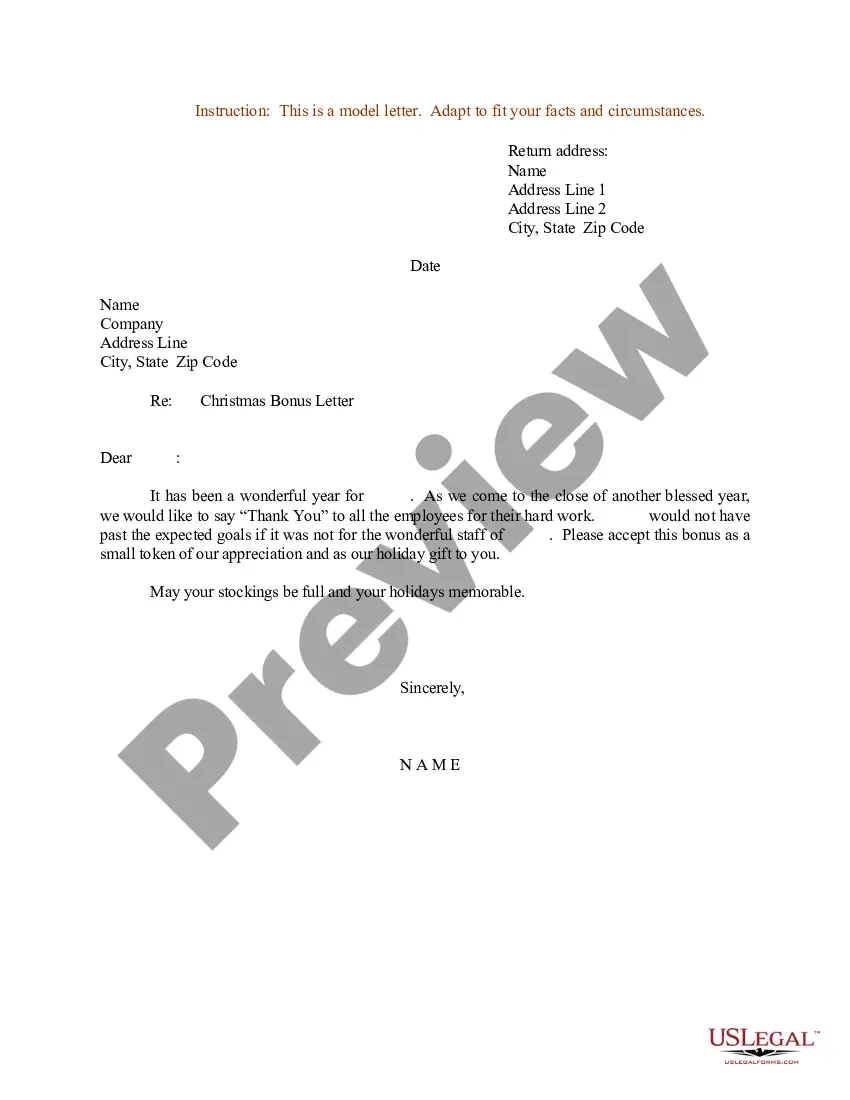
Dear Employee Name, We are pleased to present you with your year award in the amount of $__. This bonus award reflects your excellent performance, the contributions you made and the goals achieved on behalf of Company Name during the past year.
HP is a good example of a company that uses a form of an MBO bonus plan. Their employee rewards and recognition program encourages their staff to work "wherever they feel most productive," directly linking output with reward. Additionally, they offered a $200 bonus to all frontline employees during the pandemic.
Simply put, these bonuses are awarded based on how well the company performs as a whole. A typical profit-sharing bonus would be 2.5% to 7.5% of payroll, and bonuses might be given across the board or in larger proportions of compensation for high earners within your organization.
Performance bonuses vary widely depending on the industry, company, and individual performance metrics. Generally, a typical reward might range from 5% to 20% of an employee's base salary, but it can also be a fixed amount. What is the difference between an incentive and a performance bonus?
The typical bonus amount can range from 1% to 15% of an employee's salary, usually depending on a number of factors such as industry, company performance, and individual or team accomplishments. The average bonus for employees continues to rise over time. In 2020, the average employee bonus was only 8.1%.
Role, level, and seniority Executives typically receive higher bonuses in line with their performance (10–30% of their salary for an annual bonus). This higher compensation is designed to reflect their strategic decision-making and leadership roles.
Executives receive higher bonuses that can multiply based on performance, while most employees earn bonuses equal to 1% to 5% of their overall salary.

