Employment Discrimination For Ada In San Jose
Description




Get your form ready online
Our built-in tools help you complete, sign, share, and store your documents in one place.
Make edits, fill in missing information, and update formatting in US Legal Forms—just like you would in MS Word.
Download a copy, print it, send it by email, or mail it via USPS—whatever works best for your next step.
Sign and collect signatures with our SignNow integration. Send to multiple recipients, set reminders, and more. Go Premium to unlock E-Sign.
If this form requires notarization, complete it online through a secure video call—no need to meet a notary in person or wait for an appointment.
We protect your documents and personal data by following strict security and privacy standards.

Make edits, fill in missing information, and update formatting in US Legal Forms—just like you would in MS Word.

Download a copy, print it, send it by email, or mail it via USPS—whatever works best for your next step.

Sign and collect signatures with our SignNow integration. Send to multiple recipients, set reminders, and more. Go Premium to unlock E-Sign.

If this form requires notarization, complete it online through a secure video call—no need to meet a notary in person or wait for an appointment.

We protect your documents and personal data by following strict security and privacy standards.
Looking for another form?

Form popularity
FAQ
Under the Act, a plaintiff is required to present evidence that he or she (1) suffers from a disability, (2) is a qualified individual, and (3) was subjected to an adverse employment action because of the disability.
An individual with a disability is defined by the ADA as a person who has a physical or mental impairment that substantially limits one or more major life activities, a person who has a history or record of such an impairment, or a person who is perceived by others as having such an impairment.
Complaints that a program, service, or activity of CDI is not accessible to persons with disabilities should be directed to ADA Coordinator at 916-492-3388 or by e-mail the ADA Coordinator.
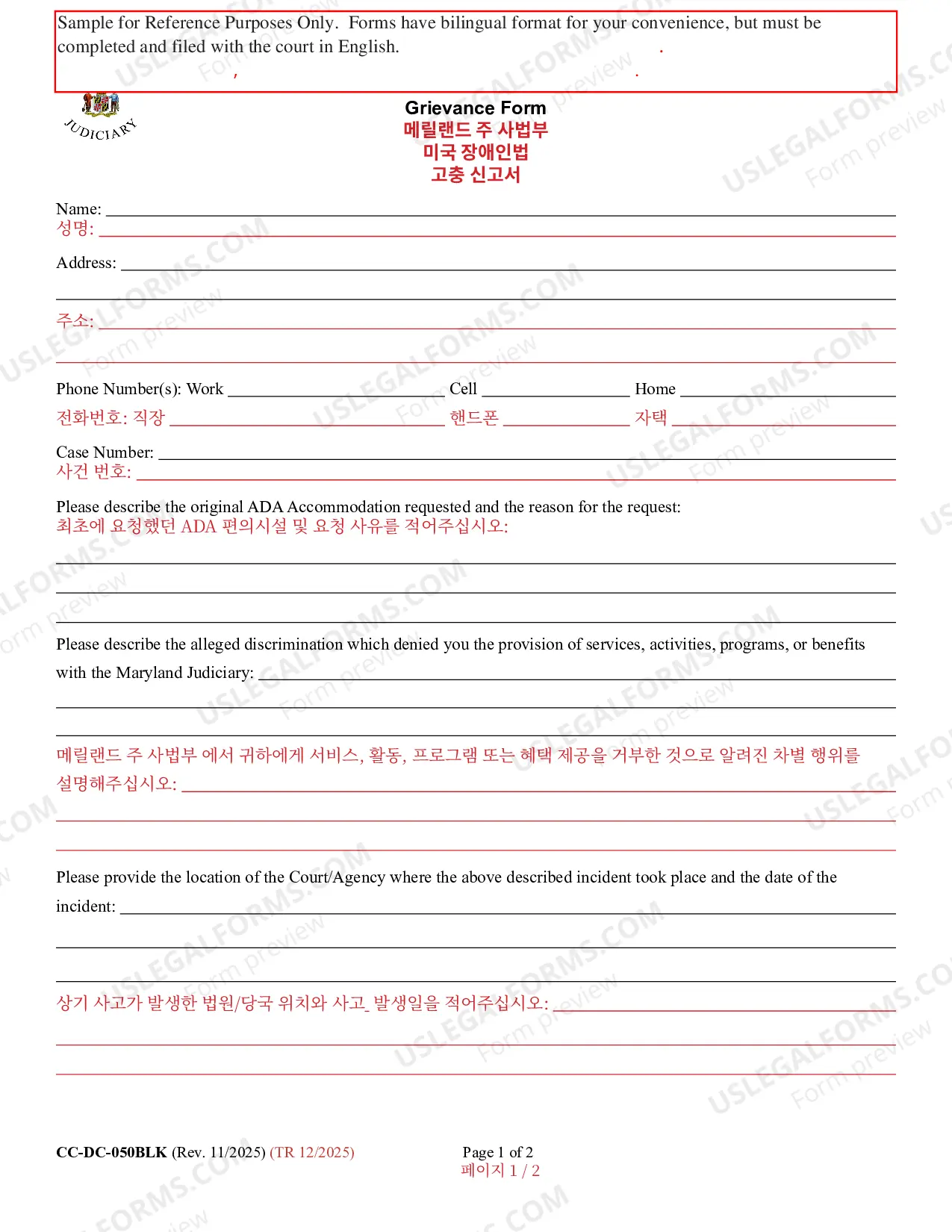
There are two options for filing an ADA complaint: Online. File a complaint by submitting a report on the Department of Justice's Civil Rights Division website. Mail. Fill out and send the paper ADA Complaint Form (Regular Format | Large Format) or a letter containing the same information, to: U.S. Department of Justice.
To establish a prima facie case of disability discrimination against an employer under the ADA requires an employee to show four elements: the employer is subject to the ADA; the employee is disabled as defined by the ADA, has a record of impairment, or is perceived to be so by the employer; the employee is able to ...
There are two options for filing an ADA complaint: Online. File a complaint by submitting a report on the Department of Justice's Civil Rights Division website. Mail. Fill out and send the paper ADA Complaint Form (Regular Format | Large Format) or a letter containing the same information, to: U.S. Department of Justice.
Initiate the process by verbally telling your employer that you have a condition affecting your ability to work. You don't need to use formal language or explicitly ask for an accommodation. Written disclosure. Inform your employer of your disability in writing instead of verbally to start the interactive process.
You can file an ADA complaint alleging disability discrimination against a state or local government (Title II) or a public accommodation (Title III - including, for example, a restaurant, doctor's office, retail store, hotel, etc.)
The ADA requires reasonable accommodations as they relate to three aspects of employment: 1) ensuring equal opportunity in the application process; 2) enabling a qualified individual with a disability to perform the essential functions of a job; and 3) making it possible for an employee with a disability to enjoy equal ...
I see why there is some confusion. Technically, before you can sue in civil court for an ADA violation, you must first file a complaint with the EEOC. You can immediately request a right to sue letter, or you can wait for EEOC to investigate, which can take up to 18 months. So that's the law suit avenue.