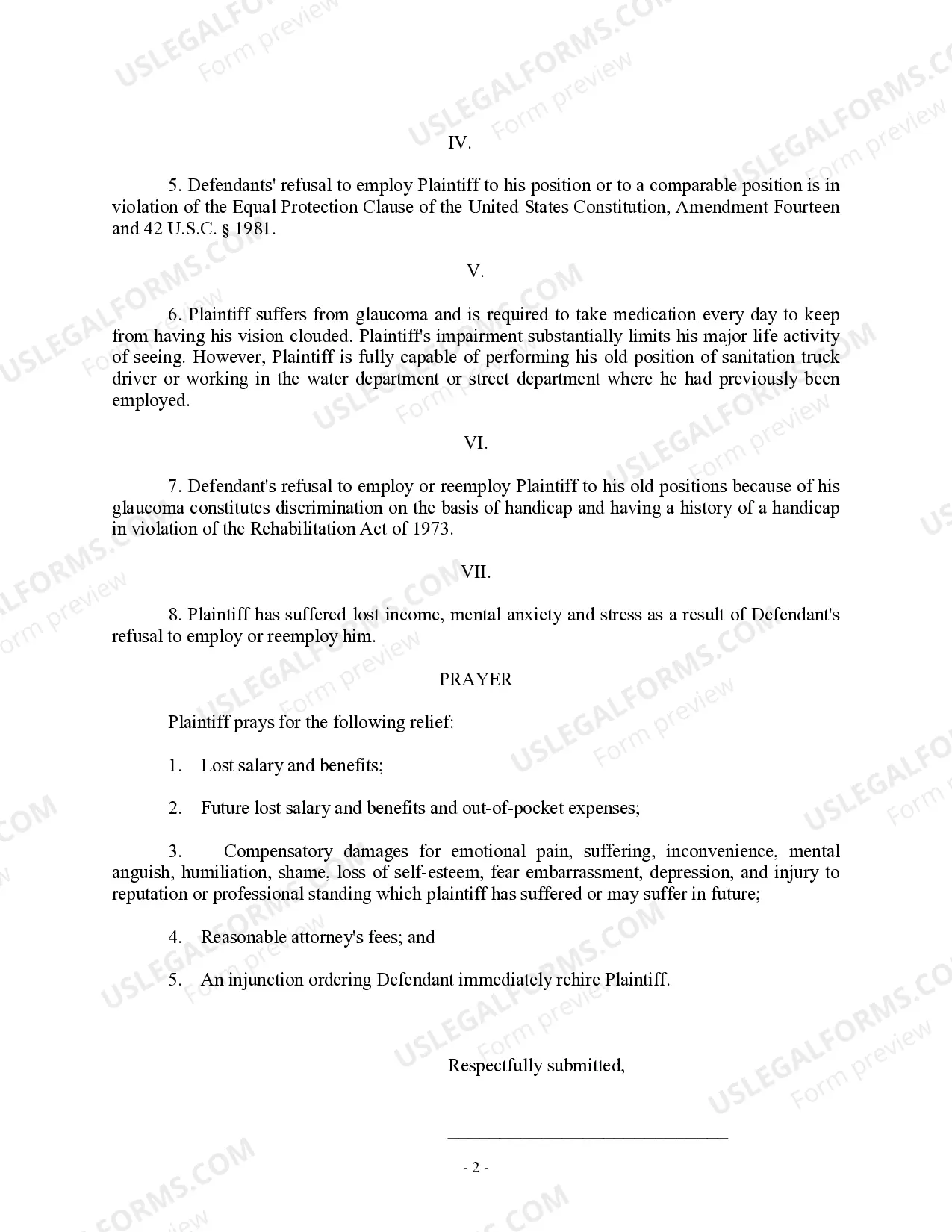
Plaintiff seeks to recover actual, compensatory, liquidated, and punitive damages for discrimination based upon discrimination concerning his disability. Plaintiff submits a request to the court for lost salary and benefits, future lost salary and benefits, and compensatory damages for emotional pain and suffering.
Discrimination With Religion In Ohio
State:
Multi-State
Category:
Control #:
US-000286
Format:
Word;
Rich Text
143 downloads
Description
Free preview





Get your form ready online
Our built-in tools help you complete, sign, share, and store your documents in one place.
Built-in online Word editor
Make edits, fill in missing information, and update formatting in US Legal Forms—just like you would in MS Word.
Export easily
Download a copy, print it, send it by email, or mail it via USPS—whatever works best for your next step.
E-sign your document
Sign and collect signatures with our SignNow integration. Send to multiple recipients, set reminders, and more. Go Premium to unlock E-Sign.
Notarize online 24/7
If this form requires notarization, complete it online through a secure video call—no need to meet a notary in person or wait for an appointment.
Store your document securely
We protect your documents and personal data by following strict security and privacy standards.

Make edits, fill in missing information, and update formatting in US Legal Forms—just like you would in MS Word.

Download a copy, print it, send it by email, or mail it via USPS—whatever works best for your next step.

Sign and collect signatures with our SignNow integration. Send to multiple recipients, set reminders, and more. Go Premium to unlock E-Sign.

If this form requires notarization, complete it online through a secure video call—no need to meet a notary in person or wait for an appointment.

We protect your documents and personal data by following strict security and privacy standards.
Looking for another form?







Form popularity
FAQ
In recent years, terms such as religism and religionism have also been used, but "religious discrimination" remains the more widely used term.
Religious discrimination means mistreating someone because of their religious beliefs. At work, religious discrimination can include refusing to hire a Muslim job applicant for their beliefs, firing someone for celebrating Jewish holidays, or refusing to promote someone because they are an atheist.
Under Title VII, employees typically have four different ways to assert religious discrimination: wrongful termination, disparate treatment, hostile work environment, and failure to accommodate.
Proving religious discrimination The harassment occurred because of, or was motivated by, religion. The conduct was pervasive or severe. The conduct had a detrimental effect on the plaintiff and. The harassment would have had such an effect on a reasonable person of the same religion in that position.
Proving religious discrimination The harassment occurred because of, or was motivated by, religion. The conduct was pervasive or severe. The conduct had a detrimental effect on the plaintiff and. The harassment would have had such an effect on a reasonable person of the same religion in that position.
Ways to Address Religious Discrimination at Work Call it out. Call the person's attention if you experience direct or indirect discrimination because of your faith. Speak to the person's manager. File a complaint. Have legal assistance.
To prove you have been discriminated against because of your religious attire, you first have to show three things: 1) your sincere religious belief requires you to wear certain attire, 2) your employer (or potential employer) has indicated that wearing the religious attire conflicts with a job requirement, and that ...
If you win your case, you are eligible to recover income you would have earned had there been no discrimination. For instance, if you made a salary of $85,000 per year, and were terminated because of your religious beliefs, you could be awarded $85,000 for every year you couldn't find work.
A. Religious discrimination is treating individuals differently because of their religious beliefs and practices, and/or their request for accommodations of their religious beliefs and practices. It also includes treating individuals differently because of their lack of religious beliefs or practices.