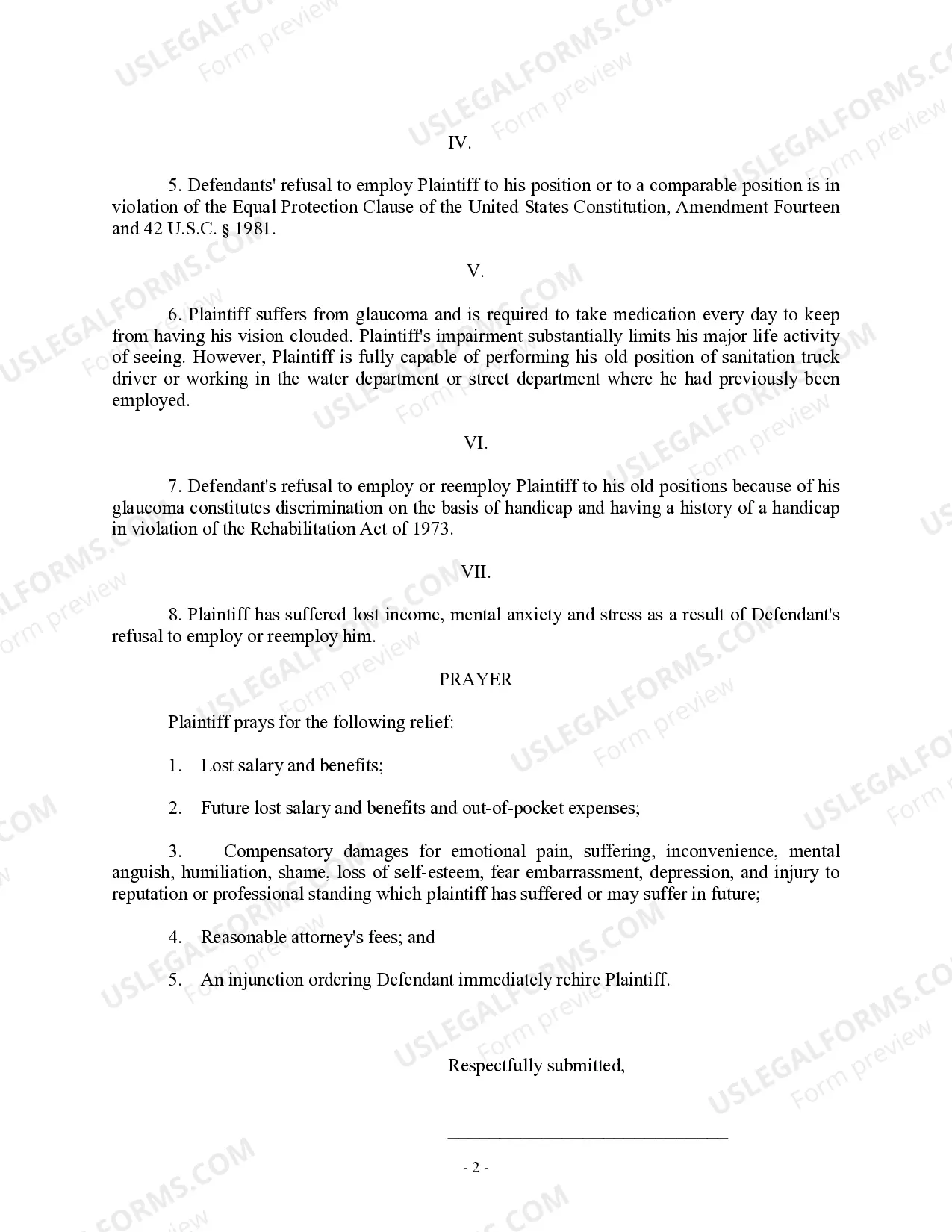
Plaintiff seeks to recover actual, compensatory, liquidated, and punitive damages for discrimination based upon discrimination concerning his disability. Plaintiff submits a request to the court for lost salary and benefits, future lost salary and benefits, and compensatory damages for emotional pain and suffering.
With Discriminatory Power In Franklin
State:
Multi-State
Category:
County:
Franklin
Control #:
US-000286
Format:
Word;
Rich Text
143 downloads
Description
Free preview





Get your form ready online
Our built-in tools help you complete, sign, share, and store your documents in one place.
Built-in online Word editor
Make edits, fill in missing information, and update formatting in US Legal Forms—just like you would in MS Word.
Export easily
Download a copy, print it, send it by email, or mail it via USPS—whatever works best for your next step.
E-sign your document
Sign and collect signatures with our SignNow integration. Send to multiple recipients, set reminders, and more. Go Premium to unlock E-Sign.
Notarize online 24/7
If this form requires notarization, complete it online through a secure video call—no need to meet a notary in person or wait for an appointment.
Store your document securely
We protect your documents and personal data by following strict security and privacy standards.

Make edits, fill in missing information, and update formatting in US Legal Forms—just like you would in MS Word.

Download a copy, print it, send it by email, or mail it via USPS—whatever works best for your next step.

Sign and collect signatures with our SignNow integration. Send to multiple recipients, set reminders, and more. Go Premium to unlock E-Sign.

If this form requires notarization, complete it online through a secure video call—no need to meet a notary in person or wait for an appointment.

We protect your documents and personal data by following strict security and privacy standards.
Looking for another form?




Form popularity
FAQ
Harassment is a form of employment discrimination that violates Title VII of the Civil Rights Act of 1964, the Age Discrimination in Employment Act of 1967, (ADEA), and the Americans with Disabilities Act of 1990, (ADA).
A: In a sexual harassment claim, the four main elements the victim must demonstrate are that they are a member of a protected class, they were subjected to workplace sexual harassment, the harassment was based on their characteristic as a protected class, and that the harassment was severe or pervasive enough that it ...
Examples of harassment include offensive or derogatory jokes, racial or ethnic slurs, pressure for dates or sexual favors, unwelcome comments about a person's religion or religious garments, or offensive graffiti, cartoons or pictures.
Harassment is a form of employment discrimination that violates Title VII of the Civil Rights Act of 1964, the Age Discrimination in Employment Act of 1967, (ADEA), and the Americans with Disabilities Act of 1990, (ADA).
Harassment of an employee is a form of unfair discrimination. The most common form of harassment reported is sexual harassment, but harassment may also occur on any of the grounds listed in the section above headed “What is Unfair Discrimination”. All such forms of harassment are prohibited.
Again, there are three elements employees have to prove: First: The employee engaged in protected activity. Second: The employer took an adverse employment action against the employee. Third: The employer took against the employee because of the protected activity.
Average Disability Discrimination Settlements in California The average settlement for a disability discrimination case can range from around $25,000 to $500,000. Less complex cases often settle for about $100,000 or less, while more involved cases can exceed $1,000,000.
The way in which that can be done and proven is generally through circumstantial evidence showing that you are a member of a protected class, that you were denied a promotion, for example, and that the reason that your employer gave for why it denied you that promotion, was actually just a pretext for discrimination.
Most discrimination cases settle out of court, with average settlements around $40,000 ing to the EEOC. However, depending on your case specifics, settlements or court awards can range into seven figures.
Asa Phillip Randolph pressured President Roosevelt to end discrimination in the defense industry. He called for a March on Washington to demand an end to the discrimination. President Roosevelt wanted to protect America's image internationally, so he only partially accepted Randolph's demands.