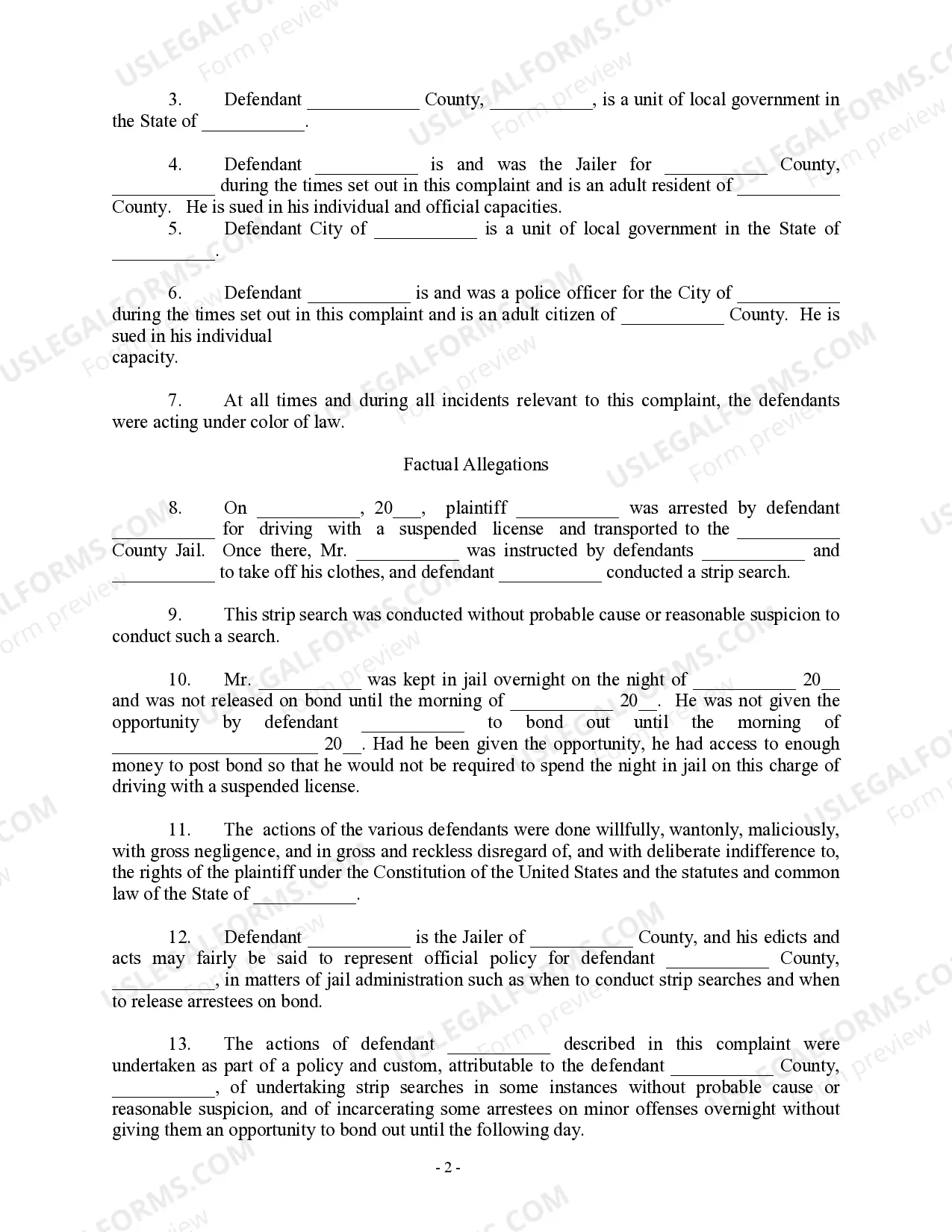
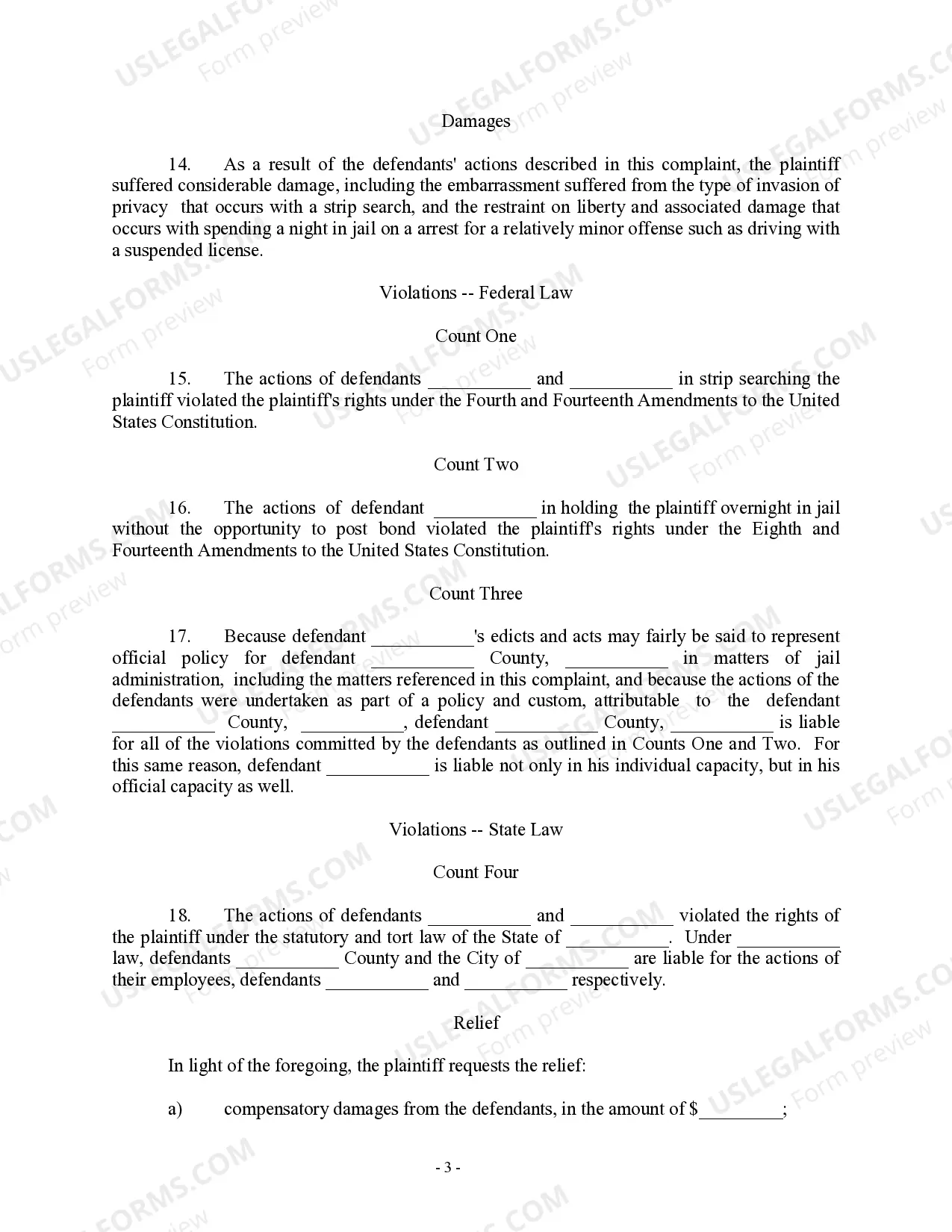
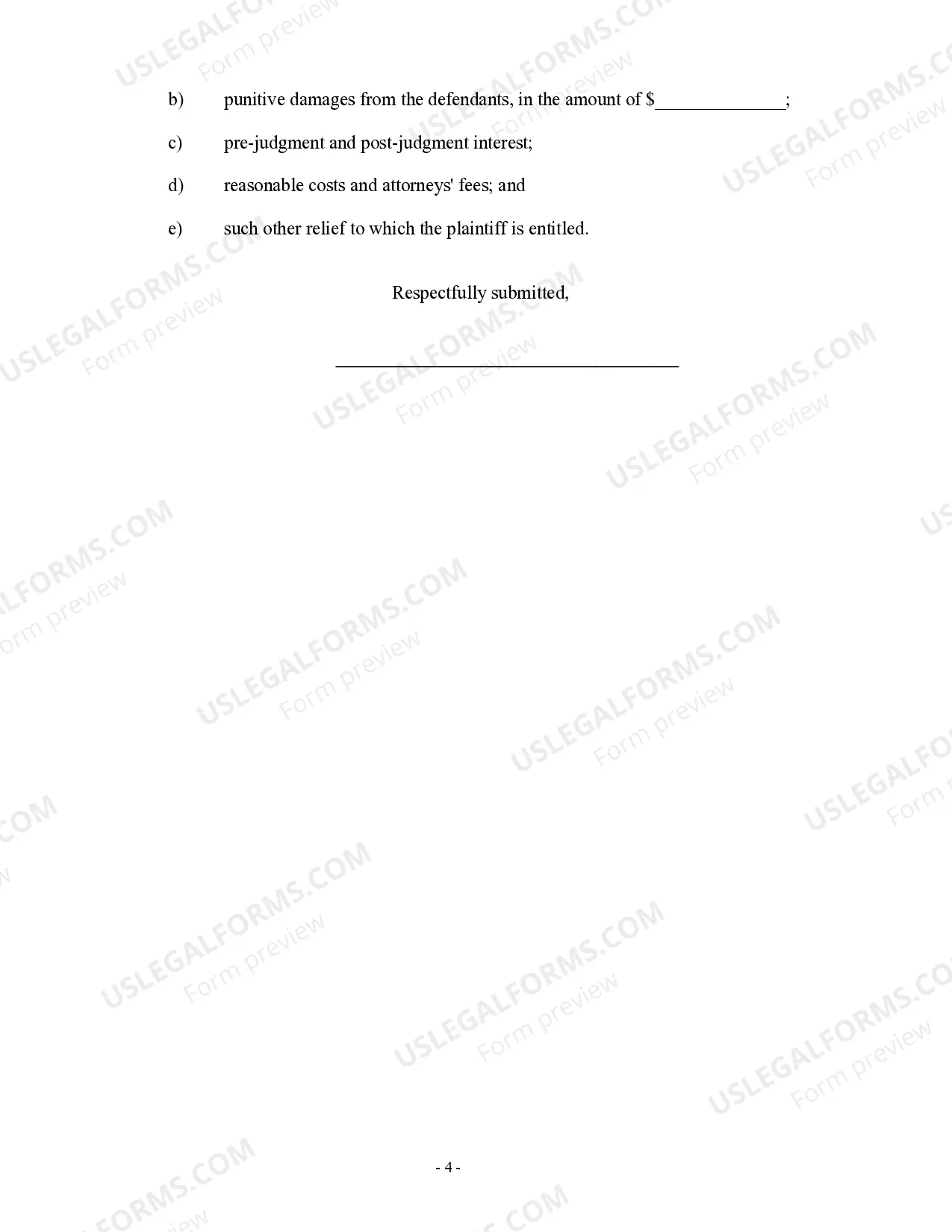
This form is a Complaint. This action was filed by the plaintiff due to a strip search which was conducted upon his/her person after an arrest. The plaintiff requests that he/she be awarded compensatory damages and punitive damages for the alleged violation of his/her constitutional rights.
Body Search For In North Carolina
State:
Multi-State
Category:
Control #:
US-000282
Format:
Word;
Rich Text
81 downloads
Description
Free preview




Get your form ready online
Our built-in tools help you complete, sign, share, and store your documents in one place.
Built-in online Word editor
Make edits, fill in missing information, and update formatting in US Legal Forms—just like you would in MS Word.
Export easily
Download a copy, print it, send it by email, or mail it via USPS—whatever works best for your next step.
E-sign your document
Sign and collect signatures with our SignNow integration. Send to multiple recipients, set reminders, and more. Go Premium to unlock E-Sign.
Notarize online 24/7
If this form requires notarization, complete it online through a secure video call—no need to meet a notary in person or wait for an appointment.
Store your document securely
We protect your documents and personal data by following strict security and privacy standards.

Make edits, fill in missing information, and update formatting in US Legal Forms—just like you would in MS Word.

Download a copy, print it, send it by email, or mail it via USPS—whatever works best for your next step.

Sign and collect signatures with our SignNow integration. Send to multiple recipients, set reminders, and more. Go Premium to unlock E-Sign.

If this form requires notarization, complete it online through a secure video call—no need to meet a notary in person or wait for an appointment.

We protect your documents and personal data by following strict security and privacy standards.
Looking for another form?









Form popularity
FAQ
Even if you have nothing to hide, do not let an officer search your vehicle. Your response should be a pleasant smile, and say, ``I have nothing to hide, but I respectfully decline to allow you to search my vehicle.'' Keep repeating that. Tape or record it on your cell phone if possible, but keep saying it.
Law enforcement is allowed to search a vehicle without a warrant under specific circumstances. These include having the owner's consent, probable cause to believe it contains evidence of a crime, conducting a search incident to a lawful arrest, or performing an inventory of an impounded vehicle.
§ 15A-243 (1997), and that only law-enforcement officers may execute them, see N.C. Gen. Stat. § 15A-247 (1997), but it does not limit those persons or entities who may apply for search warrants. Any person or entity-including, as here, a town-may apply for a search warrant.
However, searches conducted without a warrant fall into one of four general categories: Consent to search. If you allow the officer to search your vehicle, no warrant is needed. Searches conducted based on probable cause. Searches considered incident to arrest. Inventory search of an impounded vehicle.
Probable cause demands that a reasonable belief that the individual is involved in criminal activity or has violated the law is supported by enough facts that make the likelihood of criminal activity higher than for determining a reasonable suspicion exists.
§ 15A-243 (1997), and that only law-enforcement officers may execute them, see N.C. Gen. Stat. § 15A-247 (1997), but it does not limit those persons or entities who may apply for search warrants. Any person or entity-including, as here, a town-may apply for a search warrant.
For eCourts counties: You may search online for case information and court records by name, case number, attorney, and more. Individuals performing background checks should use the county clerk's office for doing so, not Portal.
In the United States, you can Access Court Records Electronically through the US Courts website as part of the Public Access to Court Electronic Records (PACER) project. This website also informs you of whether or not a case is actively involved in litigation. PACER allows you to search for cases through all US courts.
A common misconception is that a person must be absent for at least 24 hours before being legally classed as missing, but this is rarely the case. Law enforcement agencies often stress that the case should be reported as early as possible. In fact, it is extremely crucial to report a missing person as soon as possible.