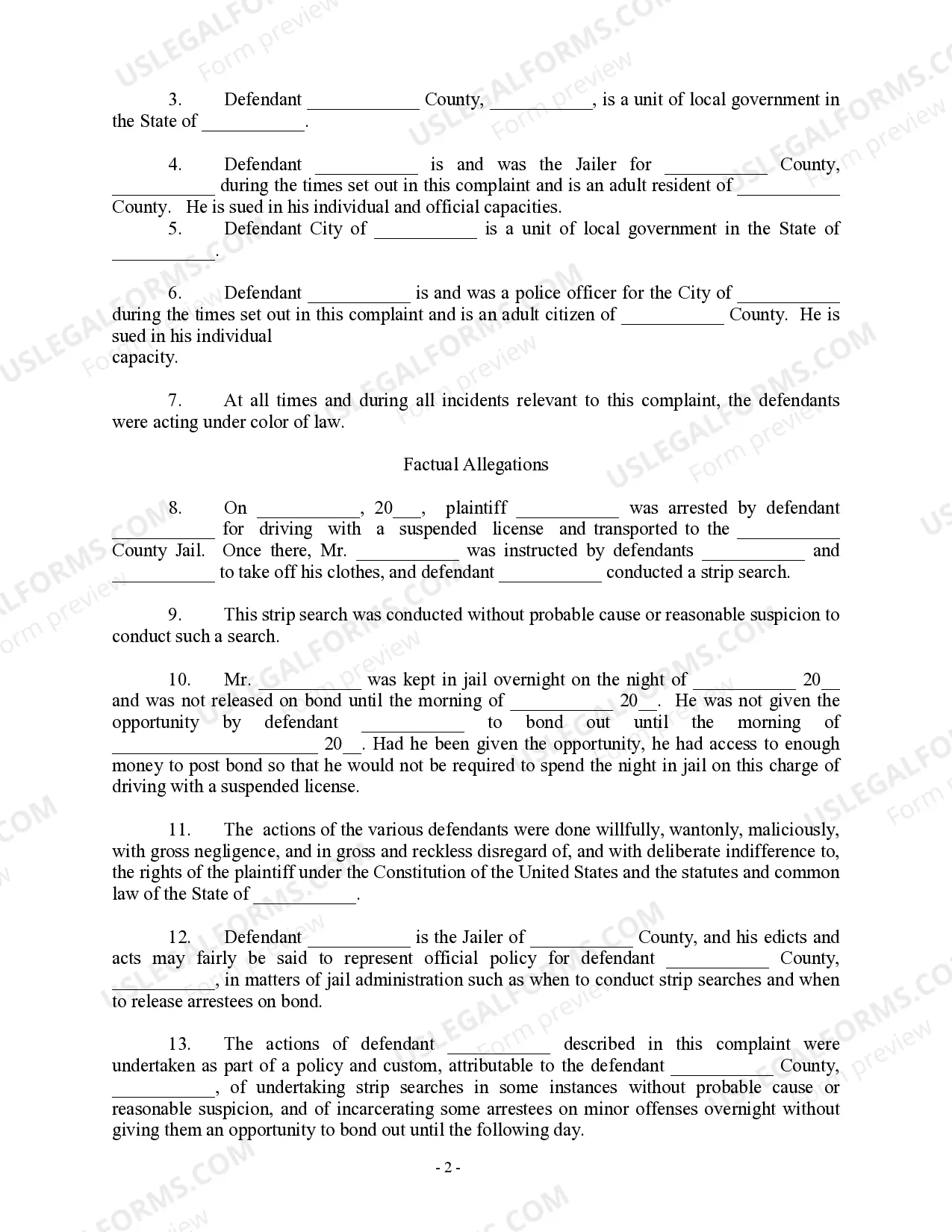
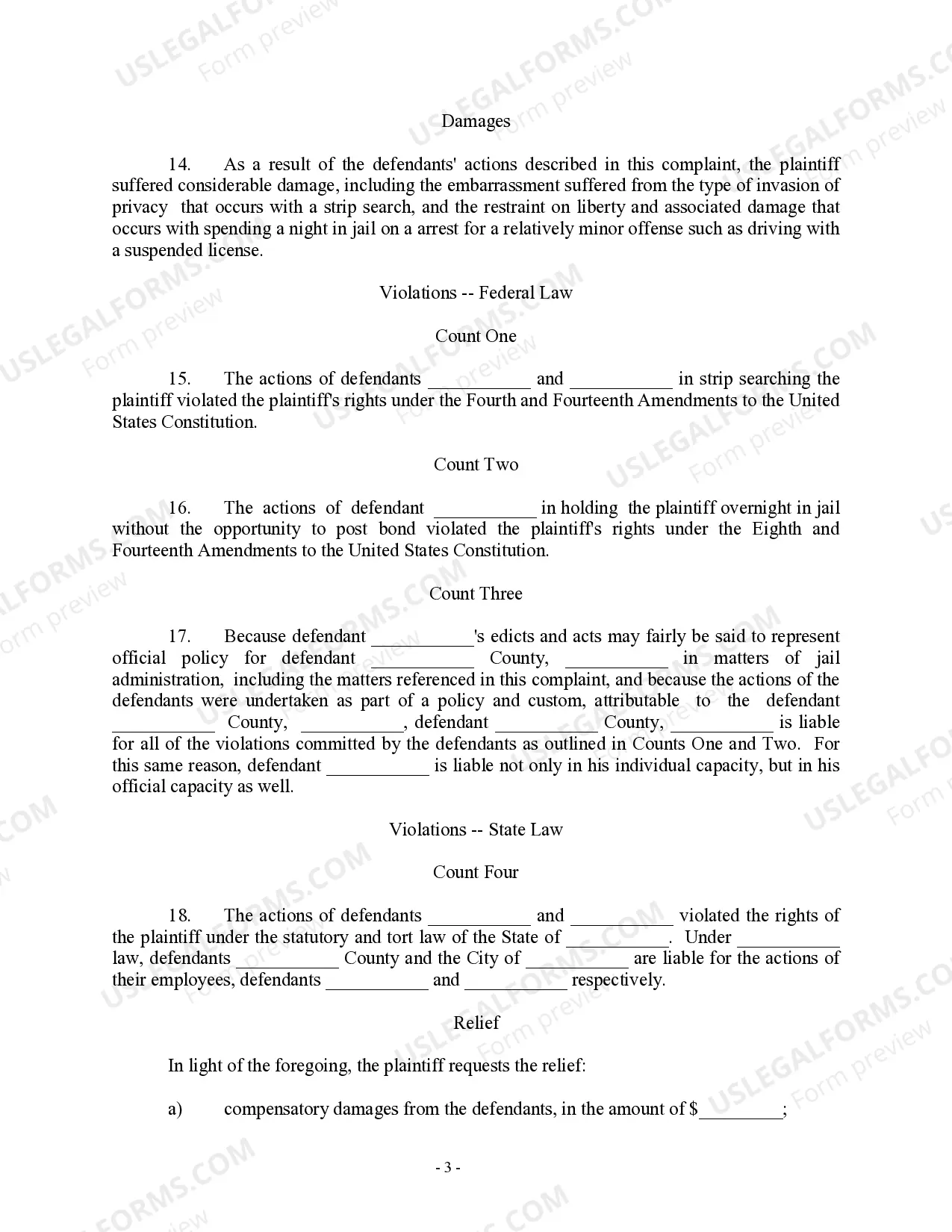
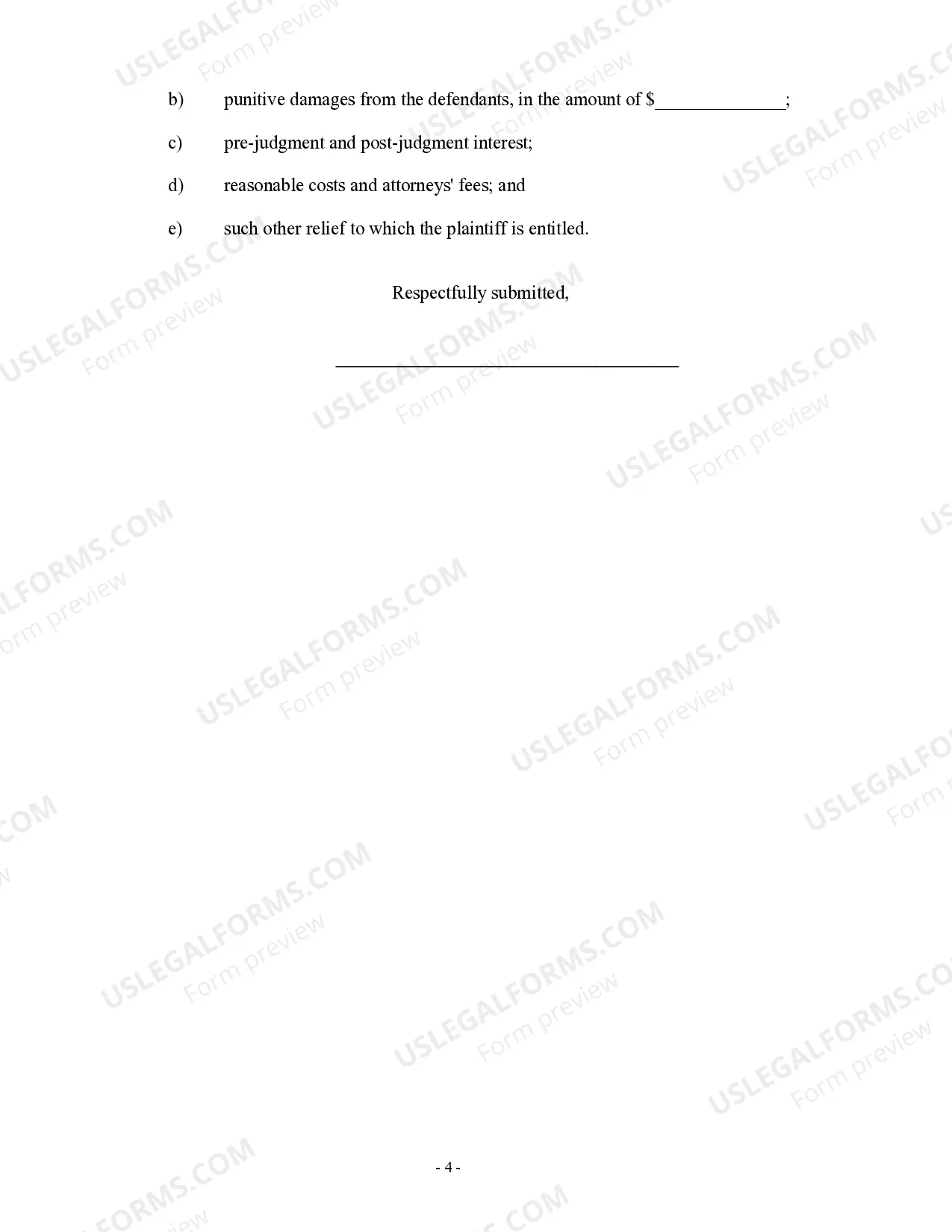
This form is a Complaint. This action was filed by the plaintiff due to a strip search which was conducted upon his/her person after an arrest. The plaintiff requests that he/she be awarded compensatory damages and punitive damages for the alleged violation of his/her constitutional rights.
Search Warrant Amendment In Maryland
Category:
State:
Multi-State
Control #:
US-000282
Format:
Word;
Rich Text
Instant download
Description
Free preview




Get your form ready online
Our built-in tools help you complete, sign, share, and store your documents in one place.
Built-in online Word editor
Make edits, fill in missing information, and update formatting in US Legal Forms—just like you would in MS Word.
Export easily
Download a copy, print it, send it by email, or mail it via USPS—whatever works best for your next step.
E-sign your document
Sign and collect signatures with our SignNow integration. Send to multiple recipients, set reminders, and more. Go Premium to unlock E-Sign.
Notarize online 24/7
If this form requires notarization, complete it online through a secure video call—no need to meet a notary in person or wait for an appointment.
Store your document securely
We protect your documents and personal data by following strict security and privacy standards.

Make edits, fill in missing information, and update formatting in US Legal Forms—just like you would in MS Word.

Download a copy, print it, send it by email, or mail it via USPS—whatever works best for your next step.

Sign and collect signatures with our SignNow integration. Send to multiple recipients, set reminders, and more. Go Premium to unlock E-Sign.

If this form requires notarization, complete it online through a secure video call—no need to meet a notary in person or wait for an appointment.

We protect your documents and personal data by following strict security and privacy standards.
Looking for another form?










Form popularity
FAQ
You can usually “quash” a bench warrant by appearing in court or a lawyer appearing for you. To successfully quash a bench warrant means the court will remove it from California's judicial system. In most cases, you must appear in court to recall a warrant.
Your best option is to hire an attorney to file a motion to recall the warrant. These motions are usually granted in this kind of case and then the warrant is quashed and your case is set for trial.
A valid search warrant must meet four requirements: (1) the warrant must be filed in good faith by a law enforcement officer; (2) the warrant must be based on reliable information showing probable cause to search; (3) the warrant must be issued by a neutral and detached magistrate; and (4) the warrant must state ...
A Maryland bench warrant does not always mean a person will go to jail. A lawyer can file a motion to recall the warrant or more properly a “Motion to Quash.” If the Judge grants the motion to quash, then the Court has the option to issue a summons for the defendant to appear at a later court or trial date.
One such option is to have your Maryland defense attorney file a “Motion to Quash Bench Warrant.” This legal document asks the court to recall (or quash) the bench warrant and instead set a new court date.
The Fourth Amendment requires law enforcement to obtain a warrant in order to conduct searches or seizures that infringe a reasonable expectation of privacy. These warrants may only be issued upon probable cause and must describe the parameters of the search with particularity.
(5) (i) The search and seizure under the authority of a search warrant shall be made within 10 calendar days after the day that the search warrant is issued. (ii) After the expiration of the 10–day period, the search warrant is void.
Generally, a person has no reasonable expectation of privacy for property and personal effects they hold open to the public. The Fourth Amendment does not protect things that are visible or in "plain view" for a person of ordinary and unenhanced vision.
Common Fourth Amendment Violations Warrantless Searches Without Consent or Probable Cause. Using Invalid or Overbroad Warrants. Unreasonable Use of Surveillance. Exceeding the Scope of a Lawful Search. Pretextual Stops and Searches. Search Incident to Arrest Without Legal Grounds. Coerced or Manipulated Consent.
Article 26 states, in pertinent part, "that all warrants, without oath or affirmation, to search suspected places, or to seize any person or property, are grievous and oppressive." MD. CONST., Declaration of Rights, art. 26.