Patent Infringement In The Philippines In Wake
Description

Get your form ready online
Our built-in tools help you complete, sign, share, and store your documents in one place.
Make edits, fill in missing information, and update formatting in US Legal Forms—just like you would in MS Word.
Download a copy, print it, send it by email, or mail it via USPS—whatever works best for your next step.
Sign and collect signatures with our SignNow integration. Send to multiple recipients, set reminders, and more. Go Premium to unlock E-Sign.
If this form requires notarization, complete it online through a secure video call—no need to meet a notary in person or wait for an appointment.
We protect your documents and personal data by following strict security and privacy standards.

Make edits, fill in missing information, and update formatting in US Legal Forms—just like you would in MS Word.

Download a copy, print it, send it by email, or mail it via USPS—whatever works best for your next step.

Sign and collect signatures with our SignNow integration. Send to multiple recipients, set reminders, and more. Go Premium to unlock E-Sign.

If this form requires notarization, complete it online through a secure video call—no need to meet a notary in person or wait for an appointment.

We protect your documents and personal data by following strict security and privacy standards.
Looking for another form?




Form popularity
FAQ
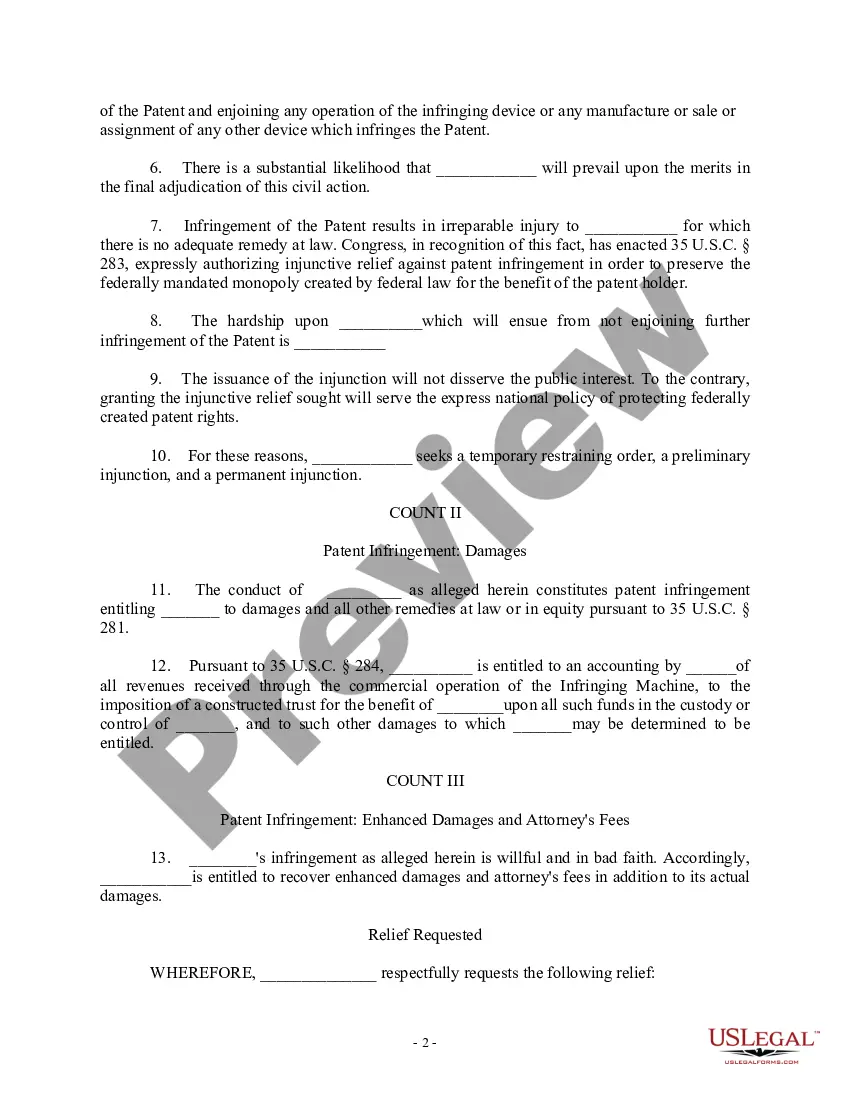
The remedy against continued infringement of a patent is an injunction. In a patent infringement suit, an injunction is a court order prohibiting the manufacture, use, or sale of the patented invention. This can include prohibition of the continued use of articles made prior to the issuance of the patent.
If a decision is reversed by the Supreme Court, the case file is referred to the Court of First Instance or the Regional Court of Appeal (whichever decision is reversed). Available remedies for patent infringement include monetary damages, preliminary and permanent injunctions.
A civil action for patent infringement may be field to recover damages sustained by the patent owner. If the damages sustained cannot be ascertained with reasonable certainty, the court may award by way of damages a sum equivalent to reasonable royalty.
Patents are enforced against an infringer either through a civil action before the Regional Trial Court (“RTC”) or an administrative action before the Bureau of Legal Affairs (“BLA”) of the Intellectual Property Office of the Philippines (“IPOPHL”).
The administrative suit is filed at the Bureau of Legal Affairs at the Intellectual Property Office of the Philippines. A civil infringement lawsuit is filed in the appropriate court located at the place where the defendant resides/is located, or where the plaintiff resides/is located, at the option of the plaintiff.
Under Philippine law, copyright infringement is punishable by the following: Imprisonment of between 1 to 3 years and a fine of between 50,000 to 150,000 pesos for the first offense. Imprisonment of 3 years and 1 day to six years plus a fine of between 150,000 to 500,000 pesos for the second offense.
Getting Started in Litigation Your attorney will file a formal complaint in federal court, explaining how the defendant has infringed on your patent. Together with your attorney, you will need to compile evidence of your ownership of the patent and the infringement.
Owners may also sell their invention rights to someone else, who then becomes the new owner of the patent. The Intellectual Property Code of the Philippines sets three conditions for an invention to be deemed patentable: it has to be new, involves an inventive step, and industrially applicable.
Indian Patent Act 1970-Sections. If any person fails to comply with any direction given under section 35 or makes or causes to be made an application for the grant of a patent in contravention of section 39 he shall be punishable with imprisonment for a term which may extend to two years, or with fine, or with both.