Patent Infringement In India In Tarrant
Description

Get your form ready online
Our built-in tools help you complete, sign, share, and store your documents in one place.
Make edits, fill in missing information, and update formatting in US Legal Forms—just like you would in MS Word.
Download a copy, print it, send it by email, or mail it via USPS—whatever works best for your next step.
Sign and collect signatures with our SignNow integration. Send to multiple recipients, set reminders, and more. Go Premium to unlock E-Sign.
If this form requires notarization, complete it online through a secure video call—no need to meet a notary in person or wait for an appointment.
We protect your documents and personal data by following strict security and privacy standards.

Make edits, fill in missing information, and update formatting in US Legal Forms—just like you would in MS Word.

Download a copy, print it, send it by email, or mail it via USPS—whatever works best for your next step.

Sign and collect signatures with our SignNow integration. Send to multiple recipients, set reminders, and more. Go Premium to unlock E-Sign.

If this form requires notarization, complete it online through a secure video call—no need to meet a notary in person or wait for an appointment.

We protect your documents and personal data by following strict security and privacy standards.
Looking for another form?




Form popularity
FAQ
The remedies to patent owners are based on certain rights granted under Section 48 of the Patents Act subject to certain exceptions. The Act also offers remedies on the infringement of these rights. The remedies include temporary injunction, permanent injunction, damages or account of profits.
Patent infringement is a serious issue because it allows someone to profit from another person's invention without permission. This can harm the inventor by preventing them from selling their invention or from being able to license it to others.
By statute, all cases “arising under” patent law must be heard exclusively by the federal courts (not state courts) and, on appeal, by the Federal Circuit (not the twelve regional circuits).
If the patent is licensed exclusively, the rights of the exclusive licensee to sue for infringement are equivalent to that of the patentee. The exclusive licensee must make the patentee a party to the proceedings either as a plaintiff or defendant.
Indian Patent Act 1970-Sections. If any person fails to comply with any direction given under section 35 or makes or causes to be made an application for the grant of a patent in contravention of section 39 he shall be punishable with imprisonment for a term which may extend to two years, or with fine, or with both.
A patent infringement action would typically name as a defendant every alleged patent infringer. This may be a particularly easy process if there is only one specific individual who has infringed on your patent. It can become much more complicated, however, when there are multiple individuals and businesses involved.
Being accused of patent infringement can be serious and have grave consequences. You could be liable for damages, including lost profits or reasonable royalties, maybe even attorneys' fees or treble damages. You could even be subject to an injunction.
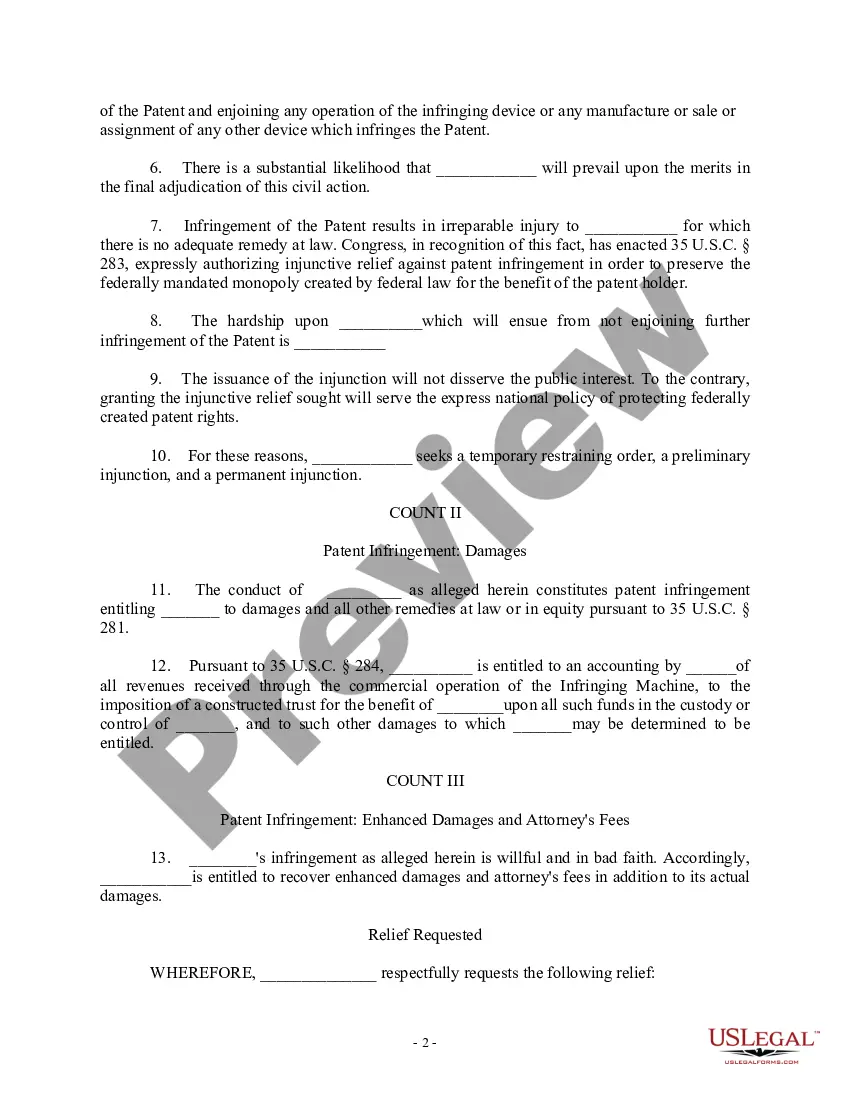
Patent infringement is not a crime. Instead, patent rights are enforced through civil litigation. Next, the court will look at whether a particular device literally infringes the claim. The elements of each of the patent's claims will be compared with the invention that is claimed to be infringing.
In India, the process of patent infringement involves filing an infringement suit in court, presenting evidence of infringement, and attending hearings to argue the case. The court assesses the evidence, including expert testimony, and delivers a judgement based on the merits of the case.
Patent infringement consists of “unauthorized making, using, offering for sale, or selling any patented invention within the United States, or importing into the United States any patented invention during its term.” You the patent owner may sue in federal court to stop the infringement and ask for financial damages.