Patent Infringement In The Philippines In Ohio
Description

Get your form ready online
Our built-in tools help you complete, sign, share, and store your documents in one place.
Make edits, fill in missing information, and update formatting in US Legal Forms—just like you would in MS Word.
Download a copy, print it, send it by email, or mail it via USPS—whatever works best for your next step.
Sign and collect signatures with our SignNow integration. Send to multiple recipients, set reminders, and more. Go Premium to unlock E-Sign.
If this form requires notarization, complete it online through a secure video call—no need to meet a notary in person or wait for an appointment.
We protect your documents and personal data by following strict security and privacy standards.

Make edits, fill in missing information, and update formatting in US Legal Forms—just like you would in MS Word.

Download a copy, print it, send it by email, or mail it via USPS—whatever works best for your next step.

Sign and collect signatures with our SignNow integration. Send to multiple recipients, set reminders, and more. Go Premium to unlock E-Sign.

If this form requires notarization, complete it online through a secure video call—no need to meet a notary in person or wait for an appointment.

We protect your documents and personal data by following strict security and privacy standards.
Looking for another form?






Form popularity
FAQ
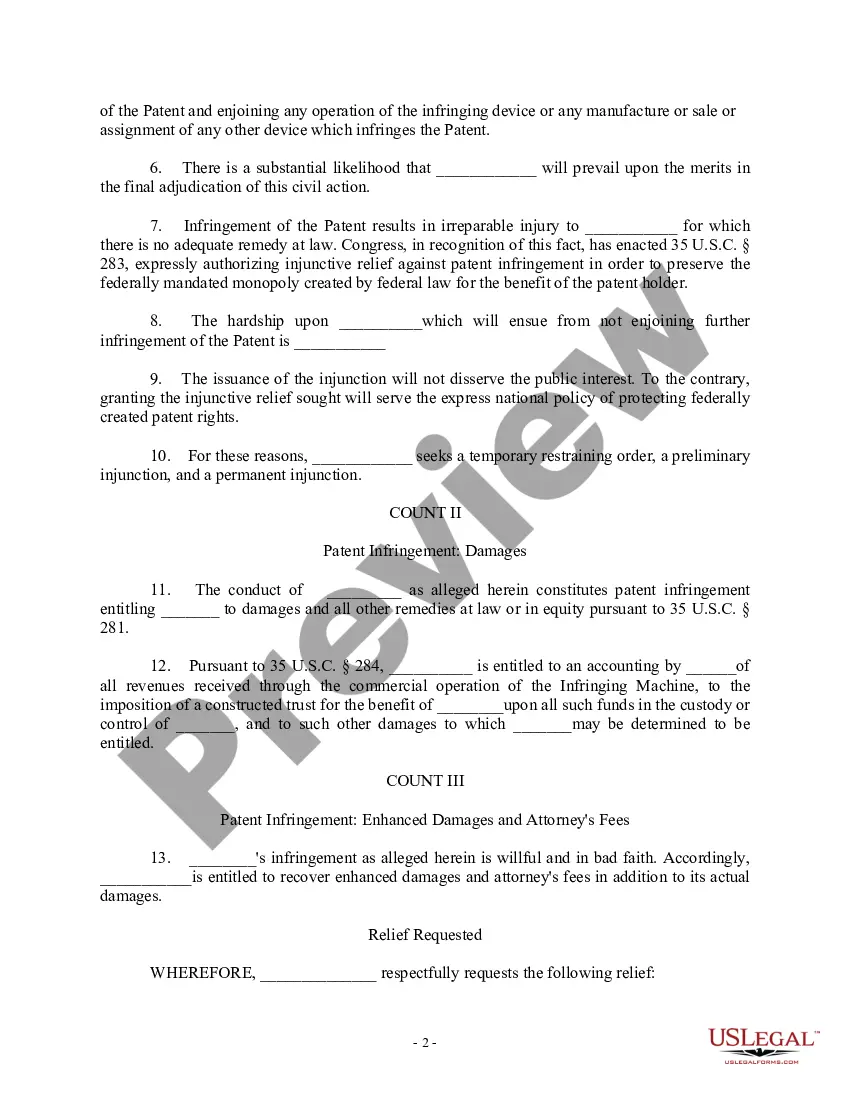
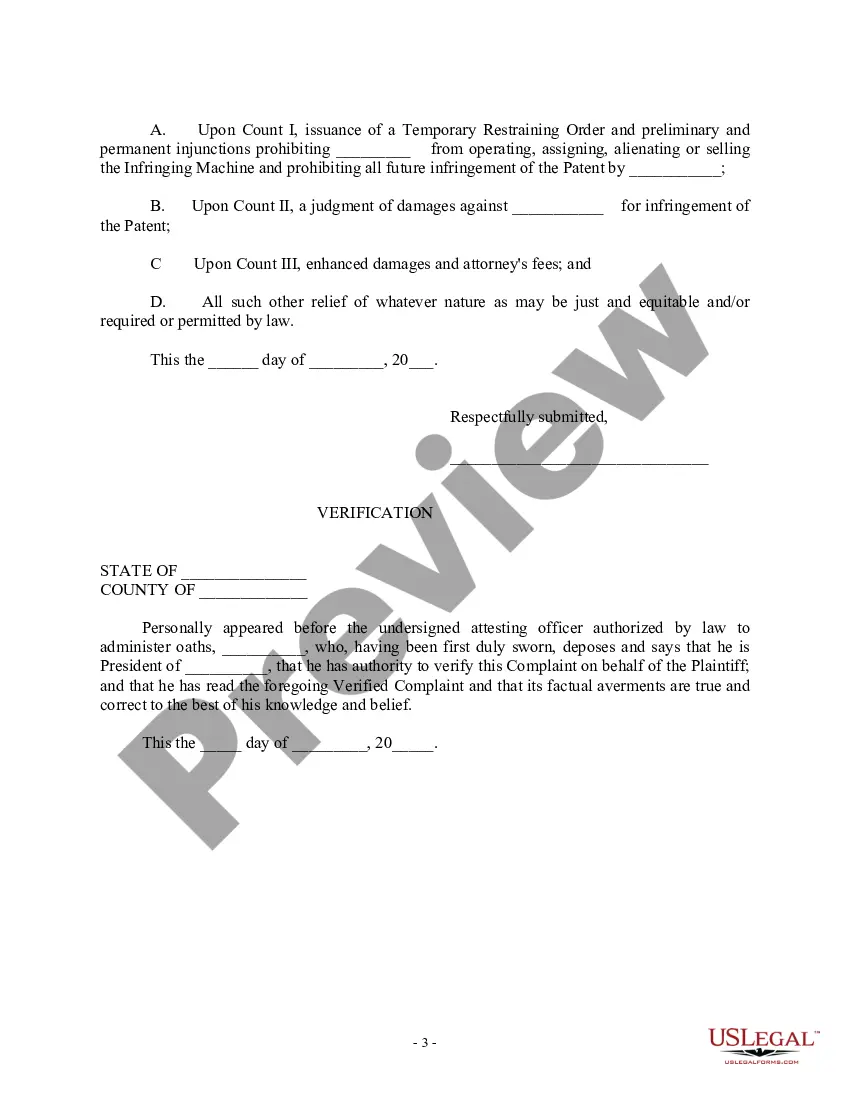
A civil action for patent infringement may be field to recover damages sustained by the patent owner. If the damages sustained cannot be ascertained with reasonable certainty, the court may award by way of damages a sum equivalent to reasonable royalty.
The usual form of protection is to apply for a patent with the Bureau of Patents of the Philippine Intellectual Property Office (IPO).
No, the use of an attorney or registered agent is not required for filing a patent application. However, an attorney or registered agent is often a useful resource and the USPTO recommends the use of such for preparing a patent application and conducting the proceedings in the USPTO.
The IPR Center encourages victims to visit its website at .IPRCenter to obtain more information about the IPR Center and to report violations of intellectual property rights online or by emailing IPRCenter@dhs. You can also report IP crime by clicking on The IRP Center's “Report IP Theft” button.
Getting Started in Litigation Your attorney will file a formal complaint in federal court, explaining how the defendant has infringed on your patent. Together with your attorney, you will need to compile evidence of your ownership of the patent and the infringement.
The Intellectual Property Code of the Philippines sets three conditions for an invention to be deemed patentable: it has to be new, involves an inventive step, and industrially applicable.
The PCT makes it possible to seek patent protection for an invention simultaneously in a large number of countries by filing a single "international" patent application instead of filing several separate national or regional patent applications.
Is a patent valid in every country? Patents are territorial rights. In general, the exclusive rights are only applicable in the country or region in which a patent has been filed and granted, in ance with the law of that country or region.
A U.S. patent holder can block importation and sale of an infringing machine, manufacture or composition of matter in the U.S. and can sue for damages. Suit can be brought against foreign companies in U.S. federal court, so long as the patent holder can serve the infringer.