Patent Infringement In Us In Fairfax
Description



Get your form ready online
Our built-in tools help you complete, sign, share, and store your documents in one place.
Make edits, fill in missing information, and update formatting in US Legal Forms—just like you would in MS Word.
Download a copy, print it, send it by email, or mail it via USPS—whatever works best for your next step.
Sign and collect signatures with our SignNow integration. Send to multiple recipients, set reminders, and more. Go Premium to unlock E-Sign.
If this form requires notarization, complete it online through a secure video call—no need to meet a notary in person or wait for an appointment.
We protect your documents and personal data by following strict security and privacy standards.

Make edits, fill in missing information, and update formatting in US Legal Forms—just like you would in MS Word.

Download a copy, print it, send it by email, or mail it via USPS—whatever works best for your next step.

Sign and collect signatures with our SignNow integration. Send to multiple recipients, set reminders, and more. Go Premium to unlock E-Sign.

If this form requires notarization, complete it online through a secure video call—no need to meet a notary in person or wait for an appointment.

We protect your documents and personal data by following strict security and privacy standards.
Looking for another form?








Form popularity
FAQ
The remedy against continued infringement of a patent is an injunction. In a patent infringement suit, an injunction is a court order prohibiting the manufacture, use, or sale of the patented invention. This can include prohibition of the continued use of articles made prior to the issuance of the patent.
Determine the Substance of the Response Denying liability. Sending a holding letter advising the patent owner that a substantive response will be forthcoming. Purchasing or licensing the patent. Modifying the accused product to avoid infringement. Stopping use of the accused product.
Getting Started in Litigation Your attorney will file a formal complaint in federal court, explaining how the defendant has infringed on your patent. Together with your attorney, you will need to compile evidence of your ownership of the patent and the infringement.
The IPR Center encourages victims to visit its website at .IPRCenter to obtain more information about the IPR Center and to report violations of intellectual property rights online or by emailing IPRCenter@dhs. You can also report IP crime by clicking on The IRP Center's “Report IP Theft” button.
Obtaining a license to use copyrighted material provides a strong defence against infringement claims. A valid license demonstrates that the use of the copyrighted material is authorized by the copyright owner and can help protect against allegations of infringement.
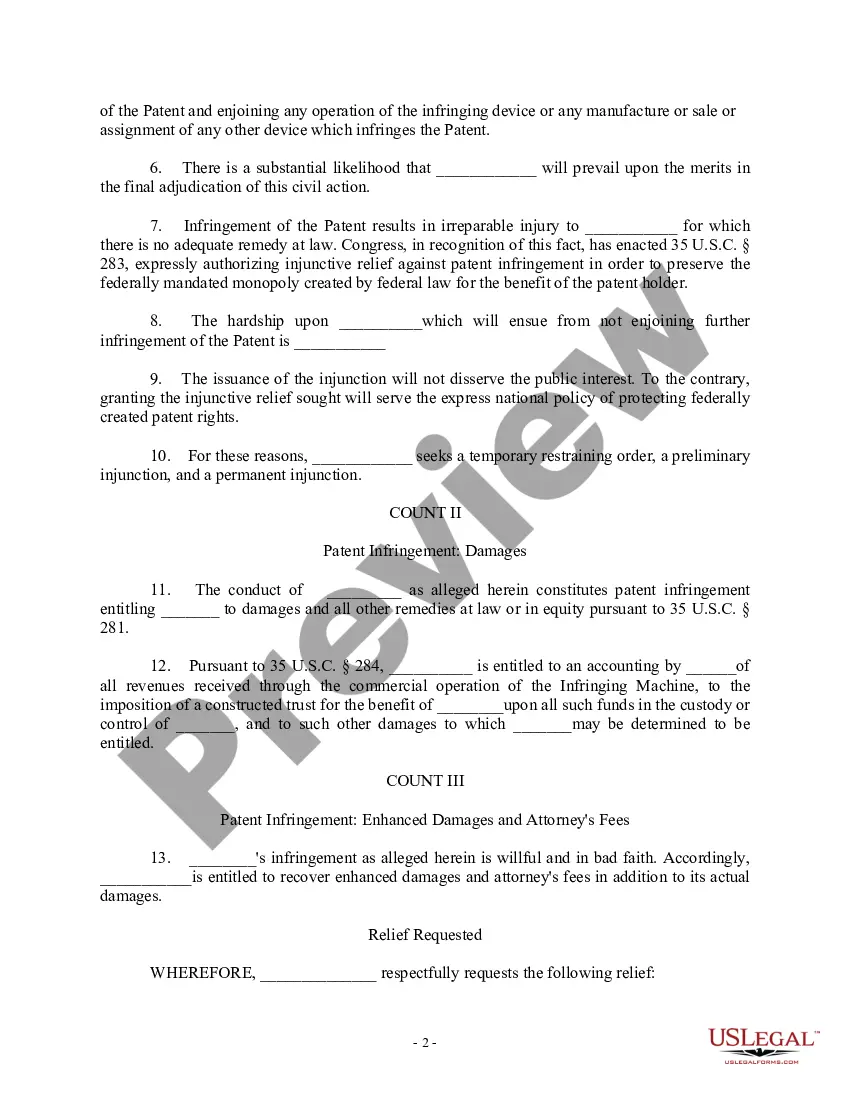
Patent infringement consists of “unauthorized making, using, offering for sale, or selling any patented invention within the United States, or importing into the United States any patented invention during its term.” You the patent owner may sue in federal court to stop the infringement and ask for financial damages.
Together with your attorney, you will need to compile evidence of your ownership of the patent and the infringement. Then, the complaint will be served on the infringer, who will have an opportunity to respond. The case will proceed similarly to other types of civil litigation after that stage.
A patent holder must sue the unauthorized party in federal district court. The patent holder can sue in any federal court where the infringed product is found. Patent lawsuits are time-consuming. Depending on where you live, these suits can take years to get to trial.
Jurisdiction for Patent Litigation matters in India As per Section 104, a person filing a suit for infringement of patent or for declaration under Section 105 or seeking any relief under Section 106, shall do so in a “district court” having jurisdiction to try the suit.
If a patent holder believes that another party has infringed upon their patent and chooses to litigate, they will file a civil lawsuit in a U.S. district court.