Declaratory Judgment Act With Hasan Minhaj In Arizona
Description





Get your form ready online
Our built-in tools help you complete, sign, share, and store your documents in one place.
Make edits, fill in missing information, and update formatting in US Legal Forms—just like you would in MS Word.
Download a copy, print it, send it by email, or mail it via USPS—whatever works best for your next step.
Sign and collect signatures with our SignNow integration. Send to multiple recipients, set reminders, and more. Go Premium to unlock E-Sign.
If this form requires notarization, complete it online through a secure video call—no need to meet a notary in person or wait for an appointment.
We protect your documents and personal data by following strict security and privacy standards.

Make edits, fill in missing information, and update formatting in US Legal Forms—just like you would in MS Word.

Download a copy, print it, send it by email, or mail it via USPS—whatever works best for your next step.

Sign and collect signatures with our SignNow integration. Send to multiple recipients, set reminders, and more. Go Premium to unlock E-Sign.

If this form requires notarization, complete it online through a secure video call—no need to meet a notary in person or wait for an appointment.

We protect your documents and personal data by following strict security and privacy standards.
Looking for another form?







Form popularity
FAQ
41-1034 - Declaratory judgment. A. Any person who is or may be affected by a rule may obtain a judicial declaration of the validity of the rule by filing an action for declaratory relief in the superior court in Maricopa county in ance with title 12, chapter 10, article 2.
Similarly, the Declaratory Judgment Act, 28 U.S.C. § 2201, is not an independent source of federal jurisdiction. The purpose of that Act is merely to provide an additional remedy, once jurisdiction is found to exist on another ground.
The benefit of a declaratory judgment is that it prevents lawsuits that are likely to be unsuccessful, which saves the courts, and ultimately taxpayers, resources and time. A policyholder that receives an unfavorable declaratory judgment is unlikely to file a lawsuit, as the suit is much more likely to be dismissed.
Declaratory relief allows a party who is not certain of his rights to prevent the accrual of avoidable damages and to obtain an adjudication before the parties bring a coercive lawsuit.
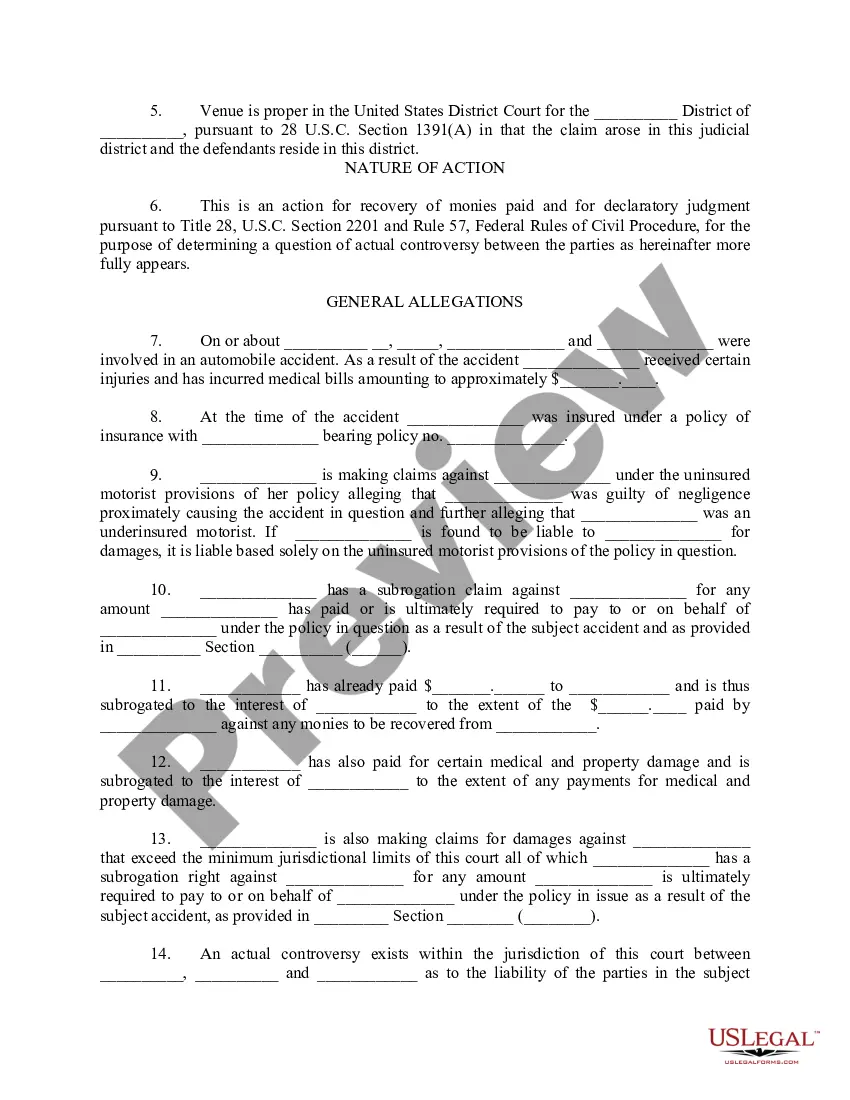
A declaratory judgment is typically requested when a party is threatened with a lawsuit but the lawsuit has not yet been filed; or when a party or parties believe that their rights under law and/or contract might conflict; or as part of a counterclaim to prevent further lawsuits from the same plaintiff (for example, ...
Declaratory judgments have the same effect and force as final judgments and are legally binding.
An execution or other process shall not be issued on a judgment after the expiration of ten years from the date of its entry unless the judgment is renewed by affidavit or process pursuant to section 12-1612 or an action is brought on it within ten years after the date of the entry of the judgment or of its renewal.
12-523 - Real property in adverse possession under title or color of title; three year limitation. A. An action to recover real property from a person in peaceable and adverse possession under title or color of title shall be commenced within three years after the cause of action accrues, and not afterward.
A declaratory judgment is a binding judgment from a court defining the legal relationship between parties and their rights in a matter before the court. When there is uncertainty as to the legal obligations or rights between two parties, a declaratory judgment offers an immediate means to resolve this uncertainty.
