Request for Student Records (Secondary School)
Understanding this form
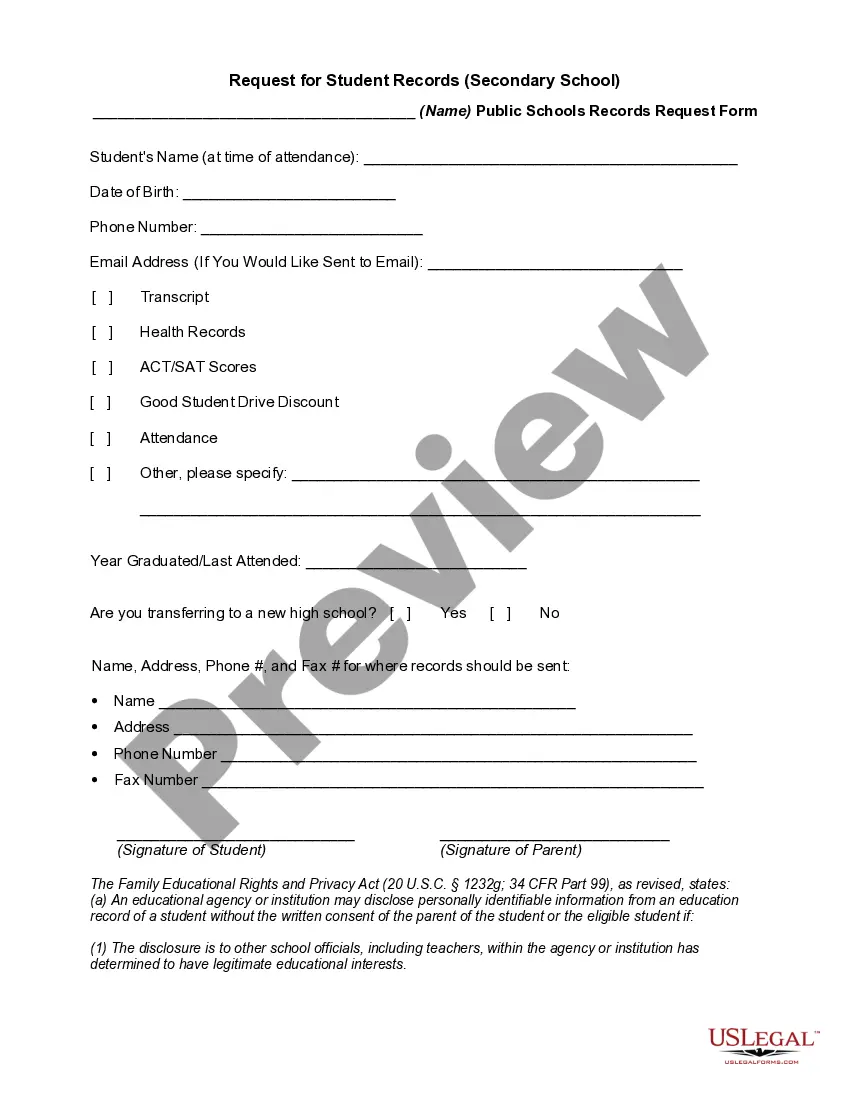
The Request for Student Records (Secondary School) is a legal document used to obtain academic and health records from a secondary school. This form is essential for students transferring to a new school or for those who need their academic history for purposes such as college applications or job opportunities. Unlike general record requests, this form specifically targets student records and lists the types of documentation that can be obtained, making it a streamlined and focused option for individuals seeking their educational information.
Key parts of this document
- Student's name and date of birth to identify records.
- Contact information for where records should be sent.
- Options for specific records being requested, including transcripts and health records.
- Graduation year or last attendance to narrow down the request.
- Signatures of the student and parent, if applicable, for authorization.

Situations where this form applies
This form is used when a student needs to request their records from a secondary school, such as when transferring to a new school, applying for college, or needing proof of attendance or academic performance. It's also useful for students re-entering education after an absence, as having accurate records can aid in course placement and financial aid applications.
Who this form is for
- Students who attended a secondary school and need their records.
- Parents or guardians requesting records on behalf of their minor children.
- New schools requesting records for incoming students to evaluate their prior education.
How to complete this form
- Fill in the student's name and date of birth accurately.
- Provide your contact information, including phone number and email if preferred.
- Select the specific records you need from the checkboxes provided.
- Indicate the year of graduation or last attendance to help locate the records.
- Enter the name, address, and contact information of where the records should be sent.
- Ensure both the student and a parent sign the form if the student is a minor.
Notarization requirements for this form
This form does not typically require notarization unless specified by local law. Always check local regulations to ensure compliance when submitting your request.
Get your form ready online
Our built-in tools help you complete, sign, share, and store your documents in one place.
Make edits, fill in missing information, and update formatting in US Legal Forms—just like you would in MS Word.
Download a copy, print it, send it by email, or mail it via USPS—whatever works best for your next step.
Sign and collect signatures with our SignNow integration. Send to multiple recipients, set reminders, and more. Go Premium to unlock E-Sign.
If this form requires notarization, complete it online through a secure video call—no need to meet a notary in person or wait for an appointment.
We protect your documents and personal data by following strict security and privacy standards.

Make edits, fill in missing information, and update formatting in US Legal Forms—just like you would in MS Word.

Download a copy, print it, send it by email, or mail it via USPS—whatever works best for your next step.

Sign and collect signatures with our SignNow integration. Send to multiple recipients, set reminders, and more. Go Premium to unlock E-Sign.

If this form requires notarization, complete it online through a secure video call—no need to meet a notary in person or wait for an appointment.

We protect your documents and personal data by following strict security and privacy standards.
Mistakes to watch out for
- Forgetting to provide the correct year of graduation or last attendance.
- Not signing the form, especially if a parent signature is required.
- Leaving contact information incomplete or incorrect.
Why use this form online
- Quick and easy access to downloadable templates without needing to visit a lawyer.
- Editable forms allow users to customize their requests according to their needs.
- Secure and accurate, reducing the likelihood of errors in submission.
Looking for another form?
Form popularity
FAQ
These records include but are not limited to grades, transcripts, class lists, student course schedules, health records (at the K-12 level), student financial information (at the postsecondary level), and student discipline files.
Most colleges want an official version of your high school transcript. Official versions are often sent directly by your high school, either through snail mail or as an e-mail. Your school may also give you an official version of your transcript inside a sealed envelope for you to send yourself.
Education records contain information about a student, such as: a student's name, address, and telephone number; a parent's or guardian's name and contact information; grades and test scores; health and immunization records; discipline reports; documentation of attendance; schools attended; courses taken; awards
FERPA defines education records as records, files, documents, and other materials that are maintained by an educational agency or institution, or by a person acting for such agency or institution. While it is clear that educational information includes a student's transcripts, GPA, grades, social security number,
FERPA Defines an Education RecordEducation records include a range of information about a student that is maintained in schools in any recorded way, such as handwriting, print, computer media, video or audio tape, film, microfilm, and microfiche.
U.S. Mail typically requires up to seven business days for delivery. We will resend the transcript one time free of charge if a reasonable amount of time has passed. Please remember that institutions can take 4-6 weeks to process incoming transcripts and make the necessary entries in their computer systems.
As a general rule of thumb, schools should keep temporary student information like attendance records for at least 5 years after a student no longer attends, and permanent records should be kept for at least 60 years.
Depending on your school, you may be able to request your transcripts online, over the phone, or through the mail. You can search for your school district at the National Center for Education Statistics website.
Schools keep records of your academic and personal progress, from kindergarten through graduation. And some schools keep student files for many years after the person has graduated or left. Student records can include quantitative information like test scores, intelligence quotients (IQs), and grades.