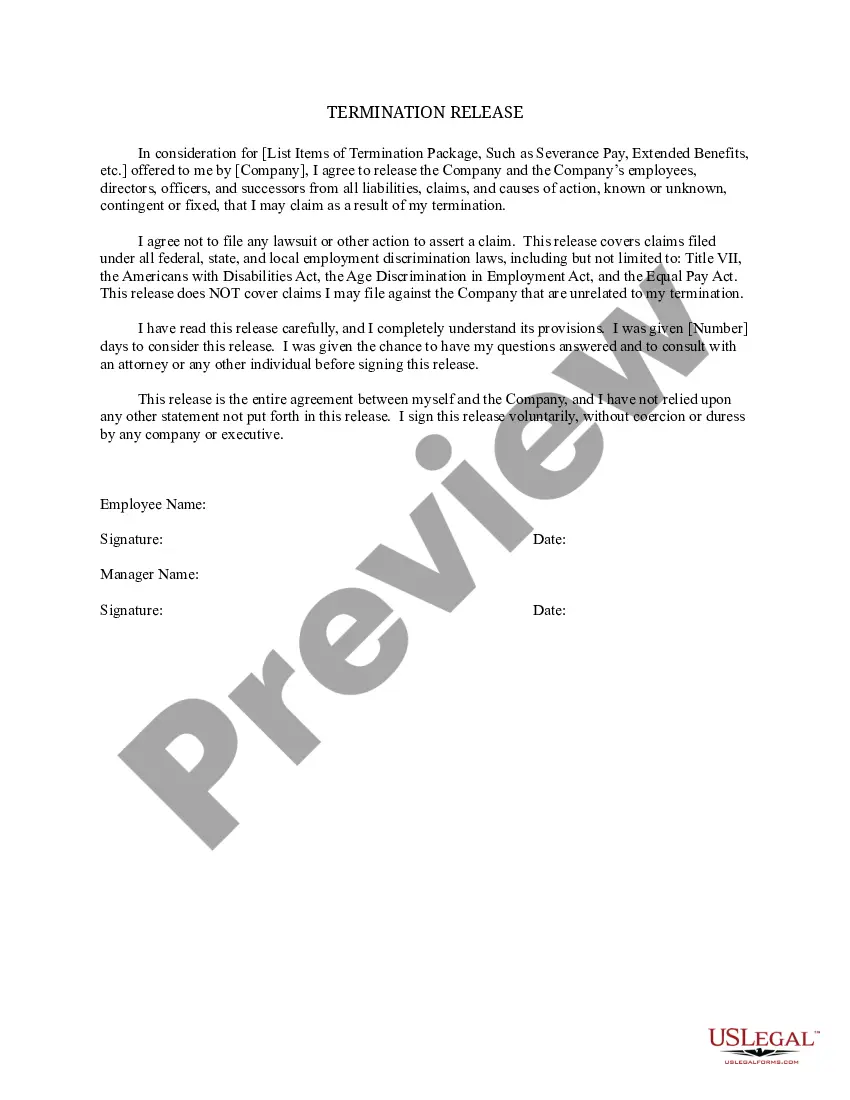
Texas Employment Termination Without Inquiry
Description

Get your form ready online
Our built-in tools help you complete, sign, share, and store your documents in one place.
Make edits, fill in missing information, and update formatting in US Legal Forms—just like you would in MS Word.
Download a copy, print it, send it by email, or mail it via USPS—whatever works best for your next step.
Sign and collect signatures with our SignNow integration. Send to multiple recipients, set reminders, and more. Go Premium to unlock E-Sign.
If this form requires notarization, complete it online through a secure video call—no need to meet a notary in person or wait for an appointment.
We protect your documents and personal data by following strict security and privacy standards.

Make edits, fill in missing information, and update formatting in US Legal Forms—just like you would in MS Word.

Download a copy, print it, send it by email, or mail it via USPS—whatever works best for your next step.

Sign and collect signatures with our SignNow integration. Send to multiple recipients, set reminders, and more. Go Premium to unlock E-Sign.

If this form requires notarization, complete it online through a secure video call—no need to meet a notary in person or wait for an appointment.

We protect your documents and personal data by following strict security and privacy standards.
Looking for another form?








Form popularity
FAQ
The average settlement for wrongful termination in Texas varies widely based on the specifics of each case. Factors affecting settlement amounts include the employee's salary, damages, and the circumstances surrounding the termination. Seeking advice from legal professionals can help you understand potential outcomes in your situation.
To legally terminate an employee in Texas, follow proper procedures by ensuring compliance with labor laws and any company policies. Document the reasons for termination and communicate clearly with the employee. Using resources from uslegalforms can help guide you through the process effectively.
Proving wrongful termination in Texas can be challenging, as you must provide sufficient evidence to support your claims. Cases often hinge on demonstrating that termination was based on illegal reasons, such as discrimination or retaliation. However, with proper documentation and legal assistance, you can improve your chances of success.
A letter of termination is not legally required in Texas, but it can be a best practice for maintaining clear communication. Providing a written notice helps clarify the reasons for termination and protects both the employer and employee. Consider using templates from platforms like uslegalforms to streamline this process.
Winning a wrongful termination case in Texas involves gathering strong evidence, such as documentation of discrimination or retaliation. You should also establish a clear connection between the termination and any unlawful reasons. Consulting with legal experts or platforms like uslegalforms can guide you in building a compelling case.
When terminating an employee in Texas, it's important to inform them clearly about the reasons for the termination. Although there are no strict legal requirements, following standard procedures helps maintain professionalism. Employers may also want to keep records of the termination process to avoid potential disputes.
To prove wrongful termination in Texas, you typically must show that your dismissal violated specific laws or contractual agreements. This can include evidence of discrimination, retaliation, or breach of contract. Collecting documentation, such as emails or performance reviews, can strengthen your case.
In Texas, employees usually have up to 180 days to file a claim for wrongful termination with the Equal Employment Opportunity Commission (EEOC). After this, there may be additional time limits to file a lawsuit in court. It is essential to act promptly to protect your rights in cases of wrongful termination.
No, Texas law does not require employers or employees to provide two weeks' notice prior to termination. Employment is generally considered 'at-will,' meaning either party can terminate the employment relationship without giving notice. However, it is courteous to inform your employer if circumstances allow.
In Texas, employment termination without inquiry typically requires no specific formalities. Employers have the right to end employment at any time, as long as there is no violation of law or contractual obligations. However, it is wise for employers to document reasons for termination to mitigate disputes.
