Us V. Texas
Description



Get your form ready online
Our built-in tools help you complete, sign, share, and store your documents in one place.
Make edits, fill in missing information, and update formatting in US Legal Forms—just like you would in MS Word.
Download a copy, print it, send it by email, or mail it via USPS—whatever works best for your next step.
Sign and collect signatures with our SignNow integration. Send to multiple recipients, set reminders, and more. Go Premium to unlock E-Sign.
If this form requires notarization, complete it online through a secure video call—no need to meet a notary in person or wait for an appointment.
We protect your documents and personal data by following strict security and privacy standards.

Make edits, fill in missing information, and update formatting in US Legal Forms—just like you would in MS Word.

Download a copy, print it, send it by email, or mail it via USPS—whatever works best for your next step.

Sign and collect signatures with our SignNow integration. Send to multiple recipients, set reminders, and more. Go Premium to unlock E-Sign.

If this form requires notarization, complete it online through a secure video call—no need to meet a notary in person or wait for an appointment.

We protect your documents and personal data by following strict security and privacy standards.
Looking for another form?



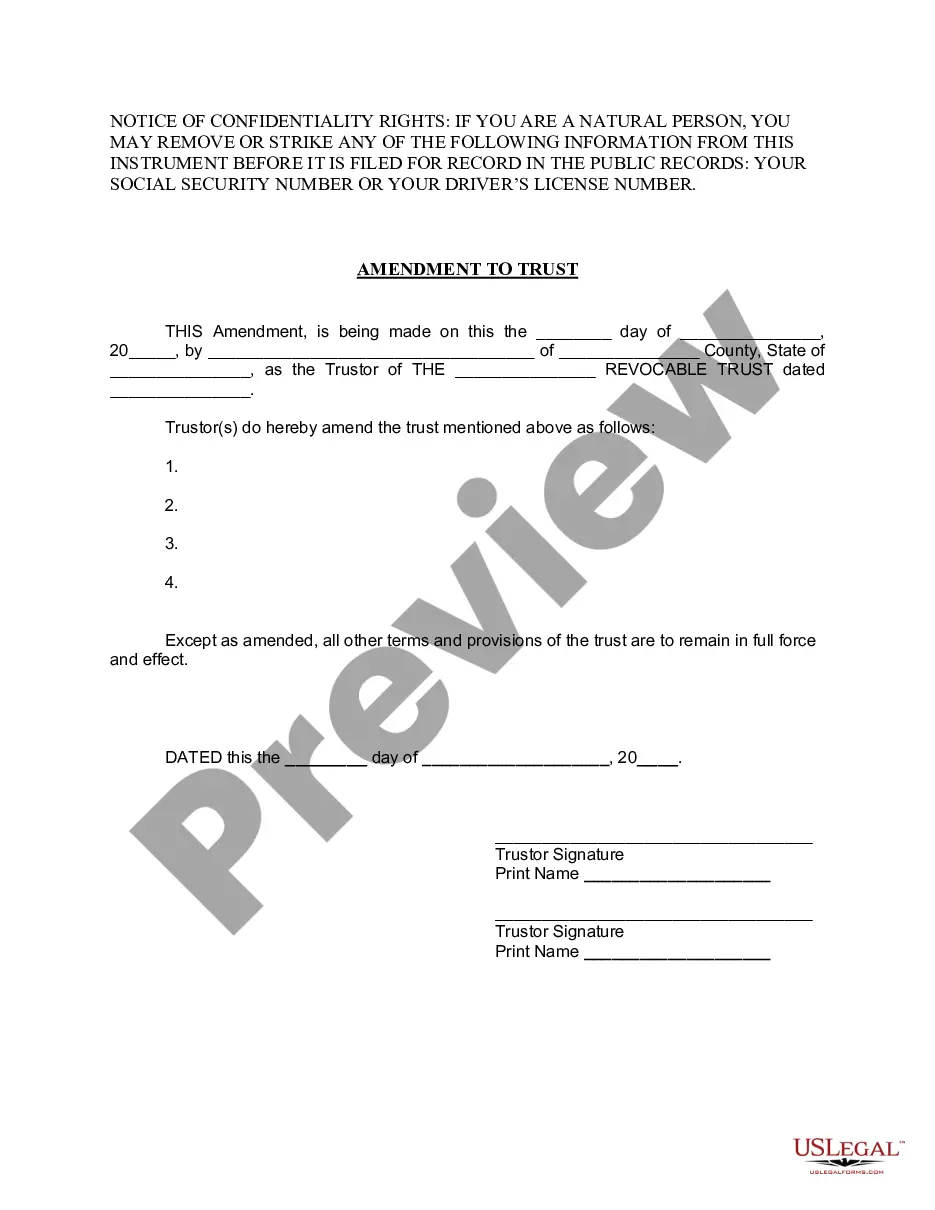
How to fill out Texas Amendment To Living Trust?
- Access your US Legal Forms account by logging in and verifying your subscription status. If it’s expired, renew based on your payment plan.
- Browse through the form descriptions and Preview mode to ensure the selected document meets your specific needs and local requirements.
- Utilize the Search feature to find additional templates if necessary, ensuring that you select the correct document for your case.
- Purchase the desired form by selecting the 'Buy Now' button and choosing your preferred subscription plan. Create an account for access to all resources.
- Complete the payment process by entering your credit card information or using a PayPal account to finalize your subscription.
- Download the form to your device for easy access. You can also find it later in the My Forms section of your account.
With US Legal Forms, you can rest assured that you are utilizing a robust resource that empowers users to create precise and legally sound documents. The service's extensive library and access to premium experts enhance your legal form experience.
Start your legal journey today with US Legal Forms – it’s time to empower yourself with the right tools!
Form popularity
FAQ
In Biden v. Texas, the Supreme Court reviewed the legality of the Biden administration's immigration policies concerning deportation priorities. The case became pivotal due to its implications for state versus federal authority in managing immigration. Ultimately, the Supreme Court's involvement highlighted the ongoing legal disputes surrounding immigration enforcement. Keeping updated on such significant cases can help you understand the evolving landscape of immigration law.
Yes, you can file a lawsuit online in Texas using the e-filing system provided by the Texas Judiciary. This system allows you to submit court documents electronically, streamlining the process significantly. However, it is essential to follow the specific guidelines for your type of case. For complex issues, USLegalForms can assist you in ensuring all forms are properly completed and filed.
The outcome of United States v. Texas was a 4-4 deadlock in the Supreme Court, which affirmed the Fifth Circuit Court's decision that blocked President Biden's immigration plan. This outcome underscored the contentious nature of immigration policy in the U.S. It also demonstrated the legal challenges states can pose against federal actions. For matters related to immigration and state law, seeking professional legal advice is crucial.
The Supreme Court's decision in United States v. Texas resulted in a tie, which effectively left the lower court's ruling intact. This case involved a challenge to President Biden's immigration policy and represented significant legal implications for state authority. The tie reflects the complexities of immigration law and state versus federal jurisdiction. Understanding the intricacies of this case can help you navigate similar legal situations.
The United States Supreme Court ruled in favor of Antoine Jones in United States v. Jones. The Court decided that the installation of a GPS tracking device on his vehicle constituted a search under the Fourth Amendment. As a result, the evidence collected through this unauthorized tracking was deemed inadmissible. This case highlights important considerations about privacy rights and surveillance.
To file criminal charges against someone in Texas, you typically start by contacting local law enforcement. An officer will investigate the matter and determine if enough evidence exists to proceed with charges. If so, the case will move forward through the district attorney’s office. For guidance on the process and legal documentation, USLegalForms can be a helpful resource.
A person can become a member of the Texas Supreme Court through a combination of legal expertise and public service. Candidates are often evaluated based on their knowledge of Texas law and previous judicial experience. Completing the necessary legal education and understanding landmark cases, including Us v. Texas, can significantly bolster a candidate's chances of being appointed or elected.
To get on the Texas Supreme Court, a candidate typically starts with a noteworthy legal career, often serving in lower courts or holding significant legal positions. They must then be appointed by the governor or run in a partisan election. It is crucial for candidates to articulate their legal philosophies clearly, especially concerning landmark cases like Us v. Texas.
Becoming a Supreme Court judge in Texas requires a solid educational foundation in law and extensive legal experience. Candidates must pass a series of evaluations, including a review of their judicial temperament and prior rulings. Once appointed or elected, they play a vital role in interpreting cases, such as Us v. Texas, that impact the state's judicial landscape.
To become a member of the Texas Supreme Court, individuals often need to be nominated by the governor. The appointment process typically involves evaluating their legal experience, qualifications, and overall contributions to the legal community, especially in cases relevant to policies like Us v. Texas. After the governor's appointment, judges usually run for re-election to secure their position.