Texas Squatters Rights For Dummies
Description
Get your form ready online
Our built-in tools help you complete, sign, share, and store your documents in one place.
Make edits, fill in missing information, and update formatting in US Legal Forms—just like you would in MS Word.
Download a copy, print it, send it by email, or mail it via USPS—whatever works best for your next step.
Sign and collect signatures with our SignNow integration. Send to multiple recipients, set reminders, and more. Go Premium to unlock E-Sign.
If this form requires notarization, complete it online through a secure video call—no need to meet a notary in person or wait for an appointment.
We protect your documents and personal data by following strict security and privacy standards.

Make edits, fill in missing information, and update formatting in US Legal Forms—just like you would in MS Word.

Download a copy, print it, send it by email, or mail it via USPS—whatever works best for your next step.

Sign and collect signatures with our SignNow integration. Send to multiple recipients, set reminders, and more. Go Premium to unlock E-Sign.

If this form requires notarization, complete it online through a secure video call—no need to meet a notary in person or wait for an appointment.

We protect your documents and personal data by following strict security and privacy standards.
Looking for another form?







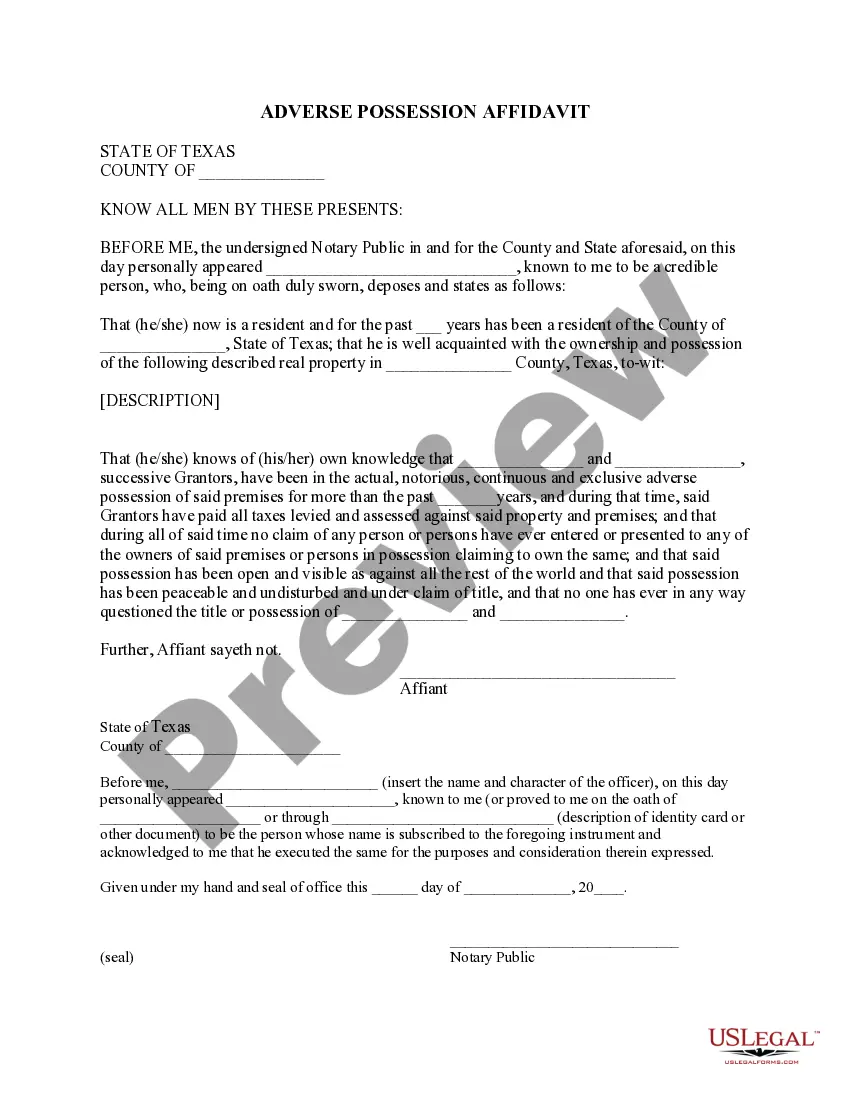
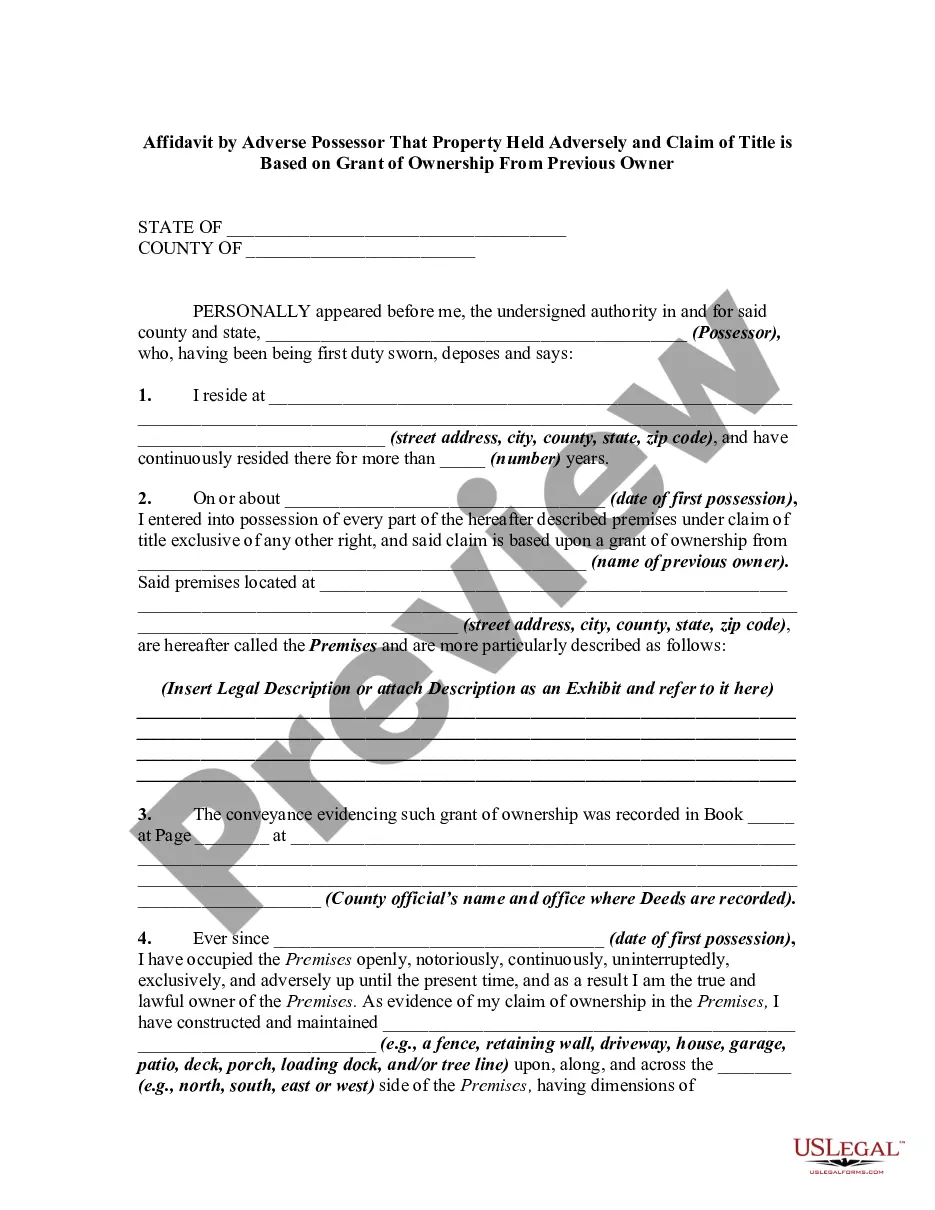
How to fill out Texas Adverse Possession Affidavit - Squatters Rights?
- Log in to your US Legal Forms account if you’ve used our service before. Ensure your subscription is active; if it's not, renew it based on your payment plan.
- For new users, start by browsing our extensive form collection. Check the Preview mode and form description to verify your selection meets your local requirements.
- If you need a different template, utilize the Search tab to find relevant forms that suit your needs.
- Once you find the right document, click on the Buy Now button and select your desired subscription plan. You will need to create an account to gain access to our library.
- Complete your purchase by entering your payment details, either through credit card or PayPal.
- Download the completed form directly to your device. You can also access it later in the My Forms section of your profile.
By leveraging US Legal Forms, you gain access to a robust library of over 85,000 legally sound documents tailored for your needs.
Don't let confusion slow you down. Start your journey towards understanding your rights today with US Legal Forms!
Form popularity
FAQ
To successfully evict a squatter in Texas, you must follow legal procedures, starting with providing written notice to vacate. If the squatter does not leave, you may file a lawsuit in the appropriate court. Resources on Texas squatters rights for dummies can prepare you for each step of this process. Using services from USLegalForms can help streamline your paperwork and ensure compliance with Texas laws.
Generally, in Texas, using deadly force against a squatter is not allowed simply for trespassing. The law requires that you must feel a reasonable threat to your life or property before using such force. Understanding Texas squatters rights for dummies helps clarify your legal options. Always consult with legal professionals before taking any action that could have serious consequences.
In Texas, to establish squatters rights, a person generally needs to occupy a property continuously for at least 10 years. This is a lengthy period, and the individual must show clear evidence of living at the property. Familiarizing yourself with Texas squatters rights for dummies can make the process easier to understand. If you're facing a situation involving squatters, consider using resources from USLegalForms to guide you through your options.
In Texas, property owners can indeed evict squatters, but the process is not instantaneous. Legal action must be taken to formally remove the squatter, which can be challenging and may take time depending on the situation. Understanding the nuances of Texas squatters rights for dummies may make the eviction process clearer and more manageable.
To claim legal ownership through squatting in Texas, you'd generally need to occupy the property for at least 10 years continuously. This period allows the squatter to apply for adverse possession and potentially obtain legal title to the property. Familiarizing yourself with Texas squatters rights for dummies can simplify this complex process.
A person typically becomes recognized as a squatter if they occupy a property without the owner's consent for a minimum of 30 days. However, ensuring that this occupation is uninterrupted and open is crucial for claiming squatters rights. Resources on Texas squatters rights for dummies can provide clarity on these parameters.
The shortest time before declaring squatters rights in Texas is around 5 years under certain conditions. This timeframe may differ based on specific nuances in local laws or the nature of the occupation. It's wise to consult resources like the uslegalforms platform for detailed guidance on Texas squatters rights for dummies.
To obtain squatters rights in Texas, one must occupy a property openly, continuously, and without permission from the owner. Additionally, this occupancy must be peaceful, meaning you do not use force to remain on the property. Learning about Texas squatters rights for dummies will help you grasp these requirements clearly.
In Texas, a person can potentially establish squatter status after residing in a property without the homeowner's permission for a specific duration, usually at least 10 years. This timeframe can vary based on specific circumstances and local laws. Therefore, understanding the implications of Texas squatters rights for dummies is essential for anyone considering this situation.
Changing the locks on a squatter in Texas can lead to legal complications. Taking such actions might be seen as an illegal eviction, which could create more problems for the property owner. Instead, it's advisable to seek legal solutions and understand the process of eviction, where resources like USLegalForms can guide you through the right steps. This understanding helps demystify Texas squatters rights for dummies, ensuring that you act according to the law.