Texas Grantors Resident For Tax Purposes
Description
Get your form ready online
Our built-in tools help you complete, sign, share, and store your documents in one place.
Make edits, fill in missing information, and update formatting in US Legal Forms—just like you would in MS Word.
Download a copy, print it, send it by email, or mail it via USPS—whatever works best for your next step.
Sign and collect signatures with our SignNow integration. Send to multiple recipients, set reminders, and more. Go Premium to unlock E-Sign.
If this form requires notarization, complete it online through a secure video call—no need to meet a notary in person or wait for an appointment.
We protect your documents and personal data by following strict security and privacy standards.

Make edits, fill in missing information, and update formatting in US Legal Forms—just like you would in MS Word.

Download a copy, print it, send it by email, or mail it via USPS—whatever works best for your next step.

Sign and collect signatures with our SignNow integration. Send to multiple recipients, set reminders, and more. Go Premium to unlock E-Sign.

If this form requires notarization, complete it online through a secure video call—no need to meet a notary in person or wait for an appointment.

We protect your documents and personal data by following strict security and privacy standards.
Looking for another form?







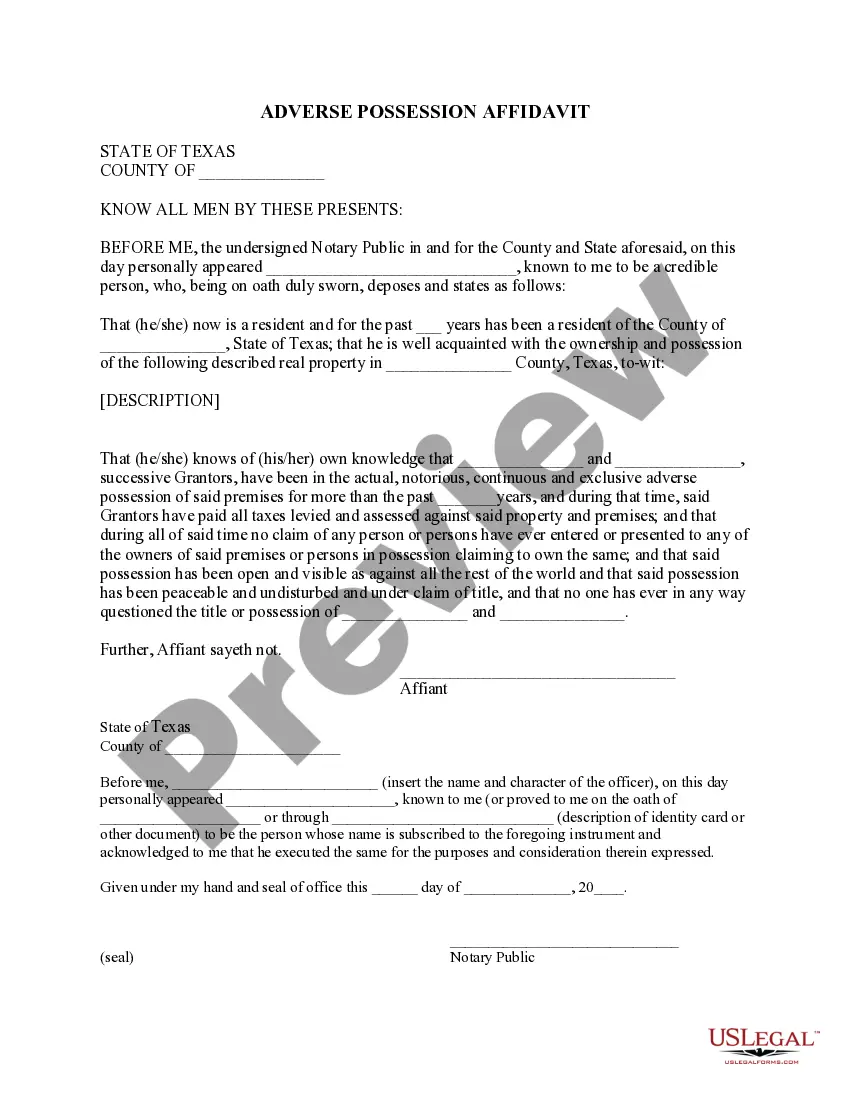
How to fill out Texas Adverse Possession Affidavit - Squatters Rights?
- If you're a returning user, simply log in to your account and download the necessary form template by clicking the Download button. Ensure that your subscription is active; renew if needed.
- For first-time users, begin by exploring the Preview mode and form descriptions to select the appropriate template that aligns with your requirements and local jurisdiction rules.
- If you encounter any discrepancies, utilize the Search tab to find an alternative template and ensure it meets your needs.
- Proceed to purchase your document by clicking the Buy Now button, and select your preferred subscription plan. Remember to create an account for full access to resources.
- Complete your transaction by entering your credit card details or using your PayPal account to finalize the subscription.
- Finally, download your form and save it on your device. You can access it anytime through the My Forms section in your profile.
In conclusion, US Legal Forms provides a robust collection of over 85,000 forms, ensuring that you have the necessary resources at your fingertips. Their accessible platform and expert support guarantee that your legal documents are completed accurately and efficiently.
Start your journey today by exploring the extensive library at US Legal Forms and ensure your legal needs are met seamlessly.
Form popularity
FAQ
To qualify as a Texas grantors resident for tax purposes, you typically need to establish a physical presence in Texas. This can include having a home or business in the state and spending a significant amount of time here each year. Additionally, maintaining a Texas driver's license and registering to vote in Texas can further demonstrate your residency status. It's essential to understand these criteria as they impact your tax obligations and benefits.
Yes, Texas residents, as grantors residents for tax purposes, are generally required to file federal tax returns, depending on their income level. However, Texas does not impose a state income tax, which can be a benefit for residents. Understanding your tax obligations can be overwhelming, but USLegalForms offers a range of resources that simplify the filing process for Texas residents.
Filing a tax return for a grantor trust involves reporting the trust's income on your personal tax return if you are the grantor. Since you are considered the owner for tax purposes, you’ll need to include the income on Form 1040. If you're unsure about the process, USLegalForms can provide templates and instructions tailored for grantor trusts, ensuring you meet all requirements.
To quickly obtain proof of residency in Texas, consider obtaining utility bills, bank statements, or lease agreements that show your name and Texas address. Additionally, a Texas driver's license or ID card can serve as proof. These documents can help establish your status as a Texas grantors resident for tax purposes. For more streamlined solutions, refer to USLegalForms.
Generally, it takes at least six months to establish yourself as a Texas grantors resident for tax purposes. This period allows you to demonstrate your commitment to living in Texas. However, factors like your actions and documentation will contribute significantly to your residency status. You can rely on USLegalForms for the necessary resources and guidance.
The quickest route to becoming a Texas grantors resident for tax purposes is to establish a permanent home in Texas. This involves moving your personal belongings, obtaining a Texas driver’s license, and registering to vote. Additionally, you should gather documents that demonstrate your intention to live in Texas. For more assistance in establishing residency, check out USLegalForms.
To qualify as a Texas grantors resident for tax purposes, you typically need to live in Texas for at least six months. However, your intent to make Texas your permanent home is equally important. Establishing a clear residency helps you take advantage of the state's tax structure. If you have questions about your personal situation, USLegalForms can guide you through the process.
Claiming residency in two states is possible, but it can lead to confusion regarding tax obligations. You may file tax returns in both states, but if both claim you as a resident, it could complicate your finances. To clarify your status as a Texas grantors resident for tax purposes while navigating other state requirements, consider utilizing platforms like uslegalforms for accurate information and helpful resources.
The timeline for establishing residency in Texas for tax purposes can vary based on your circumstances. Generally, you need to live in Texas for at least 12 months and demonstrate intent through actions like obtaining a Texas driver's license and registering to vote. Ultimately, your status as a Texas grantors resident for tax purposes may depend on the details of your situation.
Yes, it is possible to be a resident of two states for tax purposes. If you split your time between two states, both may claim you as a resident based on their laws. To navigate the complexities of being a Texas grantors resident for tax purposes while managing residency in another state, consider seeking assistance from experts like uslegalforms, which can provide helpful resources and guidance.