Does Texas Have Squatting Rights
Description
Get your form ready online
Our built-in tools help you complete, sign, share, and store your documents in one place.
Make edits, fill in missing information, and update formatting in US Legal Forms—just like you would in MS Word.
Download a copy, print it, send it by email, or mail it via USPS—whatever works best for your next step.
Sign and collect signatures with our SignNow integration. Send to multiple recipients, set reminders, and more. Go Premium to unlock E-Sign.
If this form requires notarization, complete it online through a secure video call—no need to meet a notary in person or wait for an appointment.
We protect your documents and personal data by following strict security and privacy standards.

Make edits, fill in missing information, and update formatting in US Legal Forms—just like you would in MS Word.

Download a copy, print it, send it by email, or mail it via USPS—whatever works best for your next step.

Sign and collect signatures with our SignNow integration. Send to multiple recipients, set reminders, and more. Go Premium to unlock E-Sign.

If this form requires notarization, complete it online through a secure video call—no need to meet a notary in person or wait for an appointment.

We protect your documents and personal data by following strict security and privacy standards.
Looking for another form?
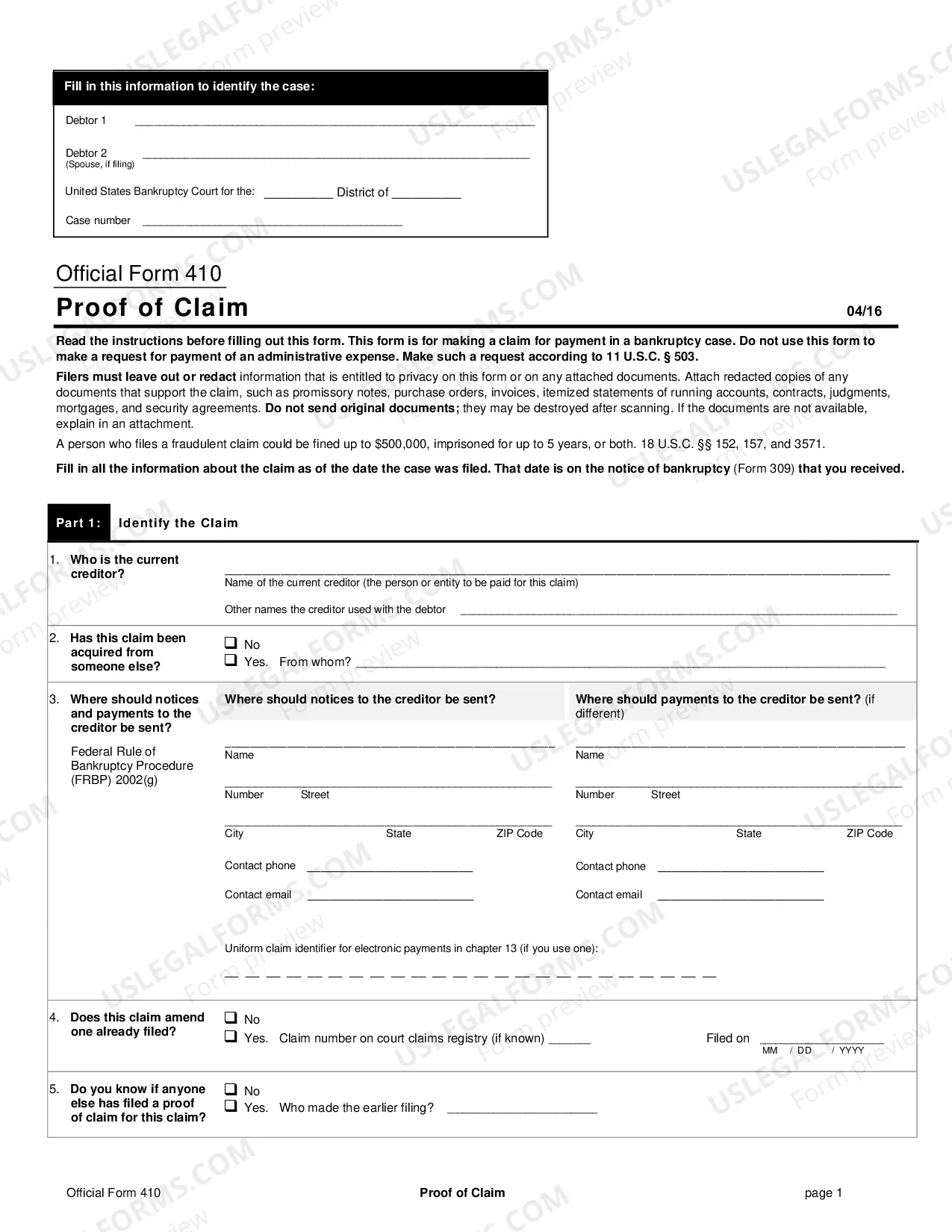
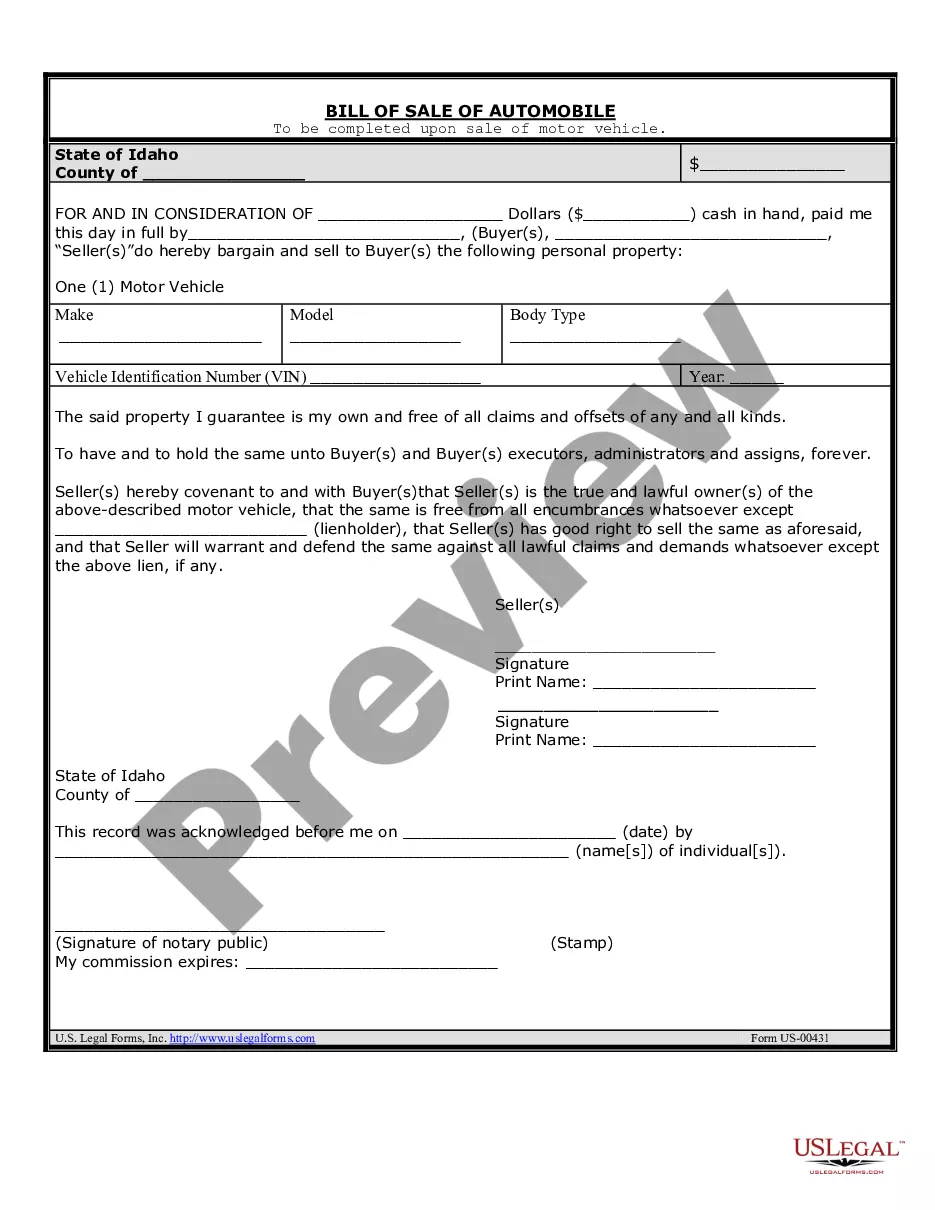
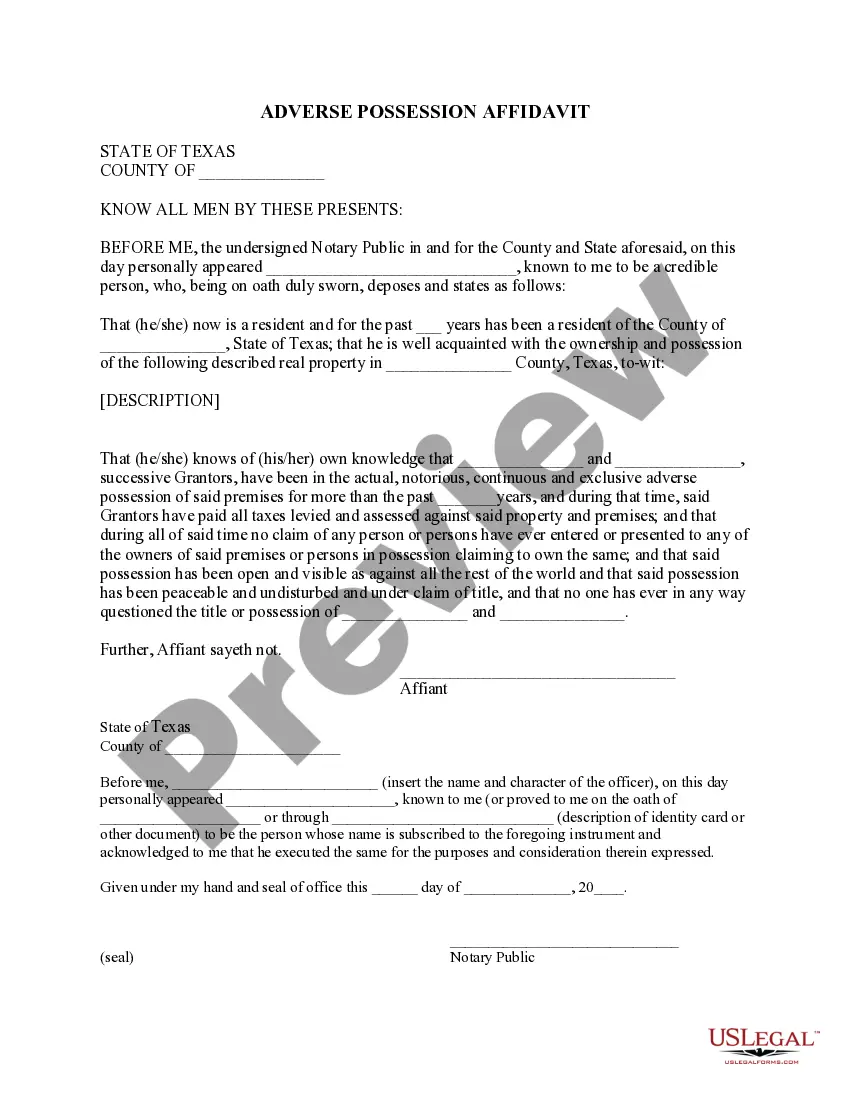
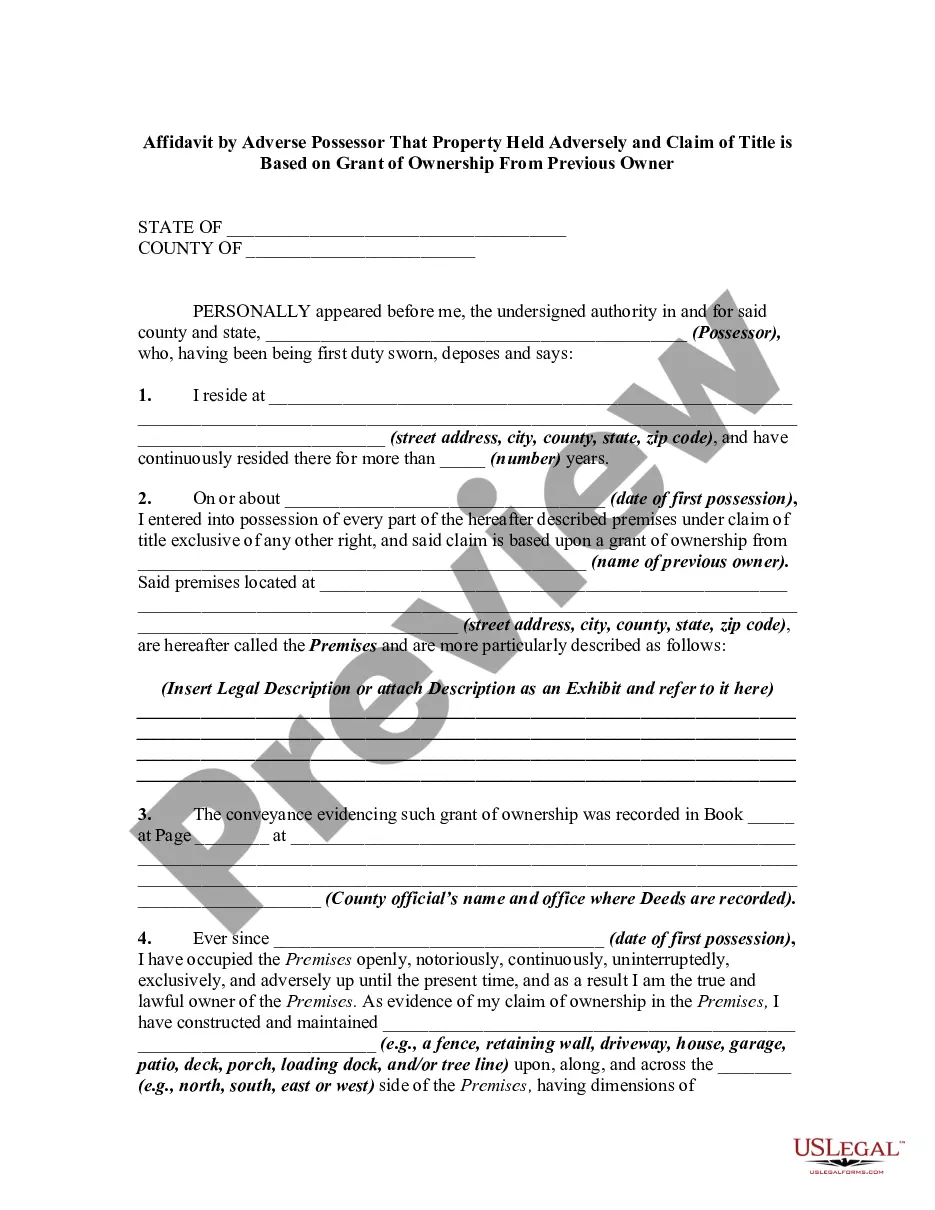
How to fill out Texas Adverse Possession Affidavit - Squatters Rights?
- If you are a returning user of US Legal Forms, log in to your account and access the required document by clicking the Download button. Ensure your subscription is active; if not, renew it according to your chosen payment plan.
- For new users, start by exploring the Preview mode and detailed form descriptions. Verify that you select the correct document that aligns with your needs and meets local jurisdiction regulations.
- If necessary, utilize the Search tab to locate alternative templates. If you find any discrepancies, adjust your search until you discover the appropriate form.
- Purchase the document. Click the Buy Now button and select your preferred subscription plan; you'll need to create an account for access.
- Complete your purchase by providing payment information via credit card or PayPal.
- Download your chosen form and save it to your device. You can always revisit it through the My documents section in your profile.
US Legal Forms empowers individuals and attorneys by providing a comprehensive library of legal documents that are easy to execute. With a vast collection of over 85,000 fillable and editable forms, users can access crucial information and expert assistance.
Taking the time to understand and secure the right legal forms is essential. Get started with US Legal Forms today and ensure your documents are precise and legally sound!
Form popularity
FAQ
Yes, you can remove a squatter from your property in Texas, but the process requires legal action. Eviction proceedings typically begin with a formal notice to vacate, followed by a court hearing if the squatter does not leave voluntarily. It is essential to follow the legal procedure to avoid complications and protect your rights as the property owner. If you're uncertain about the steps involved, exploring resources like US Legal Forms can provide you with the necessary documentation and guidance on the question, 'Does Texas have squatting rights?'.
In Texas, establishing squatter rights can take several years, typically around ten years of continuous occupancy. During this period, squatters must openly and exclusively use the property without the owner's consent. While they may gain certain legal protections over time, it is crucial to understand that each case can vary based on specific circumstances. If you're grappling with the question, 'Does Texas have squatting rights?', knowing the timeline can help you navigate this complex issue.
Forcibly removing a squatter in Texas without legal proceedings is generally not allowed. As a property owner, you must follow the lawful eviction process, as taking matters into your own hands can lead to legal trouble. Knowing the legal steps to take is crucial, especially when considering whether 'does Texas have squatting rights?' equips you to act properly and protect your property.
In Texas, squatters have certain rights under adverse possession laws. If they occupy a property continuously and openly for a specific period, they may claim legal ownership. Understanding the details of squatting rights in Texas can help you navigate issues effectively. Remember, the question 'Does Texas have squatting rights?' highlights the importance of knowing your legal options.
In Texas, to qualify for squatters' rights, you must occupy the property openly, continuously, and without the owner's permission for at least ten years. Additionally, you must have a claim of right, demonstrating your intent to possess the property. Keeping detailed records of your occupancy can be beneficial. Exploring platforms like USLegalForms can help you navigate these requirements effectively, ensuring you understand if Texas has squatting rights applicable to your situation.
To file for squatters' rights in Texas, first, ensure that you meet the necessary criteria set by state laws. You must occupy the property openly and without permission for a specific period, usually ten years. After you establish this, you can file a claim with your local court. Remember, understanding the legal process is important, and utilizing resources like USLegalForms can simplify your journey in claiming squatters' rights.
In the United States, squatters' rules vary by state, but generally, they allow individuals to claim legal ownership of property if they occupy it for a specific period. This principle is called adverse possession, which requires continuous, open, and notorious possession of the property. Being aware of these rules, particularly whether does Texas have squatting rights, can aid in making informed decisions about property occupancy.
Finding a property to squat in requires careful consideration and should be approached with awareness of legal implications. Look for abandoned or vacant houses in neighborhoods where properties often sit unused. However, before making any decisions, research local laws and regulations, especially regarding squatters' rights. Understanding does Texas have squatting rights will provide clarity and direction.
Establishing squatters' rights in Texas typically takes around 10 years of uninterrupted occupancy. During this time, it’s essential that you treat the property as your own, which includes meeting local laws and maintaining the area. There may be variations in your situation, so consulting legal resources is beneficial. Therefore, being informed about does Texas have squatting rights is advisable.
To claim squatters' rights in Texas, you should establish continuous and open possession of the property for the required duration. It's vital to demonstrate the property wasn't used or inhabited by anyone else during this time. Additionally, gathering evidence of your occupancy, such as utility bills or receipts, may strengthen your claim. Knowing how to assert your rights around does Texas have squatting rights can help protect your interests.