Texas War Of Independence
Description


Get your form ready online
Our built-in tools help you complete, sign, share, and store your documents in one place.
Make edits, fill in missing information, and update formatting in US Legal Forms—just like you would in MS Word.
Download a copy, print it, send it by email, or mail it via USPS—whatever works best for your next step.
Sign and collect signatures with our SignNow integration. Send to multiple recipients, set reminders, and more. Go Premium to unlock E-Sign.
If this form requires notarization, complete it online through a secure video call—no need to meet a notary in person or wait for an appointment.
We protect your documents and personal data by following strict security and privacy standards.

Make edits, fill in missing information, and update formatting in US Legal Forms—just like you would in MS Word.

Download a copy, print it, send it by email, or mail it via USPS—whatever works best for your next step.

Sign and collect signatures with our SignNow integration. Send to multiple recipients, set reminders, and more. Go Premium to unlock E-Sign.

If this form requires notarization, complete it online through a secure video call—no need to meet a notary in person or wait for an appointment.

We protect your documents and personal data by following strict security and privacy standards.
Looking for another form?




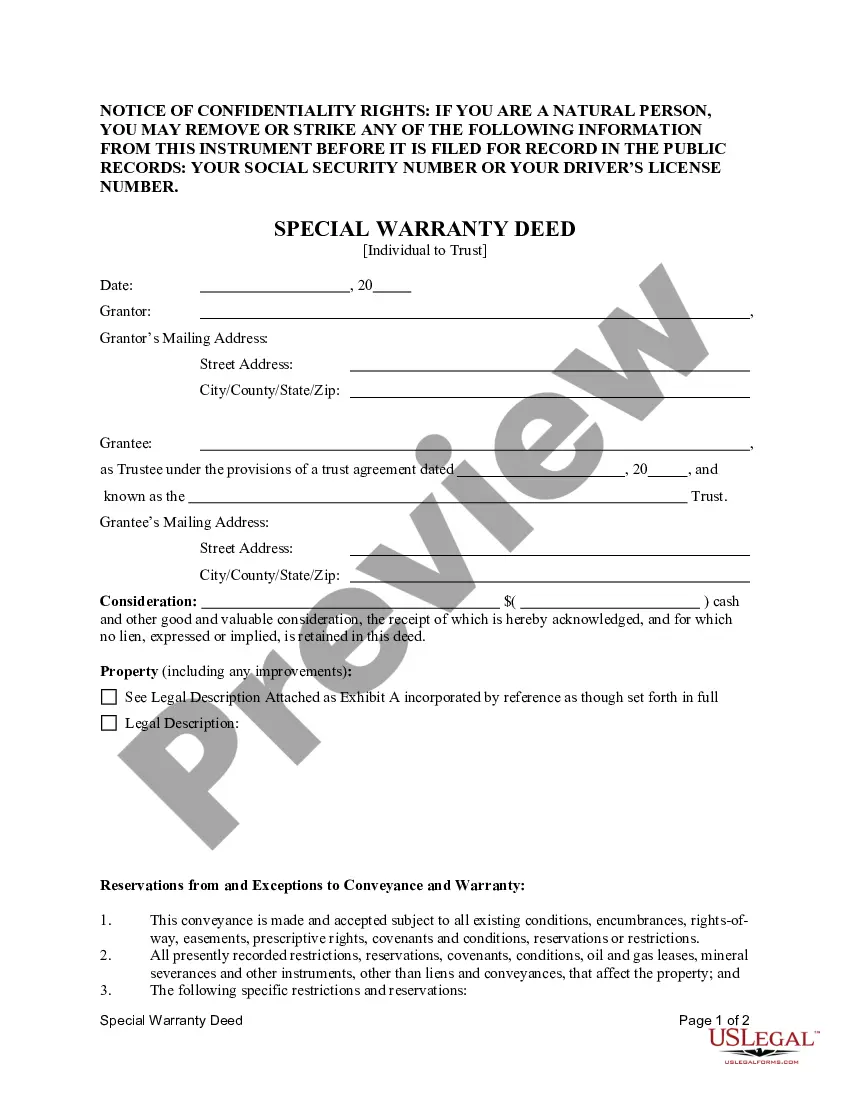
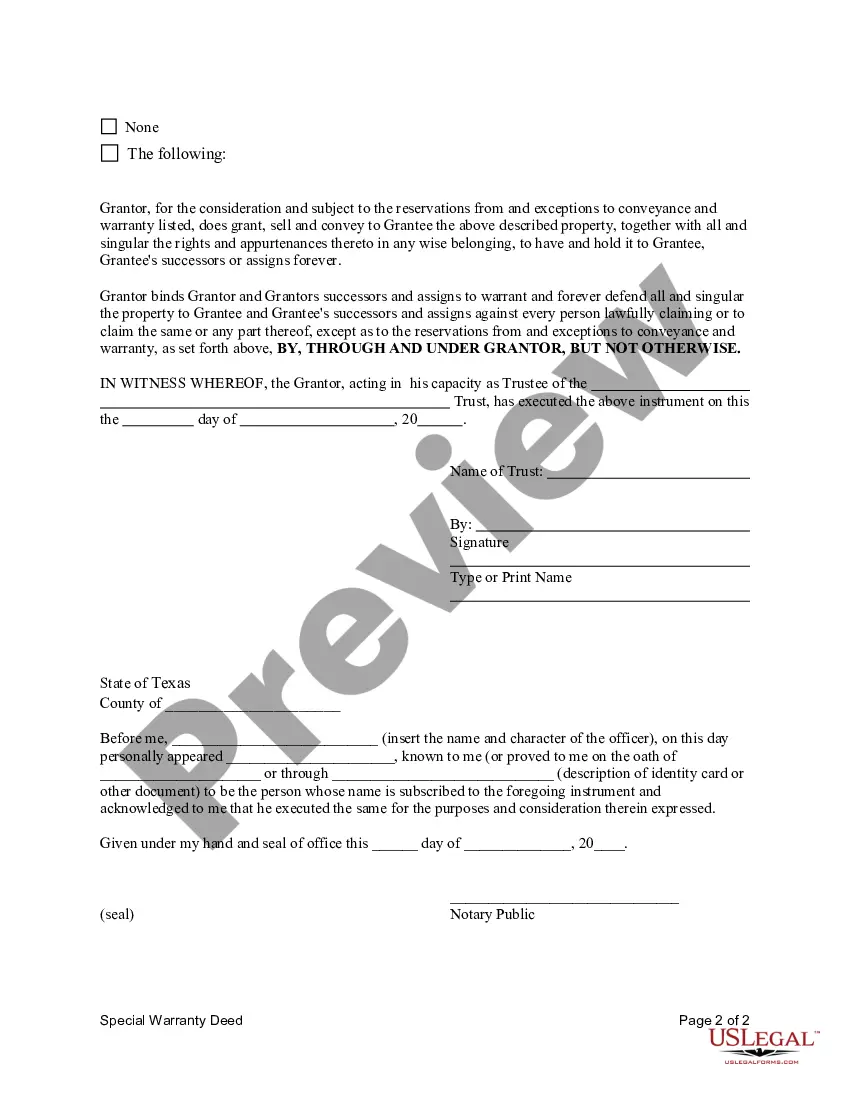
How to fill out Texas Special Warranty Deed From An Individual To A Trust?
- If you're a returning user, log into your account and locate the desired form template. Ensure that your subscription is current; renew it if necessary.
- For first-time users, explore the Preview mode and form description to confirm you've selected the correct document that aligns with your local jurisdiction.
- Should you need to search for other templates, utilize the Search tab for the right match. Proceed to the next step once you find an appropriate form.
- Purchase the document by clicking on the Buy Now button and selecting your preferred subscription plan. You'll need to create an account for access.
- Complete your payment by entering your credit card information or using your PayPal account.
- Download your document and save it to your device for completion. You can also access it later from the My Forms section.
US Legal Forms simplifies the process of obtaining legal documents, ensuring a hassle-free experience. With a robust collection of over 85,000 forms and expert assistance, you will have all the resources necessary to complete your legal tasks effectively.
Start your journey with US Legal Forms today and empower yourself with the tools to navigate your legal needs effortlessly!
Form popularity
FAQ
Interestingly, no Mexican citizens signed the Texas Declaration of Independence. This document was created by American settlers seeking independence from Mexican rule. Although tensions existed between different groups in Texas, the declaration represented solely the sentiments of the Anglo-American colonists. Understanding this context is essential when studying the Texas war of independence.
The signing ceremony of the Texas Declaration of Independence included key figures in Texas's struggle for freedom. Notable attendees included Sam Houston, James Fannin, and Edward Burleson. These leaders were crucial in mobilizing support for the revolution and providing strategic decisions during the Texas war of independence. Their presence underscored the importance of this moment in Texas history.
In total, 59 people signed the Texas Declaration of Independence. This group included influential leaders and representatives from various regions of Texas, showcasing the diverse support for independence. Each individual's signature was a commitment to the cause of freedom from Mexican rule. This act was pivotal in galvanizing support during the Texas war of independence.
The Texas Declaration of Independence was drafted by a committee of five men. This group, which included prominent leaders like Thomas Jefferson Rusk and George C. Childress, took great care in articulating the reasons for independence. Their collective efforts produced a powerful document that outlined Texas's aspirations. Their work remains a significant part of the story surrounding the Texas war of independence.
The Texas Declaration of Independence is a formal statement declaring Texas's separation from Mexico. It outlined the grievances against the Mexican government and expressed the colonists' desire for self-rule. This important document was adopted on March 2, 1836, and symbolized the determination of the Texans during the Texas war of independence. It served as a rallying point for those fighting for their rights and freedoms.
The Texas Declaration of Independence was signed by 59 individuals who represented various communities in Texas. These signers played a critical role in declaring independence from Mexico. Their commitment demonstrated a united front for the cause. Each signature represents a person's dedication to the principles of freedom and self-governance during the Texas war of independence.
One key cause of the Texas war of independence was the growing tension between Anglo-American settlers and the Mexican government. Disputes over land rights, taxes, and the enforcement of laws created friction. Settlers sought more autonomy and fought for rights they felt were being ignored. This conflict ultimately fueled their desire for independence, leading to the Texas war of independence.
Texas gained independence from Mexico through strategic battles and sustained resistance during the Texas War of Independence. The conflict began in 1835 and culminated in 1836, when the Texan army, under Sam Houston, won critical victories. The agreement following the Battle of San Jacinto effectively ended hostilities and recognized Texas as an independent entity. This historical event not only changed Texas' status but also set the stage for its future as a part of the United States.
Texas finally gained its independence from Mexico through military victories, international support, and diplomatic efforts. After the crucial Battle of San Jacinto, the Texan army captured General Santa Anna, who signed treaties recognizing Texas' independence. These treaties, although later contested, played a significant role in solidifying Texas’ claims to sovereignty. The Texas War of Independence thus marked a definitive shift in control from Mexico to the Republic of Texas.
Several factors contributed to the Texas War of Independence, including cultural differences, the growth of Anglo-American settlements, and increasing tensions over land rights. Additionally, the imposition of tariffs and laws by the Mexican government led to discontent among Texans. Another cause was the lack of political representation for Texan settlers in the Mexican government, which further fueled their desire for self-governance. These elements combined created a perfect storm that initiated the fight for independence.