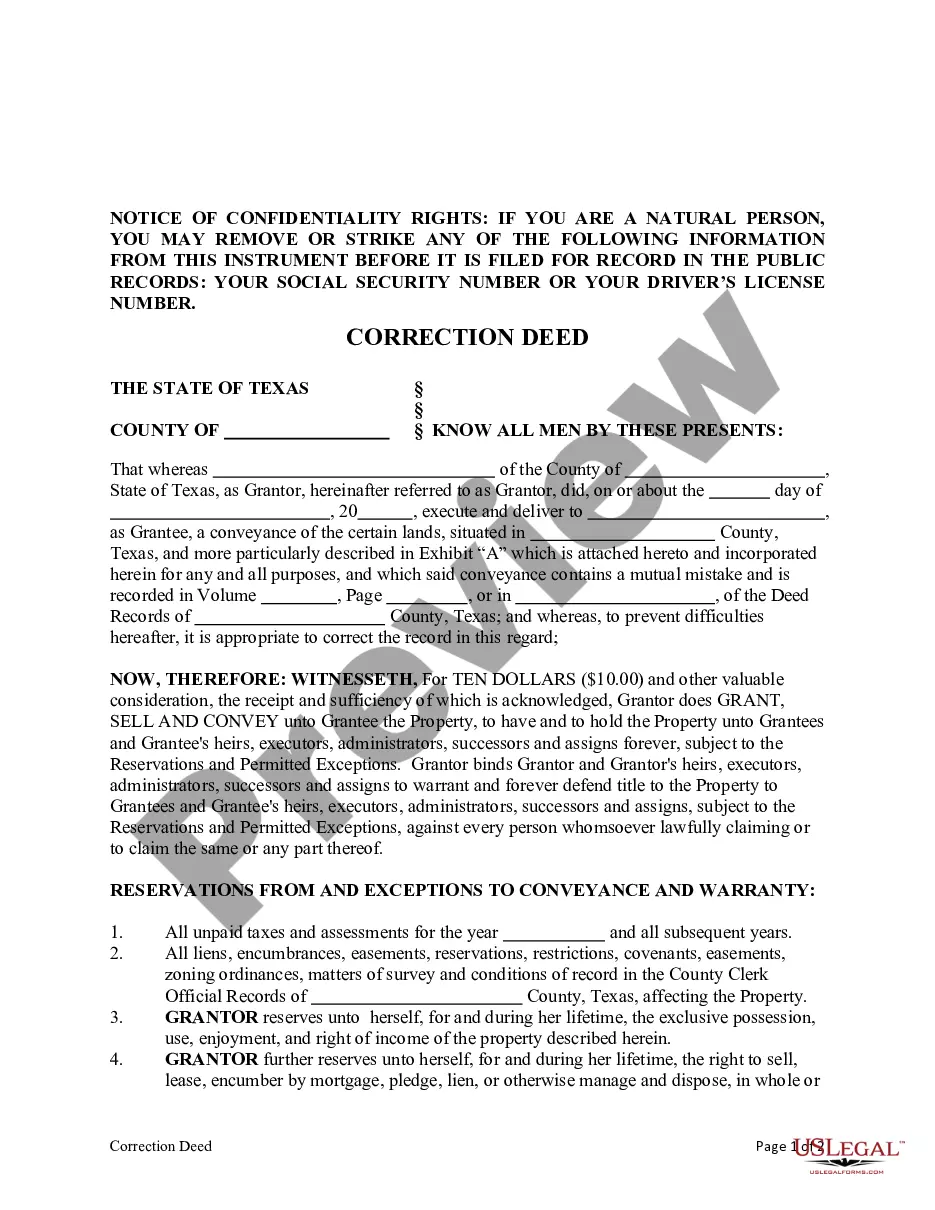
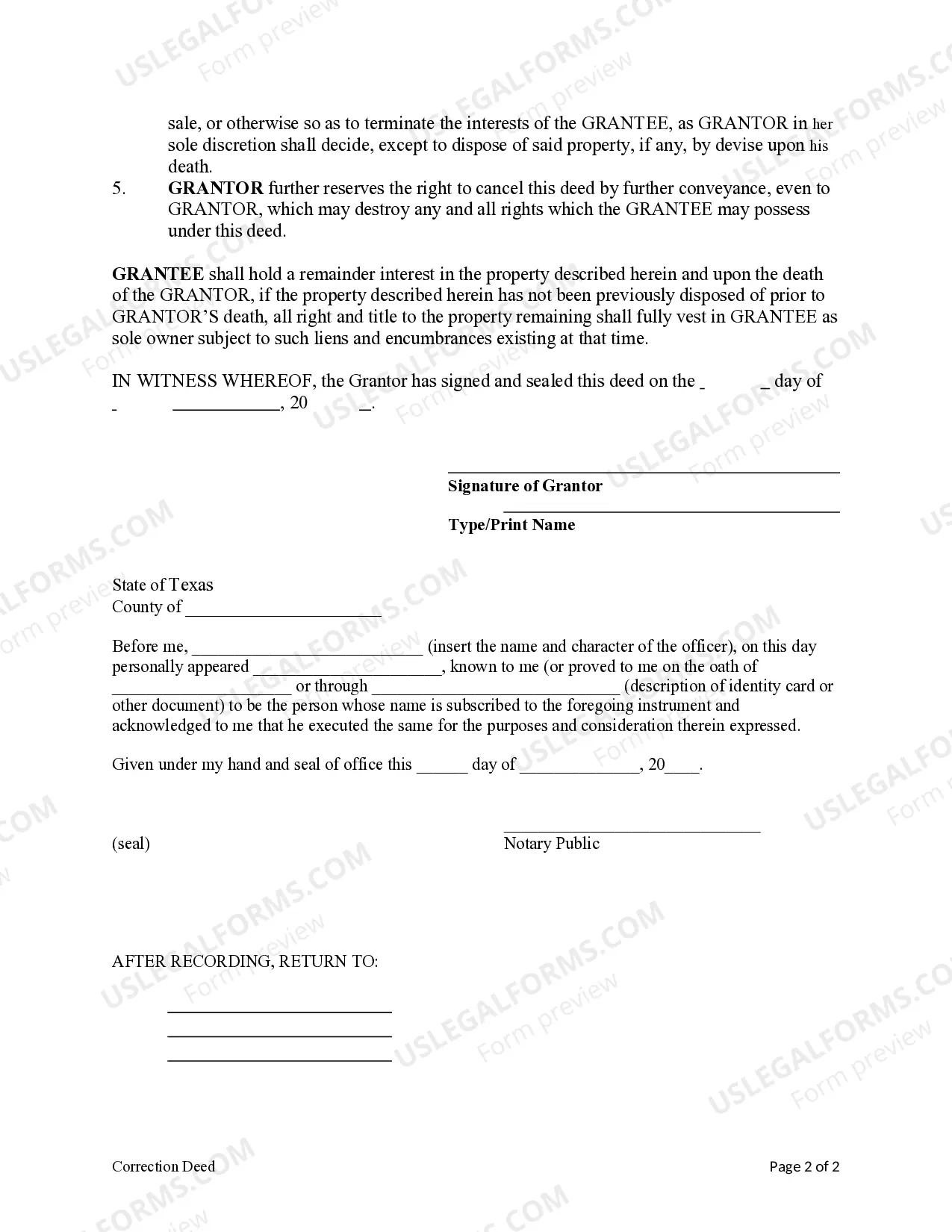
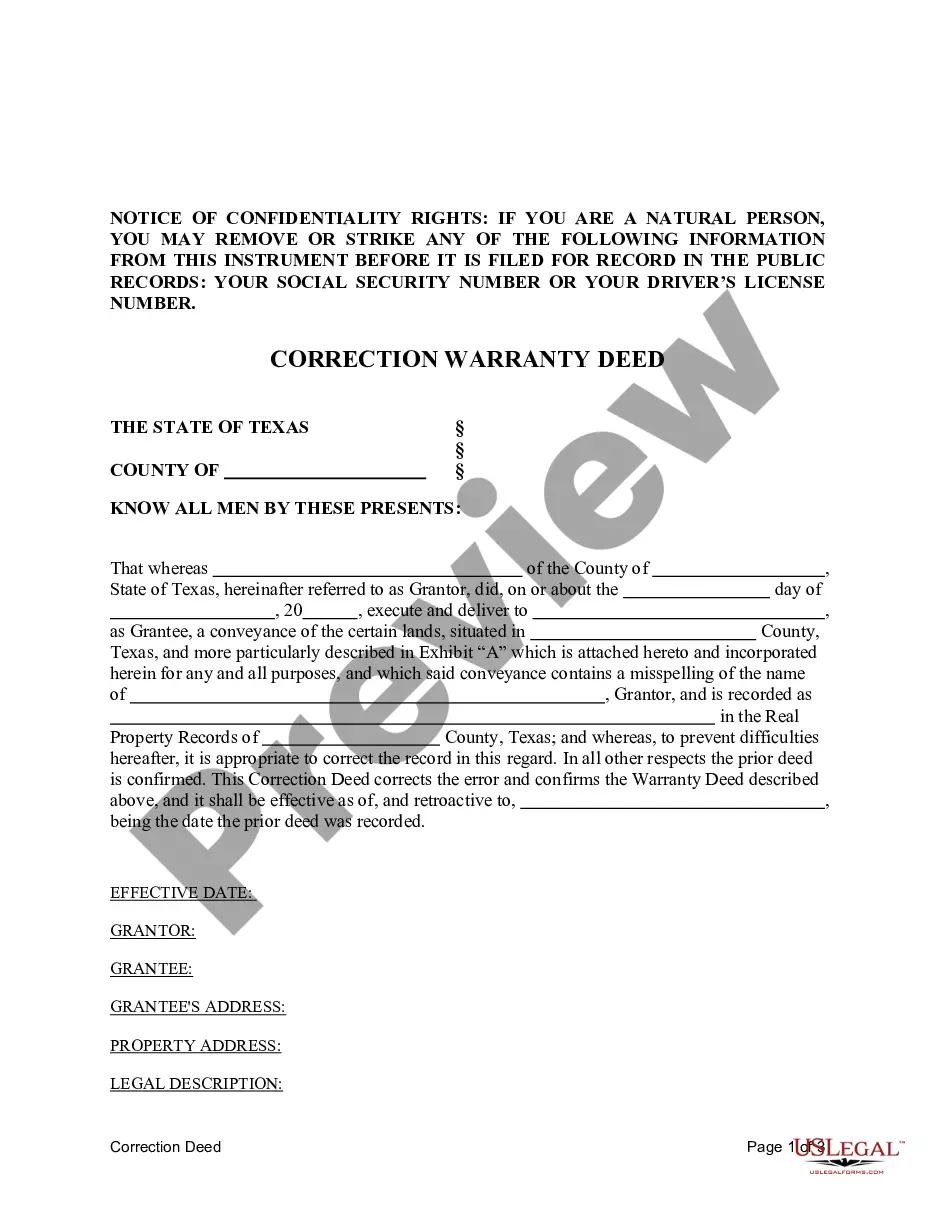
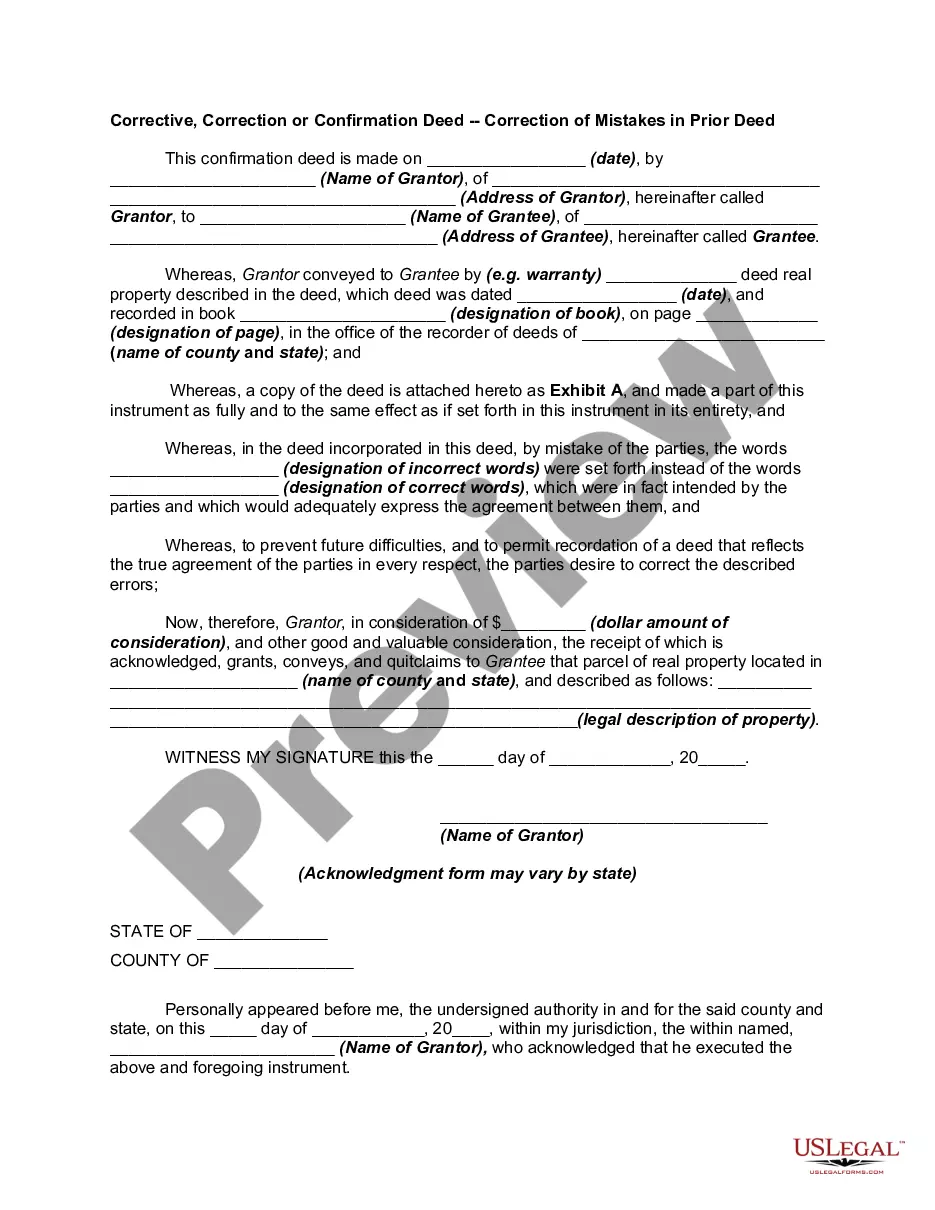
Correction Deed Form Texas Format
Description

Get your form ready online
Our built-in tools help you complete, sign, share, and store your documents in one place.
Make edits, fill in missing information, and update formatting in US Legal Forms—just like you would in MS Word.
Download a copy, print it, send it by email, or mail it via USPS—whatever works best for your next step.
Sign and collect signatures with our SignNow integration. Send to multiple recipients, set reminders, and more. Go Premium to unlock E-Sign.
If this form requires notarization, complete it online through a secure video call—no need to meet a notary in person or wait for an appointment.
We protect your documents and personal data by following strict security and privacy standards.

Make edits, fill in missing information, and update formatting in US Legal Forms—just like you would in MS Word.

Download a copy, print it, send it by email, or mail it via USPS—whatever works best for your next step.

Sign and collect signatures with our SignNow integration. Send to multiple recipients, set reminders, and more. Go Premium to unlock E-Sign.

If this form requires notarization, complete it online through a secure video call—no need to meet a notary in person or wait for an appointment.

We protect your documents and personal data by following strict security and privacy standards.
Looking for another form?








How to fill out Texas Correction Deed - Prior Deed From An Individual To An Individual?
Legal administration can be daunting, even for seasoned professionals.
When you are looking for a Correction Deed Form Texas Format and don’t have the time to invest in finding the right and updated version, the process can be taxing.
Access a valuable resource library of articles, guides, and materials tailored to your situation and needs.
Save time and effort searching for the documents you require, and use US Legal Forms’ advanced search and Review feature to find and obtain Correction Deed Form Texas Format.
Confirm that the example is recognized in your state or county. Select Buy Now when you are ready. Choose a monthly subscription plan. Locate the format you need, and Download, fill out, sign, print, and submit your document. Take advantage of the US Legal Forms online library, backed by 25 years of expertise and reliability. Streamline your document management today with a simplified and user-friendly process.
- If you hold a membership, Log In to your US Legal Forms account, look for the form, and retrieve it.
- Check your My documents section to view the documents you've previously downloaded and manage your folders as needed.
- If this is your first time with US Legal Forms, create a free account and gain unlimited access to all platform benefits.
- Here are the steps to take after obtaining the form you need.
- Ensure it is the correct form by previewing it and reviewing its details.
- Access state- or county-specific legal and business documents.
- US Legal Forms accommodates any needs you may have, from personal to corporate papers, all in one place.
- Utilize cutting-edge tools to complete and manage your Correction Deed Form Texas Format.
Form popularity
FAQ
Filing a correction deed in Texas involves several steps. First, obtain the correction deed form Texas format and fill in your details accurately. After notarizing the document, submit it to the county clerk's office where the original deed was recorded. Using a reliable resource like US Legal Forms can simplify this process and ensure you follow the correct procedures.
To correct a name on a deed in Texas, you will need to draft a correction deed that specifies the error and the correct name. Ensure that you use the proper correction deed form Texas format to facilitate this process. After completing the document, get it notarized and file it with the county clerk's office to officially update the name on record.
In Texas, any party involved in the original deed can file a correction deed. This typically includes the grantor, grantee, or their authorized representatives. To streamline this process, you can use the correction deed form Texas format from US Legal Forms, which offers guidance and templates for accurate filing.
Yes, a correction deed must be notarized in Texas to ensure its validity. This step is crucial as it verifies the identities of the parties involved and confirms that they signed the document willingly. After notarization, you can proceed to file the correction deed with the county clerk's office using the correct correction deed form Texas format.
A correction deed typically resembles a standard deed but includes specific language indicating that it is a correction. The document will reference the original deed by its date and includes the necessary corrections in a clear format. To find an accurate representation, consider using the correction deed form Texas format available on platforms like US Legal Forms.
Making corrections in a sale deed involves identifying the errors clearly and using the correct correction deed form Texas format. You will need to draft a correction deed that specifies the original deed date and the changes you wish to make. Once you have completed the form, ensure to notarize it and file it with your local county clerk to make the amendments official.
To file a correction deed in Texas, first ensure that you have the correct correction deed form Texas format. Next, complete the form with accurate information, including the necessary corrections. After filling it out, you need to sign the document in the presence of a notary, then file it with your county's clerk's office for it to be officially recorded.
To correct a mistake in a deed, start by identifying the error in the original document. Use the correction deed form in Texas format to clearly state the mistake and provide the accurate information. After filling out the form, submit it to your local county clerk's office for recording. This process legally updates the deed and ensures that the public records reflect the correct information.
To get a deed correction, you need to fill out a correction deed form in Texas format. Begin by gathering the original deed and any related documents. Then, accurately complete the form, ensuring all necessary details are included. Finally, file the completed correction deed with the appropriate county office to officially amend the public record.