Texas Intestate Succession Stepchildren
Description
Get your form ready online
Our built-in tools help you complete, sign, share, and store your documents in one place.
Make edits, fill in missing information, and update formatting in US Legal Forms—just like you would in MS Word.
Download a copy, print it, send it by email, or mail it via USPS—whatever works best for your next step.
Sign and collect signatures with our SignNow integration. Send to multiple recipients, set reminders, and more. Go Premium to unlock E-Sign.
If this form requires notarization, complete it online through a secure video call—no need to meet a notary in person or wait for an appointment.
We protect your documents and personal data by following strict security and privacy standards.

Make edits, fill in missing information, and update formatting in US Legal Forms—just like you would in MS Word.

Download a copy, print it, send it by email, or mail it via USPS—whatever works best for your next step.

Sign and collect signatures with our SignNow integration. Send to multiple recipients, set reminders, and more. Go Premium to unlock E-Sign.

If this form requires notarization, complete it online through a secure video call—no need to meet a notary in person or wait for an appointment.

We protect your documents and personal data by following strict security and privacy standards.
Looking for another form?







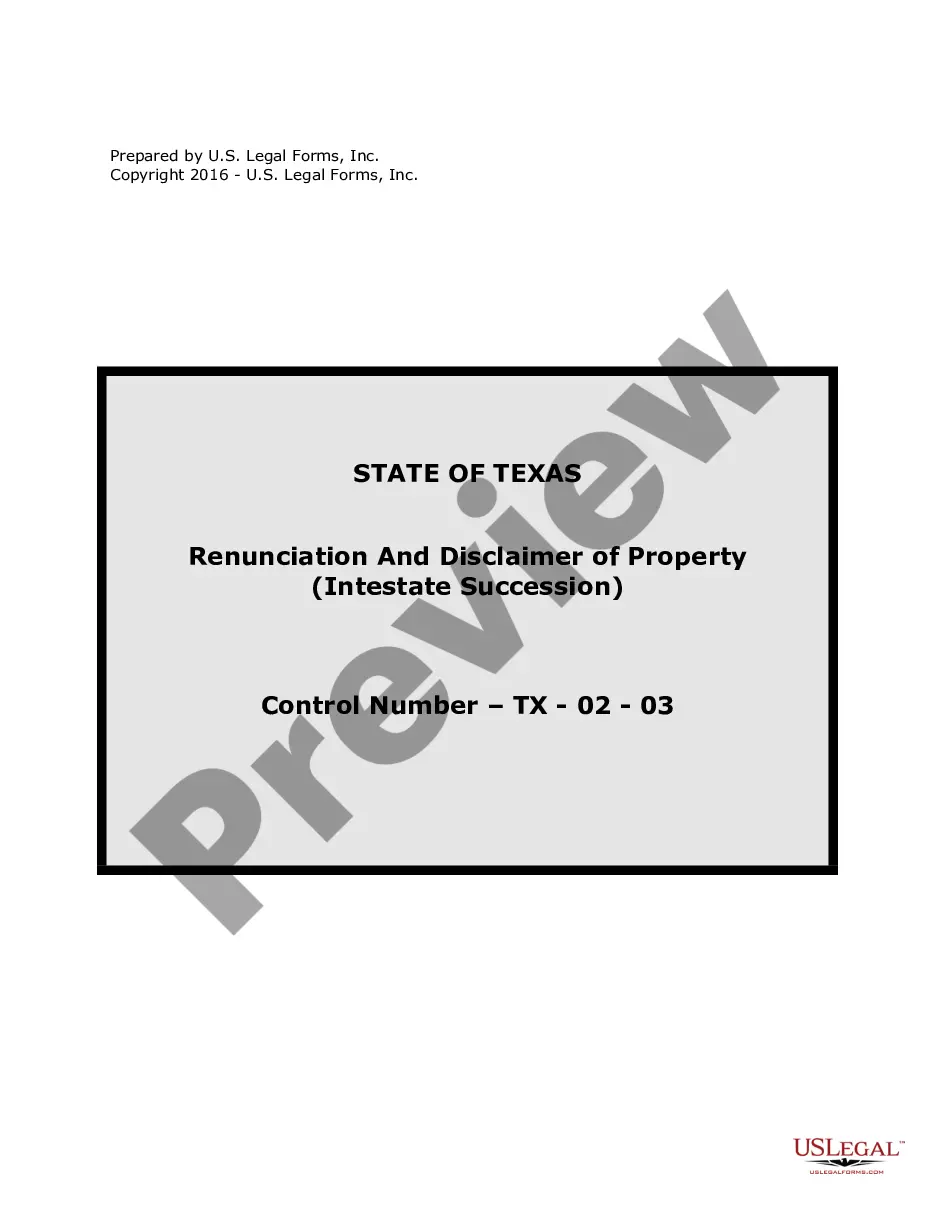
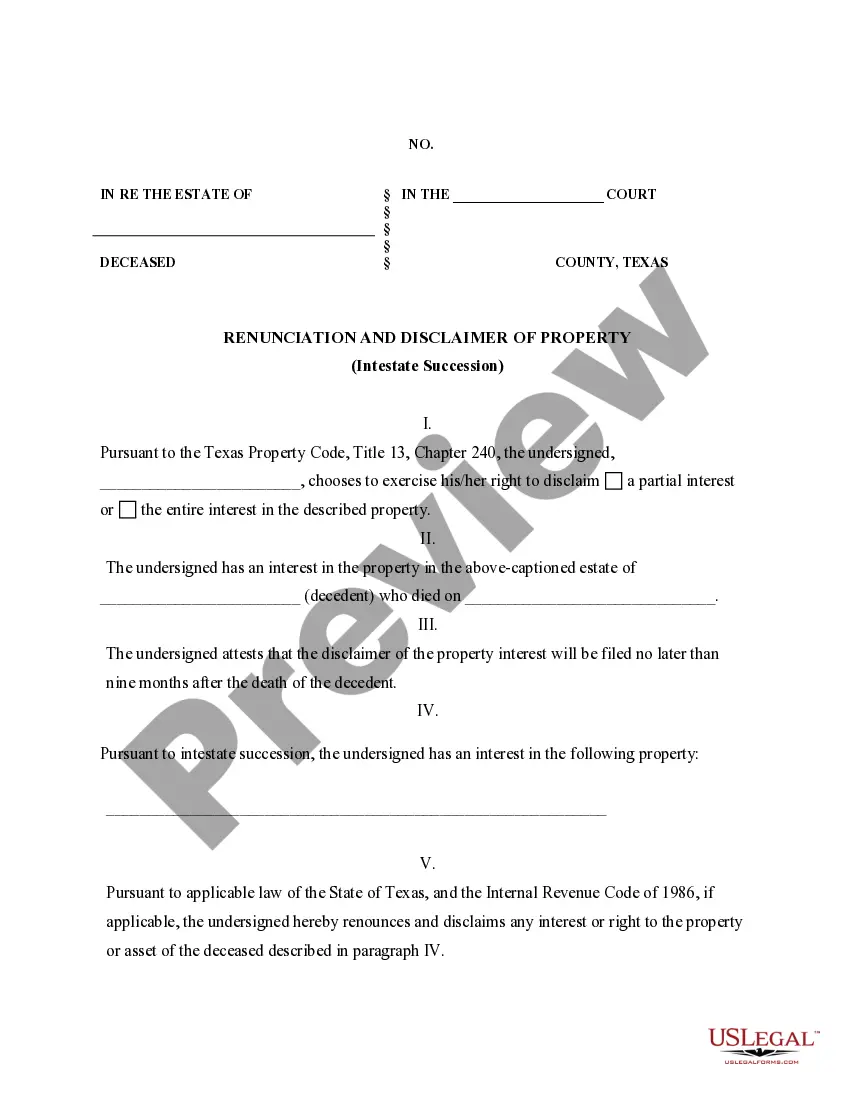
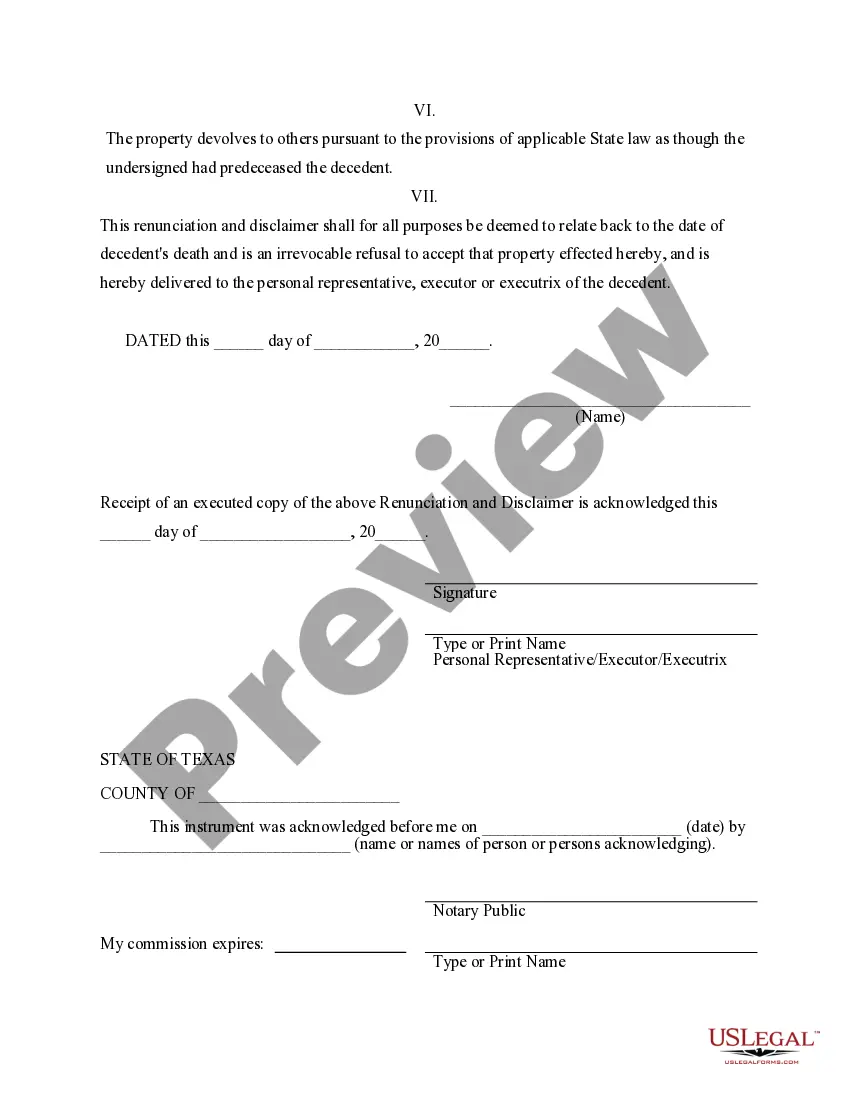
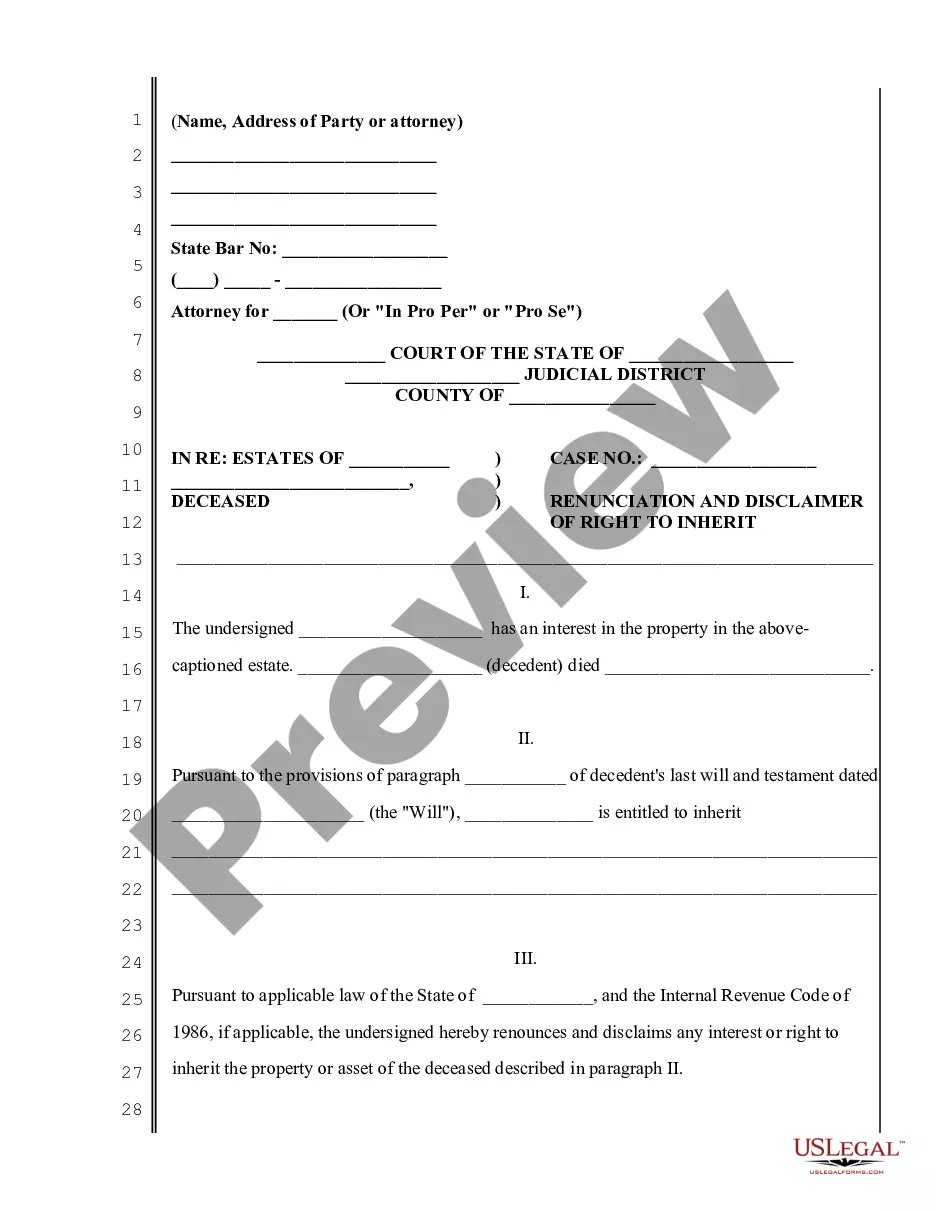
How to fill out Texas Renunciation And Disclaimer Of Property Received By Intestate Succession?
- If you have used US Legal Forms before, log in to your account and download the required form template directly to your device by selecting the Download button. Ensure your subscription is active; if not, renew it according to your plan.
- For new users, start by reviewing the Preview mode and form description to verify that you've selected the correct document for your jurisdiction.
- If your needs change, use the Search tab to explore more templates and find the one that fits your situation perfectly.
- Once satisfied, click the Buy Now button and choose your preferred subscription plan. Note that you'll need to create an account to access the extensive library.
- Proceed to payment by entering your credit card details or using your PayPal account to finalize your subscription purchase.
- After completing the purchase, download your form and save it on your device for completion. You can always access it later in the My Forms section of your profile.
US Legal Forms empowers users and attorneys with an extensive library of over 85,000 editable legal forms, making it easy to execute legal documents accurately.
Empower yourself today and streamline your legal document needs with US Legal Forms to ensure your rights are protected.
Form popularity
FAQ
When someone passes away in Texas without a will, the concept of power of attorney becomes irrelevant as it ceases upon the individual's death. Instead, the court will appoint an executor or administrator to manage the deceased's estate. Understanding the implications of Texas intestate succession stepchildren can help ensure their interests are represented correctly during this process.
Stepchildren do not inherit from a stepparent in Texas if there is no will unless they were legally adopted prior to the stepparent's death. This aspect of Texas intestate succession can come as a surprise in blended families. Families facing this situation should seek guidance to ensure everyone’s interests are being addressed properly.
Under Texas intestate succession laws, stepchildren are not automatically considered heirs. They will not inherit unless they have been legally adopted by the deceased. Understanding this aspect is crucial for families, as it affects how the estate is distributed, especially in scenarios involving blended families.
If a parent dies in Texas without a will, Texas intestate succession laws dictate how their estate is divided. Generally, the surviving children inherit the estate equally, while stepchildren may not receive anything unless they were legally adopted. It's essential to consult with a legal expert to understand your rights and options during this difficult time.
When someone dies without a will in Texas, their bank accounts may become part of the probate process. This means the account will likely be frozen until the court determines the rightful heirs based on the state's intestate succession laws. If there are Texas intestate succession stepchildren, they may have to navigate the law to find their place in the inheritance.
In Texas, the order of heirship determines who inherits property when someone dies without a will. Typically, the order starts with the deceased's children and their descendants, followed by the deceased's parents, then siblings, and finally more distant relatives. It's important to note that Texas intestate succession stepchildren do not automatically inherit unless legally adopted.
To protect inheritance from stepchildren, consider creating a comprehensive estate plan that includes a will and trusts if necessary. Clearly specify who inherits what and make sure to exclude stepchildren if that is your wish. Using legal documents from platforms like US Legal Forms can help structure your estate plan effectively. Taking these proactive steps ensures that your intentions regarding Texas intestate succession stepchildren are honored.
Under Texas intestate succession, stepchildren are not automatically entitled to inherit from a step-parent unless legally adopted. Therefore, if there is no will specifying otherwise, they may receive nothing from the estate. To include stepchildren in inheritance plans, clearly state your wishes in estate documents. This clarity allows for family harmony and respects the rights of Texas intestate succession stepchildren.
In Texas, a stepchild does not have a legal claim as next of kin under intestate succession laws. Instead, biological children, spouses, and parents take precedence in inheritance matters. This classification means that in the absence of a will, stepchildren may not inherit any portion of the estate. It is crucial to document your family structure in planning to ensure that Texas intestate succession stepchildren are considered according to your wishes.
Stepchildren are not automatically considered beneficiaries under Texas intestate succession unless they are legally adopted. This means that if a step-parent dies without a will, the stepchildren may not inherit anything unless the step-parent specified their wishes in a legal document. It is advisable to formally adopt stepchildren if you want to ensure they receive inheritance. Clarifying this in your estate planning will address any confusion regarding Texas intestate succession stepchildren.