Texas Enhanced Individual Foreclosure
Description
Get your form ready online
Our built-in tools help you complete, sign, share, and store your documents in one place.
Make edits, fill in missing information, and update formatting in US Legal Forms—just like you would in MS Word.
Download a copy, print it, send it by email, or mail it via USPS—whatever works best for your next step.
Sign and collect signatures with our SignNow integration. Send to multiple recipients, set reminders, and more. Go Premium to unlock E-Sign.
If this form requires notarization, complete it online through a secure video call—no need to meet a notary in person or wait for an appointment.
We protect your documents and personal data by following strict security and privacy standards.

Make edits, fill in missing information, and update formatting in US Legal Forms—just like you would in MS Word.

Download a copy, print it, send it by email, or mail it via USPS—whatever works best for your next step.

Sign and collect signatures with our SignNow integration. Send to multiple recipients, set reminders, and more. Go Premium to unlock E-Sign.

If this form requires notarization, complete it online through a secure video call—no need to meet a notary in person or wait for an appointment.

We protect your documents and personal data by following strict security and privacy standards.
Looking for another form?









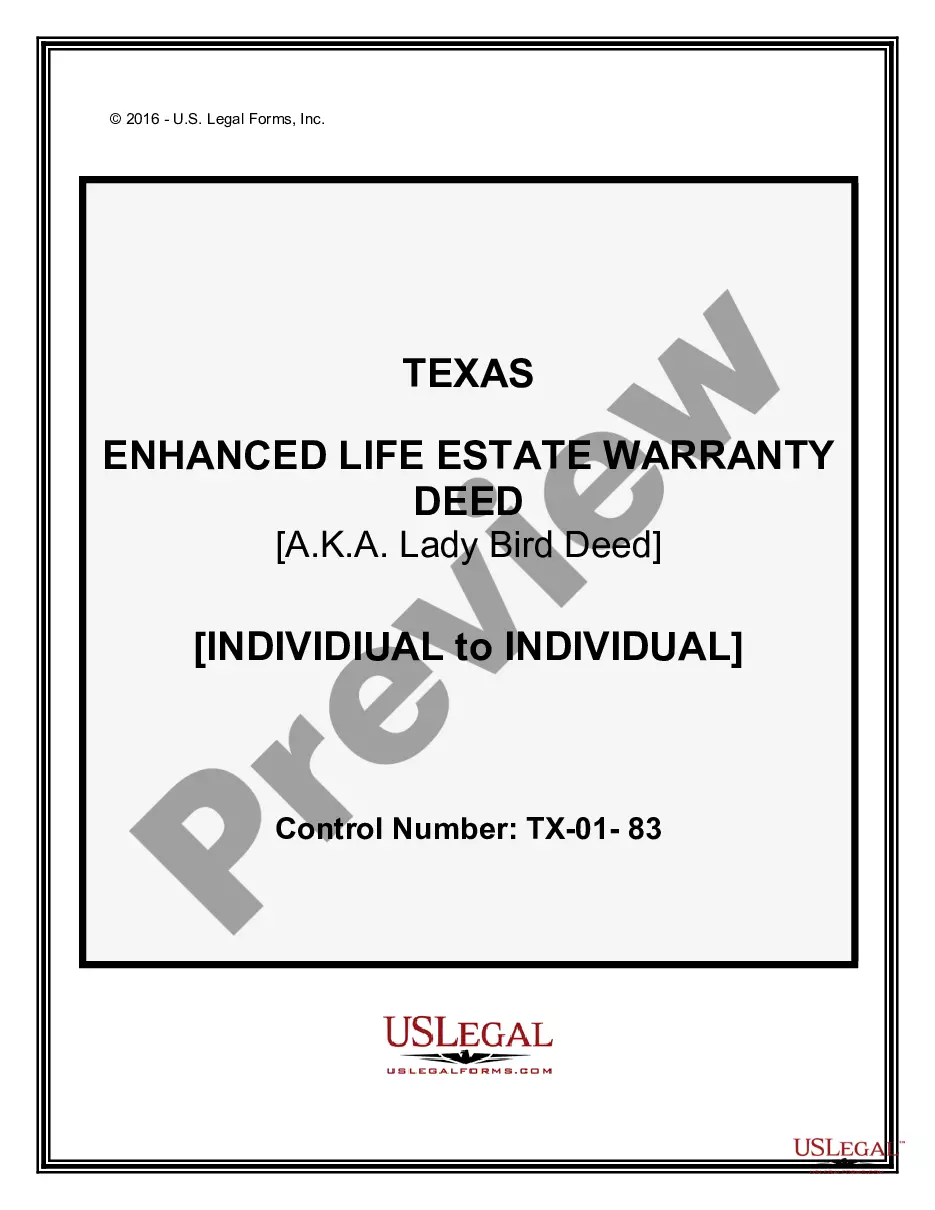
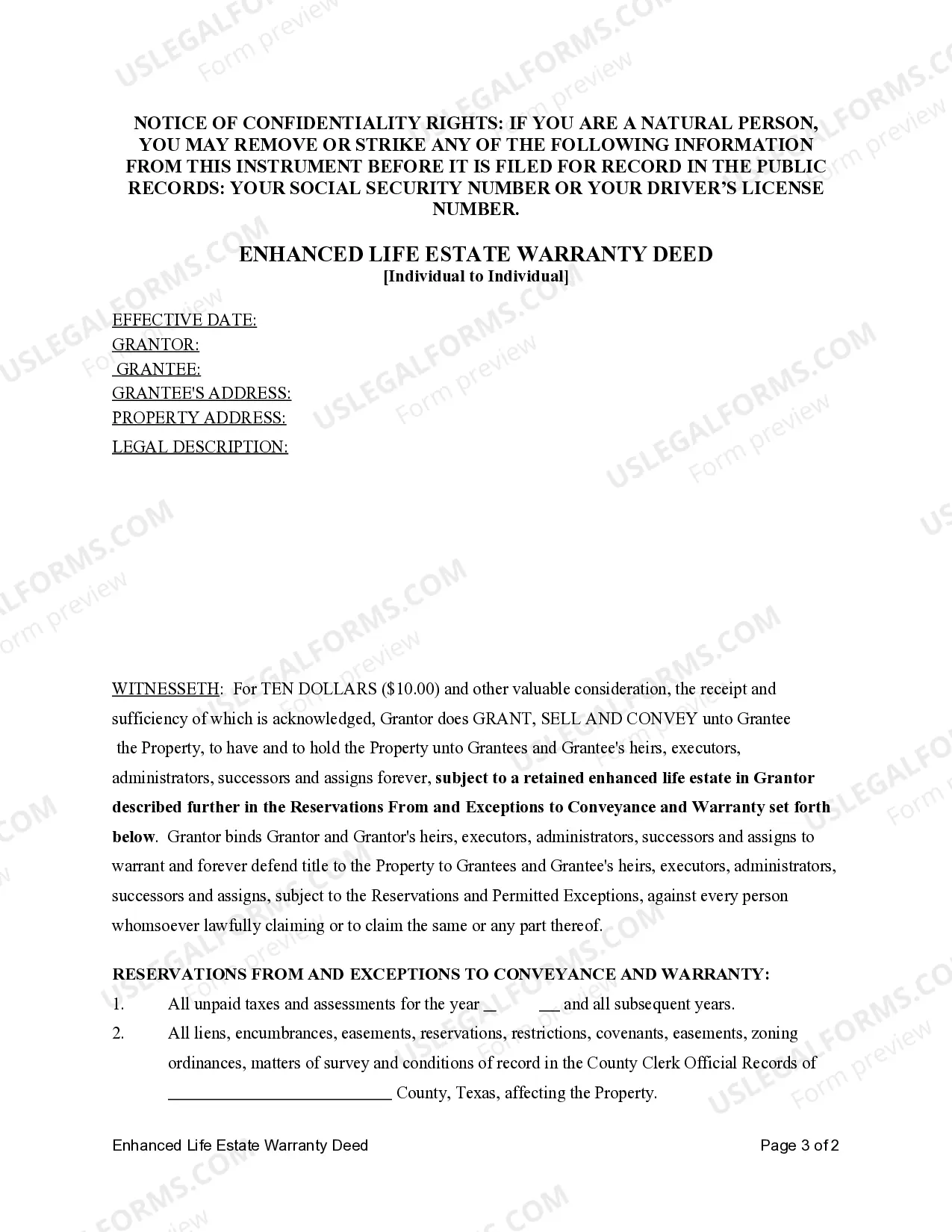
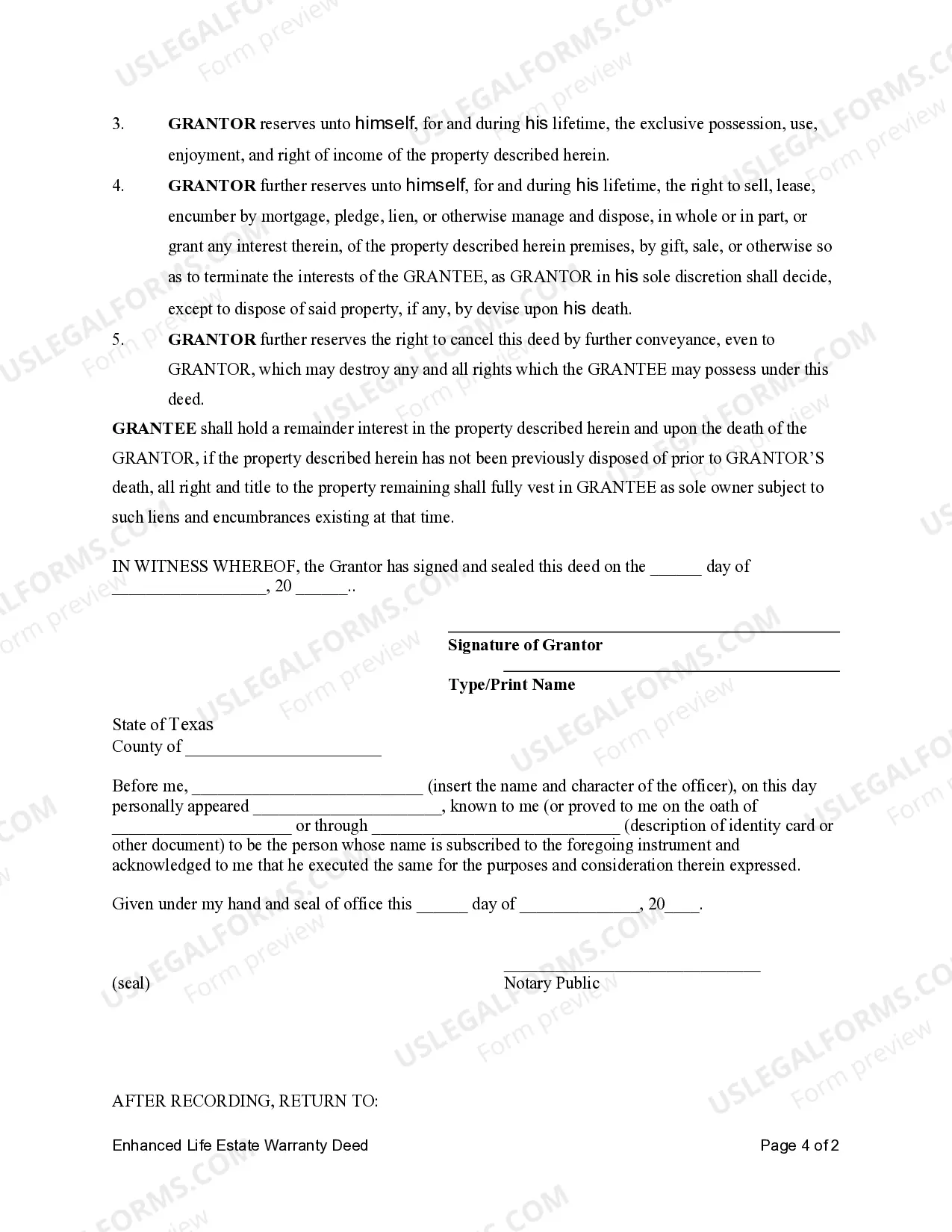
How to fill out Texas Lady Bird Or Enhanced Life Estate Warranty Deed - Individual To Individual?
- If you've previously used US Legal Forms, log in to your account at the provided link and select the form template for download. Ensure your subscription is current to proceed.
- Review the Preview mode and description of the form to confirm it aligns with your specific needs and meets Texas jurisdiction requirements.
- If needed, utilize the Search tab to find any additional templates that may better serve your requirements.
- Select the form you wish to purchase by clicking the Buy Now button and pick an appropriate subscription plan. You'll need to create an account to access the library.
- Complete the payment process by entering your credit card information or using your PayPal account for the subscription.
- Finally, download your document to your device. You can also re-access your templates anytime via the My Forms menu in your profile.
By leveraging US Legal Forms, you empower yourself to streamline the legal document process efficiently. With over 85,000 customizable templates at your disposal, professional support is just a click away.
Get started today and ensure your legal documents are accurately prepared for your Texas enhanced individual foreclosure!
Form popularity
FAQ
The 120-day foreclosure rule in Texas applies primarily to home loans secured by a mortgage or a deed of trust. This rule does not typically apply to all types of contracts, so understanding which ones fall under this rule can be crucial. Consumers often find clarity on this through resources provided by platforms like UsLegalForms, which cater specifically to Texas enhanced individual foreclosure needs.
No, Texas is not considered a foreclosure redemption state. In Texas, once the foreclosure sale occurs, the borrower does not have the right to reclaim the property by paying off the debt. This contrasts with other states where redemption periods allow borrowers to recover their homes post-foreclosure. It's essential to consider this when dealing with Texas enhanced individual foreclosure situations.
In Texas, certain exceptions to the 120-day foreclosure rule exist. For example, if the borrower files for bankruptcy, this rule may not apply. Additionally, properties subject to federal regulations, such as those backed by Fannie Mae or Freddie Mac, might have different timelines. Understanding these exceptions in the context of Texas enhanced individual foreclosure can help you navigate the process more effectively.
To foreclose on personal property in Texas, you must follow the legal procedures outlined in Texas law for Texas enhanced individual foreclosure. Start by reviewing your mortgage agreement and understanding your rights. Next, ensure you provide proper notice to the borrower, as this step is crucial for compliance. Lastly, consider using platforms like US Legal Forms to obtain necessary templates and guides that simplify the foreclosure process.
An expedited foreclosure is a process that reduces the traditional timeline for foreclosures, allowing lenders to reclaim properties more quickly under specific conditions. In Texas, this applies primarily to certain non-primary residences or in cases of severe financial loss. By leveraging Texas enhanced individual foreclosure laws, lenders can efficiently manage their risk while providing borrowers clarity about their options. It's essential to consult legal resources when facing such a situation.
To claim foreclosure overage in Texas, you must first ensure that your property foreclosure has resulted in an excess amount after settling the debts. The law mandates that any surplus after the sale must be returned to the homeowner or lienholder. Navigating the laws surrounding Texas enhanced individual foreclosure is vital to reclaiming any rightful overages. Resources like uslegalforms can help clarify this process, ensuring you take the right steps.
An expedited foreclosure in Texas refers to a process that allows for faster resolution of foreclosure cases under certain circumstances. Typically, this applies when the property is not the borrower's primary residence or when there is significant financial distress. Texas enhanced individual foreclosure laws enable lenders to seek expedited remedies to recover their investments swiftly. It’s important for borrowers to understand their specific case to prepare effectively.
One effective way a borrower can challenge a non-judicial foreclosure in Texas is by proving that the lender did not follow the required procedures. Borrowers should carefully review the notice of default and foreclosure sale for any discrepancies. Texas enhanced individual foreclosure laws provide specific guidelines that lenders must adhere to, offering borrowers potential grounds for dispute. Seeking help from platforms like uslegalforms can provide clarity in navigating these challenges.
Foreclosing on a property in Texas can take as little as 21 to 60 days, depending on the type of foreclosure process utilized. The non-judicial process, in line with Texas enhanced individual foreclosure regulations, allows lenders to post notice and proceed swiftly. However, if the process goes through judicial channels, it can extend to several months or more. Being aware of these timelines can assist borrowers in managing their expectations.
Non-judicial foreclosure is generally faster than judicial foreclosure in Texas. This method avoids court proceedings, enabling lenders to act quickly on delinquent loans. In the context of Texas enhanced individual foreclosure, this efficiency benefits both lenders and homeowners seeking resolution through swift action. As such, it is essential for borrowers to remain informed about their options.