Easement For Utility Company
Description
Get your form ready online
Our built-in tools help you complete, sign, share, and store your documents in one place.
Make edits, fill in missing information, and update formatting in US Legal Forms—just like you would in MS Word.
Download a copy, print it, send it by email, or mail it via USPS—whatever works best for your next step.
Sign and collect signatures with our SignNow integration. Send to multiple recipients, set reminders, and more. Go Premium to unlock E-Sign.
If this form requires notarization, complete it online through a secure video call—no need to meet a notary in person or wait for an appointment.
We protect your documents and personal data by following strict security and privacy standards.

Make edits, fill in missing information, and update formatting in US Legal Forms—just like you would in MS Word.

Download a copy, print it, send it by email, or mail it via USPS—whatever works best for your next step.

Sign and collect signatures with our SignNow integration. Send to multiple recipients, set reminders, and more. Go Premium to unlock E-Sign.

If this form requires notarization, complete it online through a secure video call—no need to meet a notary in person or wait for an appointment.

We protect your documents and personal data by following strict security and privacy standards.
Looking for another form?









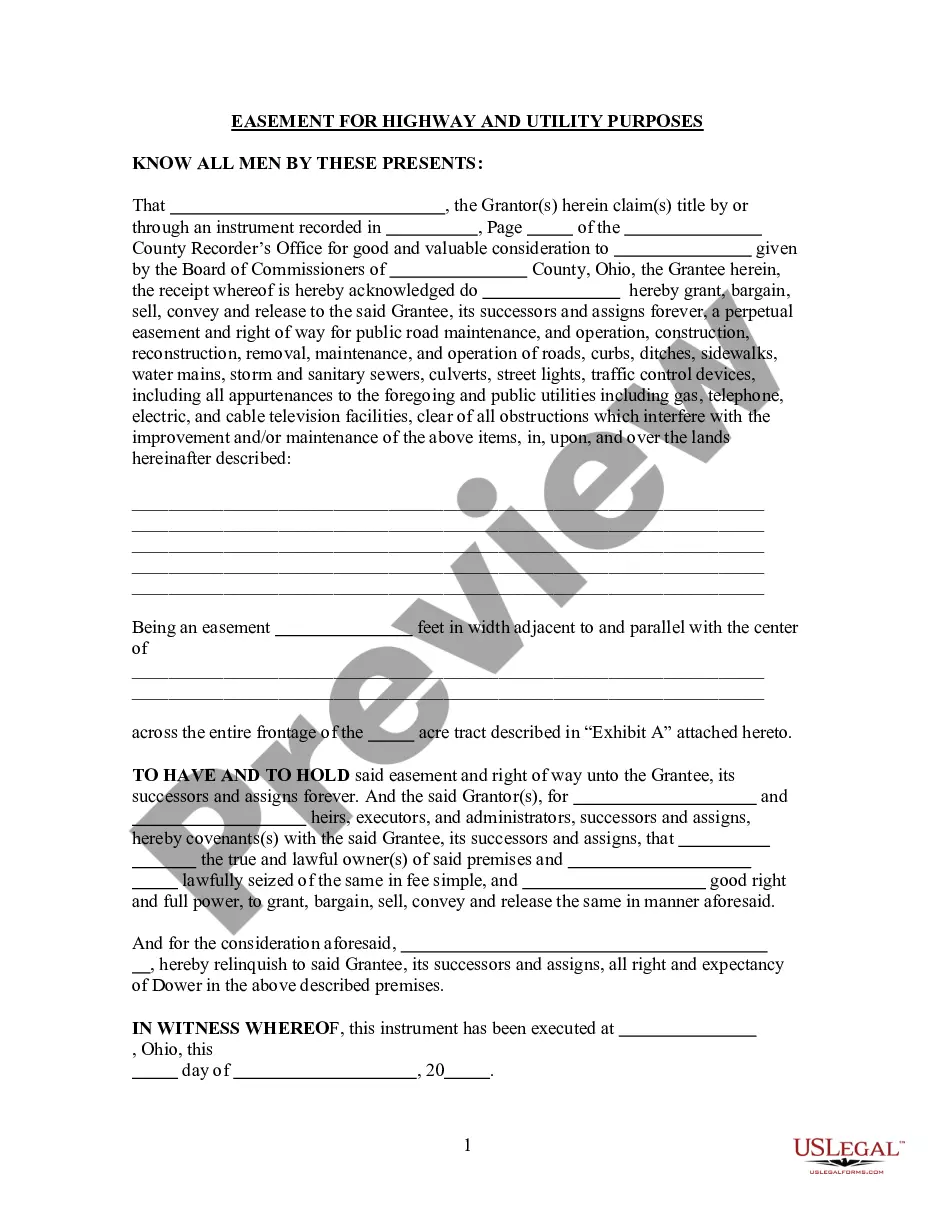
How to fill out Ohio Easement For Highway And Utility Purposes?
How to obtain professional legal documents that adhere to your state regulations and prepare the Easement For Utility Company without consulting an attorney.
Numerous online services provide templates to address various legal situations and formalities.
However, it may require time to identify which of the available samples meet both your usage requirements and legal standards.
Download the Easement For Utility Company using the applicable button next to the file name. If you do not have an account with US Legal Forms, follow the instructions below.
- US Legal Forms is a trusted platform that aids you in locating official documents created in compliance with the most recent state law amendments and helps you save on legal costs.
- US Legal Forms is not merely a standard web library.
- It's a repository of over 85,000 verified templates for diverse business and personal scenarios.
- All documents are categorized by area and state for a more efficient and convenient search experience.
- It also offers integrations with robust tools for PDF editing and electronic signatures, enabling users with a Premium subscription to efficiently complete their documents online.
- Acquiring the required documentation demands minimal effort and time.
- If you already possess an account, Log In and ensure your subscription is active.
Form popularity
FAQ
The most common type of easement, a utility easement allows a utility company to run its pipes, lines, etc., under or on other people's property in order to serve its customers. As opposed to buying all the land necessary, utility companies negotiate easement agreements with landowners.
How Might Utility Easements Affect My Property Ownership Rights? The most common kind of easement is one that has been given in writing to a utility company or a city or municipality.
PUE stands for Public Utility Easement. Like other easements, a PUE grants certain rights to the owner of the easement.
A common example of an easement is when one person is given the right to cross or access a road across another person's property. Other common examples of easements are phone, gas, and power lines. In addition, sewage and water pipes are also common types of easements that are installed on private property.
A utility easement allows power, gas, water, sewer, drainage, telephone, cable utilities the right to use an owner's property for specific purposes such as to construct, repair, maintain, operate, and manage utility facilities. The property owner owns the land upon which the easement is located.