Closing Statement Format

Description

Get your form ready online
Our built-in tools help you complete, sign, share, and store your documents in one place.
Make edits, fill in missing information, and update formatting in US Legal Forms—just like you would in MS Word.
Download a copy, print it, send it by email, or mail it via USPS—whatever works best for your next step.
Sign and collect signatures with our SignNow integration. Send to multiple recipients, set reminders, and more. Go Premium to unlock E-Sign.
If this form requires notarization, complete it online through a secure video call—no need to meet a notary in person or wait for an appointment.
We protect your documents and personal data by following strict security and privacy standards.

Make edits, fill in missing information, and update formatting in US Legal Forms—just like you would in MS Word.

Download a copy, print it, send it by email, or mail it via USPS—whatever works best for your next step.

Sign and collect signatures with our SignNow integration. Send to multiple recipients, set reminders, and more. Go Premium to unlock E-Sign.

If this form requires notarization, complete it online through a secure video call—no need to meet a notary in person or wait for an appointment.

We protect your documents and personal data by following strict security and privacy standards.
Looking for another form?
How to fill out New Jersey Closing Statement?
- Log into your US Legal Forms account if you're a returning user and download the required form template by clicking the Download button. Make sure your subscription is active; otherwise, renew it as needed.
- If it's your first time, begin by exploring the Preview mode to review the description of the closing statement format. Confirm that it aligns with your needs and local jurisdiction.
- If adjustments are needed, utilize the Search tab to find alternative templates that suit your situation better.
- Once satisfied, click on the Buy Now button and select your desired subscription plan. You'll need to create an account to access the full library.
- Complete your purchase by entering your payment details via credit card or PayPal.
- Download the closing statement format to your device for completion, and access it anytime in the My Forms section of your profile.
In conclusion, US Legal Forms simplifies the process of obtaining essential legal documentation. By following these straightforward steps, you can ensure that your closing statement format is both precise and legally sound.
Don't hesitate to start your journey toward effective legal form completion with US Legal Forms today!
Form popularity
FAQ
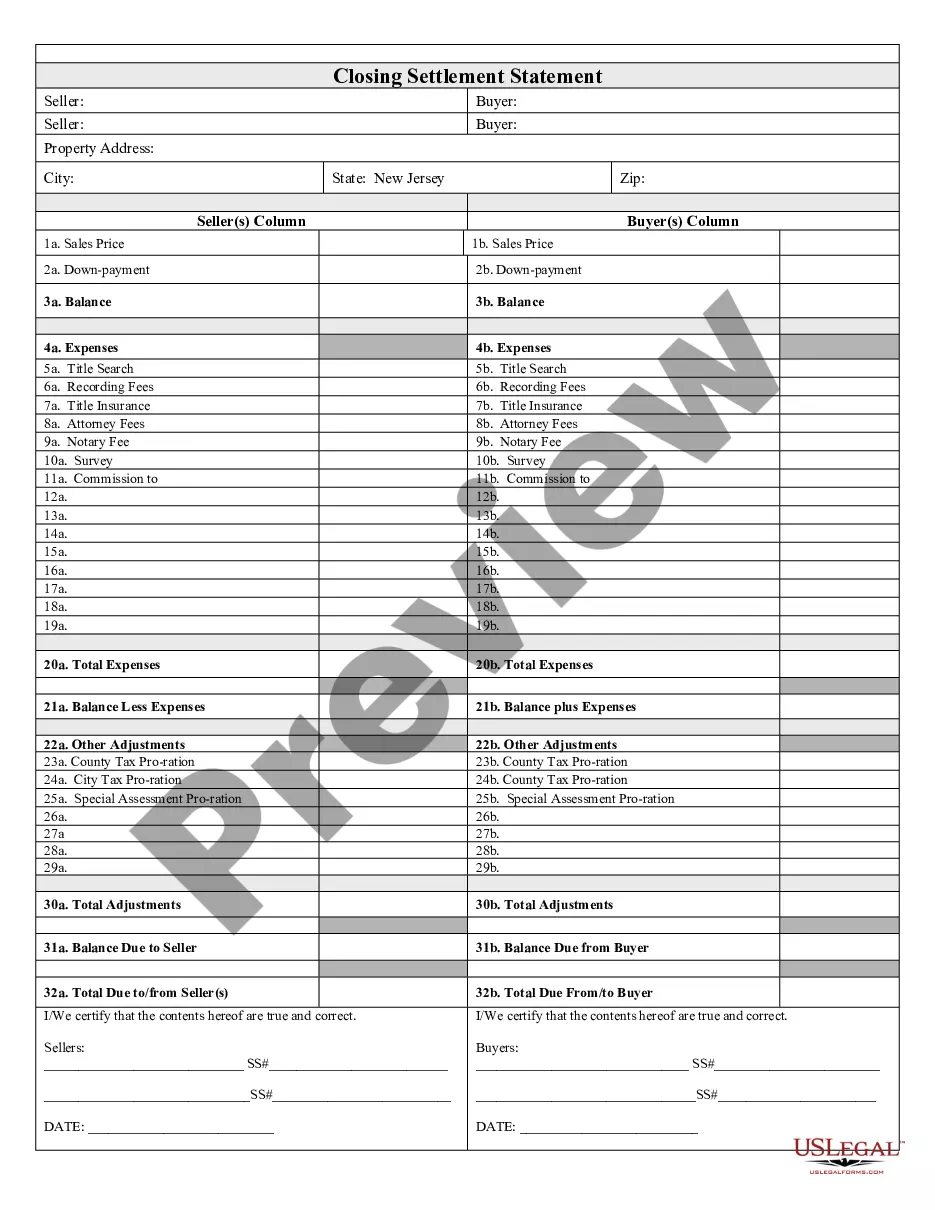
The purpose of a closing statement in real estate is to provide a clear and detailed financial account of the transaction. It helps both parties understand the final costs and ensures that all financial obligations are met. Utilizing a reliable platform like US Legal Forms can help you generate an accurate closing statement format, making the process smoother and more efficient.
A close statement refers to the document that summarizes the financials at the end of a real estate transaction. This document details all costs, expenses, and any credits that affect the final amount the buyer needs to bring or the seller receives. Understanding the close statement format is crucial for both buyers and sellers to grasp the complete financial picture.
Effective closing statements clearly convey critical financial information while being straightforward and organized. They follow a standard closing statement format that helps all parties grasp the essential details at a glance. Incorporating transparency and accuracy fosters trust and satisfaction among those involved.
The length of a closing statement varies, but it generally spans one to two pages. The key is to cover all necessary details succinctly while maintaining clarity in the closing statement format. Aim for a balance between comprehensive information and brevity to avoid overwhelming the reader.
To write a closing statement, start by organizing all financial information related to the transaction. Use a clear closing statement format that includes sections for income, expenses, and disbursements. It is crucial to double-check the figures and ensure that all parties involved have access to this important document.
A closing statement is a document summarizing the financial details and transactions of a real estate deal or legal case. It highlights the amounts involved, credits, and debits for each party. Understanding the closing statement format is essential for ensuring transparency and accuracy in the transaction process.
To structure your closing statement effectively, begin with an introduction that summarizes your argument. Next, present your key points in a logical order, using transitional phrases to guide your audience through your reasoning. Conclude with a strong, memorable closing that encourages reflection. Adopting a structured closing statement format ensures clarity and efficiency.
When writing your closing statement, focus on being concise yet impactful. Use straightforward language and clarify the key points you want to convey to your audience. Revisit the main arguments presented during your discussion and unify them under a common theme. This method creates a cohesive closing statement format that reinforces your message.
To structure a closing statement, first, introduce the main purpose of the statement. Follow this with a logical presentation of your points, supporting evidence, and any counterarguments that need addressing. Finish with a compelling conclusion that encapsulates your argument. Adopting a clear closing statement format will enhance understanding and retention.
Writing a powerful closing statement involves clarity and persuasion. Begin by summarizing your main points and reinforcing the critical takeaways. Emphasize the importance of your argument and connect with your audience emotionally, ensuring your message resonates. This approach will enhance the impact of your closing statement format.