Real Estate Form With Llc
Description
Get your form ready online
Our built-in tools help you complete, sign, share, and store your documents in one place.
Make edits, fill in missing information, and update formatting in US Legal Forms—just like you would in MS Word.
Download a copy, print it, send it by email, or mail it via USPS—whatever works best for your next step.
Sign and collect signatures with our SignNow integration. Send to multiple recipients, set reminders, and more. Go Premium to unlock E-Sign.
If this form requires notarization, complete it online through a secure video call—no need to meet a notary in person or wait for an appointment.
We protect your documents and personal data by following strict security and privacy standards.

Make edits, fill in missing information, and update formatting in US Legal Forms—just like you would in MS Word.

Download a copy, print it, send it by email, or mail it via USPS—whatever works best for your next step.

Sign and collect signatures with our SignNow integration. Send to multiple recipients, set reminders, and more. Go Premium to unlock E-Sign.

If this form requires notarization, complete it online through a secure video call—no need to meet a notary in person or wait for an appointment.

We protect your documents and personal data by following strict security and privacy standards.
Looking for another form?








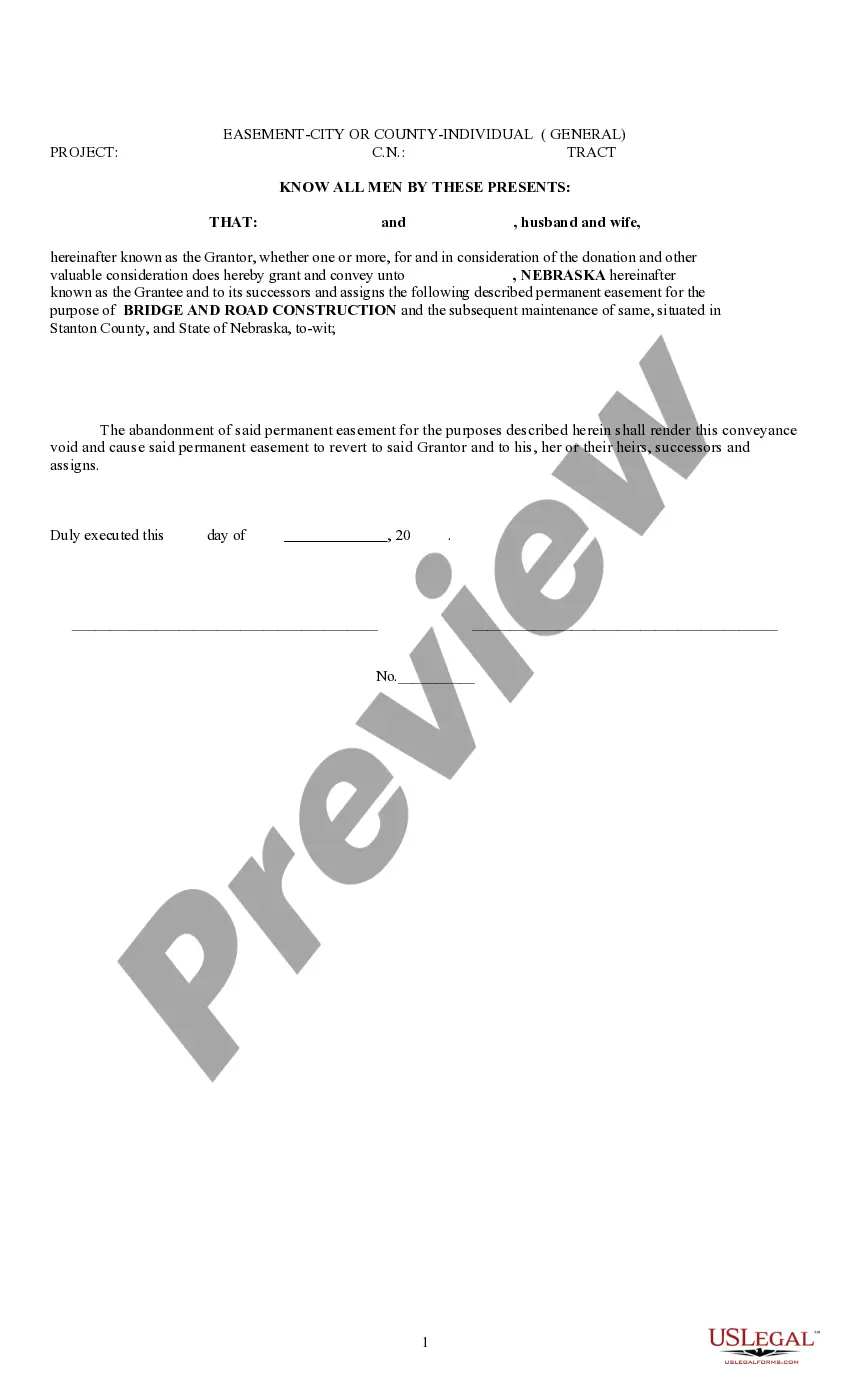
How to fill out Nebraska Easement For Bridge And Road Construction?
- Log in to your existing US Legal Forms account and verify your subscription status. If your subscription is inactive, renew it to continue using our services.
- Browse the previews and descriptions of available forms to find the one that fits your specific legal needs and complies with local regulations.
- If you can't find the exact template, use the search feature to locate alternative options that may be better suited for your requirements.
- Select the desired form and click the 'Buy Now' button. Choose your subscription plan and register for an account to unlock full access.
- Complete your purchase by entering your payment details via credit card or PayPal.
- Download the completed form to your device, so you can fill it out and access it anytime through the 'My Forms' menu in your profile.
US Legal Forms empowers individuals and attorneys alike by offering a vast library of resources to swiftly manage legal documentation. With our extensive collection of over 85,000 customizable forms, obtaining a real estate form with LLC has never been easier.
Don't let legal complexities hold you back; start your journey with US Legal Forms today for a hassle-free experience!
Form popularity
FAQ
If you are a real estate agent, forming an LLC can provide significant advantages. An LLC can protect your personal assets by separating them from your business liabilities. Additionally, using a real estate form with LLC allows you to streamline transactions and enhance your professional image. This structure can also offer potential tax benefits, making it a smart choice for many agents.
Forming an LLC can be a beneficial move for realtors. It offers personal liability protection and can provide clarity in transactions, separating business from personal assets. Additionally, using a real estate form with LLC simplifies tax reporting and can improve professionalism. As a realtor, considering this option can lead to a more organized and secure business operation.
The most significant disadvantage of an LLC is the costs and complexities involved in setup and maintenance. Forming an LLC requires legal documentation and may incur state fees. Additionally, there are ongoing requirements such as annual reports that can complicate management. Therefore, it's important to weigh these factors against the benefits of a real estate form with LLC.
Putting a property in an LLC has both advantages and drawbacks. On the plus side, an LLC provides liability protection and can help in managing rental income and expenses. However, there may be downsides, such as additional paperwork and fees associated with maintaining the LLC. Thus, reviewing the implications of using a real estate form with LLC is crucial before proceeding.
People often place their homes under an LLC for various reasons. One major reason is liability protection; an LLC can safeguard personal assets from lawsuits related to the property. Additionally, using a real estate form with LLC can simplify the process of transferring ownership and managing the property. Overall, this strategy can help achieve both personal and financial security.
To put real estate in an LLC, you first need to create the LLC by filing the necessary documents with your state, which can often be done easily online. After establishing your LLC, you must transfer the property title to the LLC using a real estate form with LLC, which typically involves a quitclaim deed. It's also wise to consult a legal professional to ensure compliance with local laws and any applicable taxes. This process helps secure your investment and leverages the benefits of LLC ownership.
An LLC is often preferred for real estate ownership due to its flexible structure and liability protection. With an LLC, you can separate your personal and business finances, minimizing your risk in the event of legal issues. Moreover, using a real estate form with LLC can lead to tax advantages, as profits and losses can pass through to your personal tax return. This combination of benefits makes LLCs a smart choice in the real estate market.
Many people opt to put their houses under an LLC for liability protection. By doing this, you create a separate legal entity that can shield your personal assets in case of lawsuits or other legal claims. Additionally, using a real estate form with LLC can simplify the management of your property and offer potential tax benefits. This strategic move provides peace of mind and promotes a secure ownership structure.
An LLC can offer several tax benefits when owning property, including the ability to write off operational expenses and depreciation. This helps reduce the overall tax liability. Additionally, owners can take advantage of pass-through taxation, where profits pass directly to personal tax returns, avoiding double taxation. By utilizing a real estate form with LLC, you can easily track these benefits.
To hold real estate in an LLC, you first need to form the LLC according to your state’s regulations. Then, transfer the property title from your name to the LLC, ensuring all necessary documents are filed properly. It is wise to consult professionals who can help you navigate the process efficiently, and using a real estate form with LLC makes this step easier.