Tenant Without Agreement
Description

Get your form ready online
Our built-in tools help you complete, sign, share, and store your documents in one place.
Make edits, fill in missing information, and update formatting in US Legal Forms—just like you would in MS Word.
Download a copy, print it, send it by email, or mail it via USPS—whatever works best for your next step.
Sign and collect signatures with our SignNow integration. Send to multiple recipients, set reminders, and more. Go Premium to unlock E-Sign.
If this form requires notarization, complete it online through a secure video call—no need to meet a notary in person or wait for an appointment.
We protect your documents and personal data by following strict security and privacy standards.

Make edits, fill in missing information, and update formatting in US Legal Forms—just like you would in MS Word.

Download a copy, print it, send it by email, or mail it via USPS—whatever works best for your next step.

Sign and collect signatures with our SignNow integration. Send to multiple recipients, set reminders, and more. Go Premium to unlock E-Sign.

If this form requires notarization, complete it online through a secure video call—no need to meet a notary in person or wait for an appointment.

We protect your documents and personal data by following strict security and privacy standards.
Looking for another form?









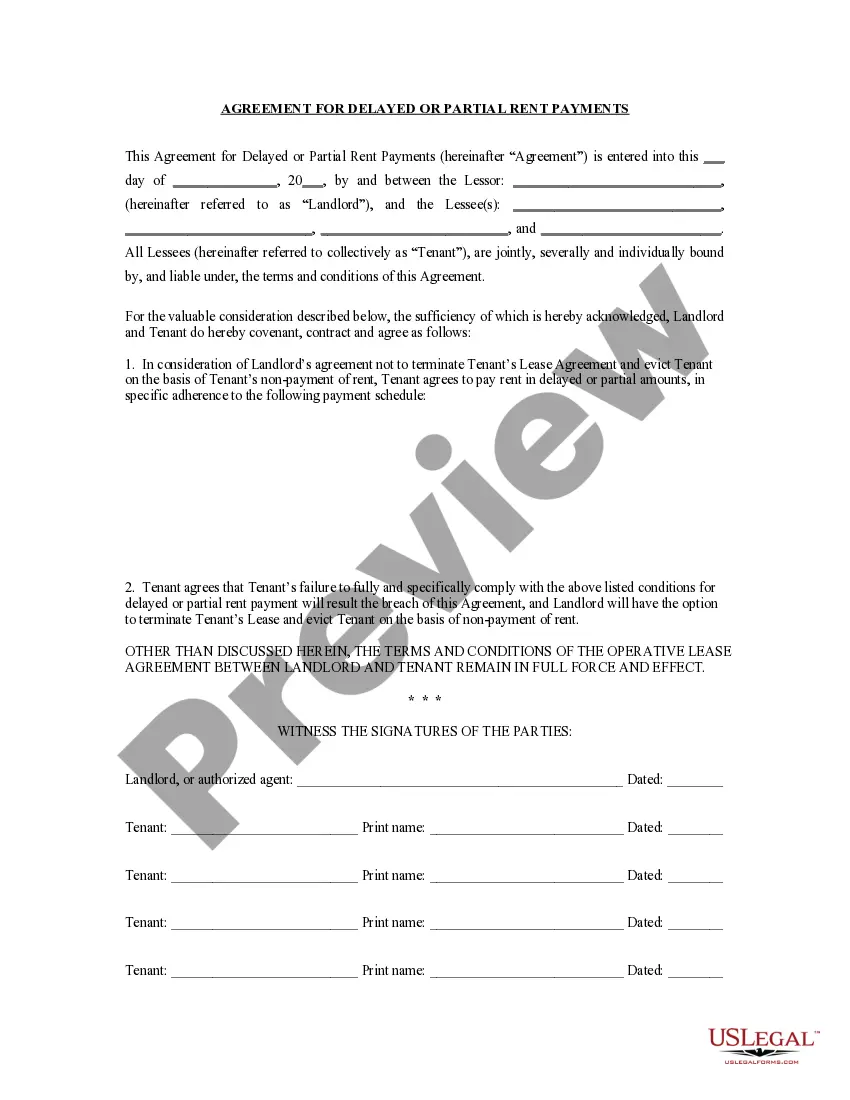
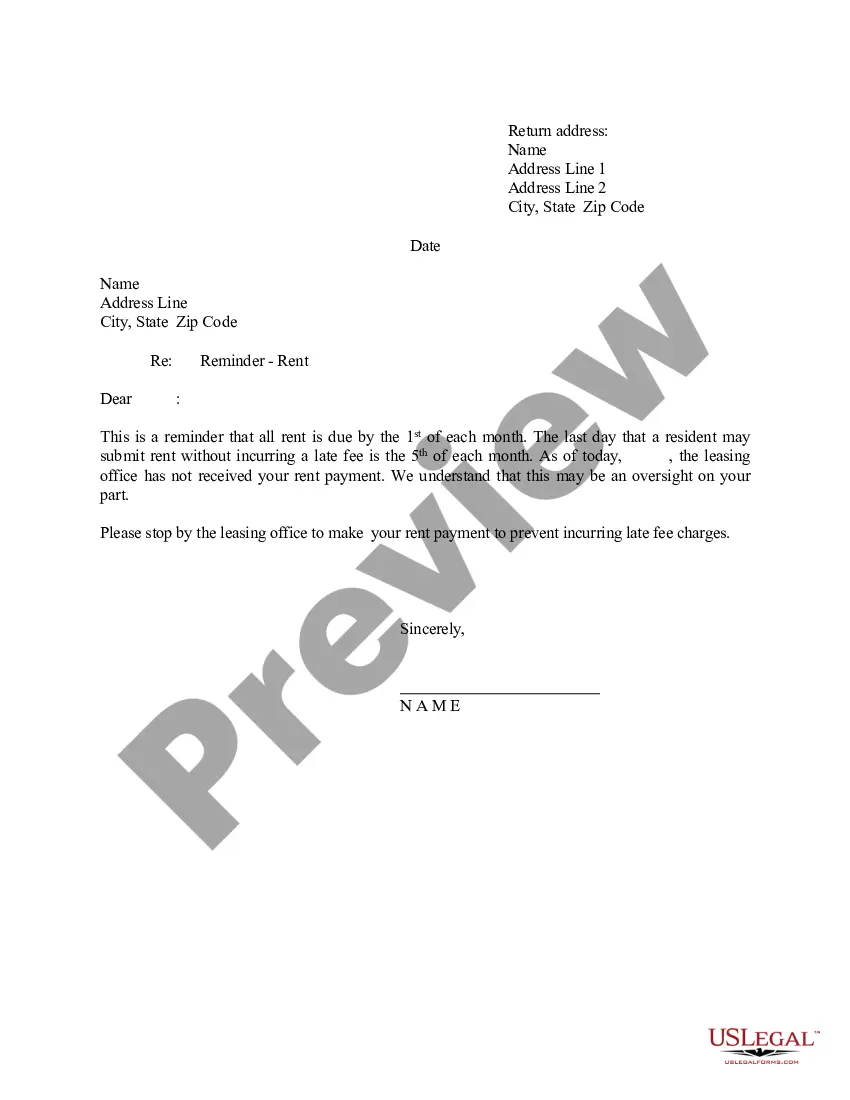
How to fill out Minnesota Agreement For Delayed Or Partial Rent Payments?
There's no longer a necessity to waste time searching for legal documents to comply with your state regulations.
US Legal Forms has gathered all of them in a single location and made access easier.
Our site provides over 85k templates for various business and personal legal situations organized by state and usage area.
Use the search bar above to look for another sample if the previous one didn't meet your needs.
- All forms are properly written and verified for accuracy, ensuring you receive a current Tenant Without Agreement.
- If you're accustomed to our service and possess an account, you must confirm that your subscription is active before obtaining any templates.
- Log In to your account, choose the document, and click Download.
- You can also access all previous documents whenever necessary by visiting the My documents tab in your profile.
- If you're experiencing our service for the first time, the process will require a few additional steps to finalize.
- Here's how new users can locate the Tenant Without Agreement in our collection.
- Review the page content thoroughly to verify it includes the sample you require.
- To do this, use the form description and preview options if available.
Form popularity
FAQ
A tenant without a written contract is still entitled to all the statutory rights a regular tenant with a contract is, including water, heating, a safe environment etc. In a similar vein, the tenant is still obligated to pay rent on time and take reasonable care of the property.
To evict the tenant without going to court, you must give 'reasonable notice', either verbally or in writing. This is usually the regular period of rent payments; for example, if they pay rent monthly, the notice can be a month.
Tenants without a lease can be evicted if the landlord gives them 60 days' notice that the landlord or their family requires the premises.
If there is no tenancy agreement, a tenant cannot be given a section 21 notice for eviction. Instead, a landlord must use a section 8 notice (with a ground for eviction). To be able to evict a tenant in the absence of a written tenancy agreement, a landlord will need to apply to the courts for a possession order.
If there is no tenancy agreement therefore, then there is no authority for the landlord to make any deductions from the tenancy deposit no matter how dreadful the condition of the property when the tenant moves out. If he tries to make any deductions, any challenge made by the tenant will succeed at adjudication.