Deed Property To Child
Description
Get your form ready online
Our built-in tools help you complete, sign, share, and store your documents in one place.
Make edits, fill in missing information, and update formatting in US Legal Forms—just like you would in MS Word.
Download a copy, print it, send it by email, or mail it via USPS—whatever works best for your next step.
Sign and collect signatures with our SignNow integration. Send to multiple recipients, set reminders, and more. Go Premium to unlock E-Sign.
If this form requires notarization, complete it online through a secure video call—no need to meet a notary in person or wait for an appointment.
We protect your documents and personal data by following strict security and privacy standards.

Make edits, fill in missing information, and update formatting in US Legal Forms—just like you would in MS Word.

Download a copy, print it, send it by email, or mail it via USPS—whatever works best for your next step.

Sign and collect signatures with our SignNow integration. Send to multiple recipients, set reminders, and more. Go Premium to unlock E-Sign.

If this form requires notarization, complete it online through a secure video call—no need to meet a notary in person or wait for an appointment.

We protect your documents and personal data by following strict security and privacy standards.
Looking for another form?







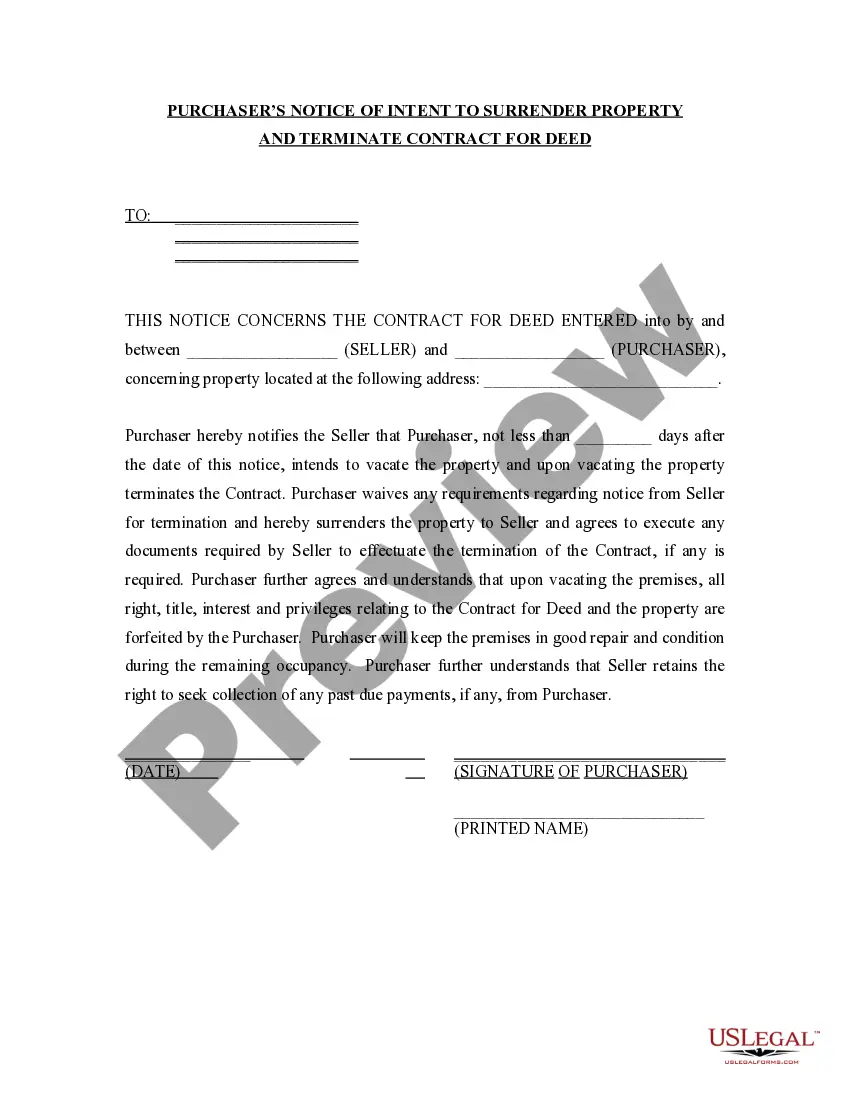
How to fill out Michigan Buyer's Notice Of Intent To Vacate And Surrender Property To Seller Under Contract For Deed?
There's no longer any need to squander hours looking for legal documents to comply with your local state regulations.
US Legal Forms has gathered all of them in one location and simplified their availability.
Our website offers over 85k templates for both business and personal legal matters organized by state and area of application. All forms are expertly created and verified for accuracy, so you can trust in acquiring an updated Deed Property To Child.
Choose the desired pricing plan and either create an account or Log In. Complete your subscription payment using a credit card or through PayPal to proceed. Select the file format for your Deed Property To Child and download it to your device. Print your form to fill it out manually or upload the document if you prefer to utilize an online editor. Organizing official documents under federal and state laws is quick and easy with our library. Try US Legal Forms today to maintain your documents in order!
- If you are accustomed to our platform and already possess an account, make sure your subscription is active before accessing any templates.
- Log In to your account, select the document, and click Download.
- You can also revisit all obtained documents at any time by accessing the My documents tab in your profile.
- If you have not previously used our platform, the process will involve a few more steps to complete.
- Here's how new users can find the Deed Property To Child in our library.
- Carefully read the page content to ensure it contains the sample you need.
- Utilize the form description and preview options if available.
- Use the Search bar above to look for another example if the current one does not suit you.
- Click Buy Now next to the template title when you identify the correct one.
Form popularity
FAQ
Communicating the need for your adult child to move out requires a respectful approach. Begin by expressing your feelings about the current living situation and the importance of independence for both parties. You can suggest a timeline for them to find a new place and offer support during the transition. Using US Legal Forms, you can create a formal agreement that outlines expectations and responsibilities, ensuring clarity for both sides.
If your adult child refuses to move out, it's essential to approach the situation with care and understanding. Start by having an open conversation about their plans and the need for independence. Setting clear expectations regarding living arrangements can help guide the discussion. If necessary, explore options like providing resources for them to find their own place or using US Legal Forms to draft agreements that outline timelines.
Deeding property to a child can be a straightforward process if you follow the proper steps. First, you must prepare a new deed that transfers ownership from you to your child. Ensure that the deed complies with local laws, and consider consulting a legal expert to make the process seamless. Using a platform like US Legal Forms can simplify drafting the deed correctly.
Leaving property to children after your passing can be effectively managed by establishing a will or a living trust. These legal documents ensure your wishes are clearly outlined and can help avoid costly probate fees. If you wish to deed property to child prior to your death, it’s a straightforward process that can simplify inheritance. Always seek guidance from legal professionals to navigate this essential planning.
To give your house to your child, one of the simplest methods is to complete a deed transfer. By choosing to deed property to child, you provide a clear record of ownership. Additionally, you might explore establishing a living trust that allows for a smoother transition while retaining certain rights. Consulting an attorney can help you discover the best approach for your unique situation.
The most effective way to pass property to a child is to create a well-structured plan that outlines your intentions. Deeding property to child can be executed through various methods, such as trusts or direct transfers. This ensures a clear transfer of ownership and reduces possible complications for your heirs. Always consider discussing your options with a legal expert to ensure compliance.
To leave a property to your child in a tax-efficient manner, consider utilizing a living trust or directly deeding property to child while you retain some control. This approach can help avoid probate and may reduce tax liabilities. It's essential to familiarize yourself with gift tax regulations and work with a tax advisor to maximize benefits and protect your assets.
Transferring a property title between family members can be achieved through a deed transfer. You can easily deed property to child using a quitclaim deed, which requires minimal paperwork. This option is often preferred because it simplifies the process and minimizes potential disputes. However, it is advisable to consult a legal professional to ensure a smooth transfer.
To put your children on your house deed, you will need to create a new deed that includes their names along with yours. This process involves drafting a deed or using an online service like US Legal Forms, which provides templates and guidance. Once you have the new deed ready, sign it, and then file it with your local recorder's office. This action officially changes the ownership and effectively allows you to deed property to child.
Yes, you can transfer a deed property to child without an attorney by following specific procedures. You need to prepare a new deed that includes the names of the new owners, which in this case are your children. It's important to ensure that you meet all state requirements for the transfer and properly record the deed with your local government. However, while it's possible to do this alone, consulting a professional can help you avoid any legal complications.