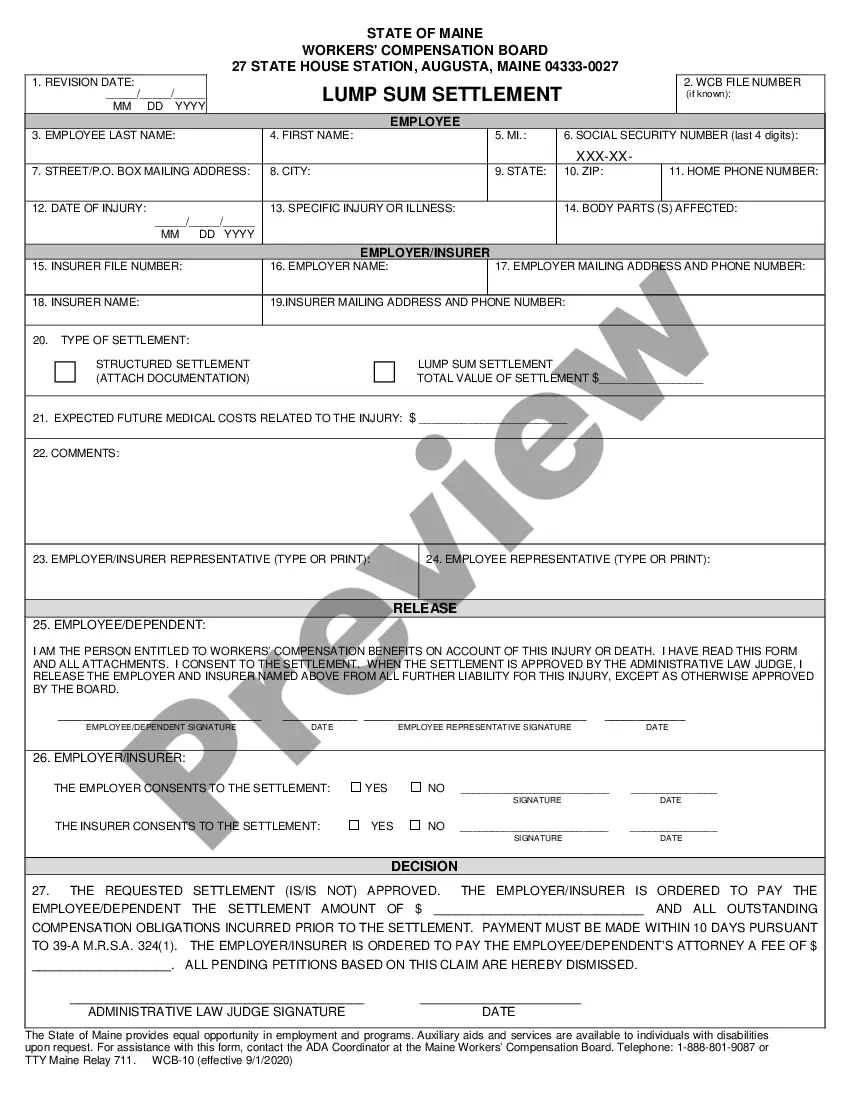
This is one of the official Workers' Compensation forms for the state of Maine.
Maine Workers Comp Settlements For Back Injury
State:
Maine
Control #:
ME-WCB-10-WC
Format:
PDF
Instant download
This website is not affiliated with any governmental entity
Public form
Description

Get your form ready online
Our built-in tools help you complete, sign, share, and store your documents in one place.
Built-in online Word editor
Make edits, fill in missing information, and update formatting in US Legal Forms—just like you would in MS Word.
Export easily
Download a copy, print it, send it by email, or mail it via USPS—whatever works best for your next step.
E-sign your document
Sign and collect signatures with our SignNow integration. Send to multiple recipients, set reminders, and more. Go Premium to unlock E-Sign.
Notarize online 24/7
If this form requires notarization, complete it online through a secure video call—no need to meet a notary in person or wait for an appointment.
Store your document securely
We protect your documents and personal data by following strict security and privacy standards.

Make edits, fill in missing information, and update formatting in US Legal Forms—just like you would in MS Word.

Download a copy, print it, send it by email, or mail it via USPS—whatever works best for your next step.

Sign and collect signatures with our SignNow integration. Send to multiple recipients, set reminders, and more. Go Premium to unlock E-Sign.

If this form requires notarization, complete it online through a secure video call—no need to meet a notary in person or wait for an appointment.

We protect your documents and personal data by following strict security and privacy standards.
Looking for another form?

How to fill out Maine Lump Sum Settlement For Workers' Compensation?
Managing legal documents can be exasperating, even for the most seasoned professionals.
When you are looking for a Maine Workers Comp Settlements For Back Injury and don’t have the time to spend seeking the correct and updated version, the process can be stressful.
Access legal and organizational forms specific to your state or county. US Legal Forms addresses all needs you might have, from personal to business paperwork, in one single location.
Utilize advanced tools to complete and manage your Maine Workers Comp Settlements For Back Injury.
Here are the steps to follow after finding the form you need: Confirm it is the correct document by previewing it and reviewing its details. Ensure the template is recognized in your state or county. Click Buy Now when you are ready. Select a subscription plan. Choose the format you prefer, and Download, fill out, sign, print, and send your documents. Benefit from the US Legal Forms online library, backed by 25 years of experience and reliability. Transform your daily document management into a seamless and user-friendly process today.
- Access a collection of articles, guides, handbooks, and resources pertinent to your circumstances and needs.
- Save time and energy searching for the forms you require, and utilize US Legal Forms’ sophisticated search and Review tool to find Maine Workers Comp Settlements For Back Injury and obtain it.
- If you have a subscription, Log In to your US Legal Forms account, locate the form, and download it.
- Check your My documents tab to see the documents you have previously saved and to organize your folders as desired.
- If it’s your first experience with US Legal Forms, create an account and gain unlimited access to all benefits of the library.
- A comprehensive online form library can be a transformative resource for anyone aiming to navigate these situations effectively.
- US Legal Forms stands as a leader in online legal forms, with over 85,000 state-specific legal documents accessible at any time.
- With US Legal Forms, you can.
Form popularity
FAQ
The maximum compensation rate for injuries on or after January 1, 2020 is 125% of the State Average Weekly Wage. Update for 2022: the state average weekly wage (SAWW) to $1,036.13. Provides that the maximum for injuries occurring July 1, 2022, through June 30, 2023, is $1295.16. States that the multiplier is 1.05298.
The compensation rate equals 2/3 of your average weekly wage. Compensation rates vary depending on dates of injury. Information about maximum compensation rates can be found under ?ITEMS OF INTEREST? on the Workers' Compensation Board's website.
The good news is no, you do not lose your benefits if you are fired. Your workers' compensation benefits do not end whether your employer has fired you or laid you off. The law requires that you continue to receive wage loss payments and medical benefits through your former employers' insurance company.
Do you have to pay taxes on your workers' compensation payments? The answer is no. Whether you received wage loss benefits on a weekly basis or a lump sum settlement, workers' compensation is not taxable. IRS Publication 907 reads as follows: ?The following payments are not taxable ?
Regardless of your date of injury, if your incapacity is total, you may receive benefits for as long as you are unable to work.